
Buying guide · Freshness
Best coffee-bean storage for home
Decide whether a resealable roaster bag is enough, and compare Fellow Atmos and Airscape canisters by mechanism, capacity, light protection and upkeep.
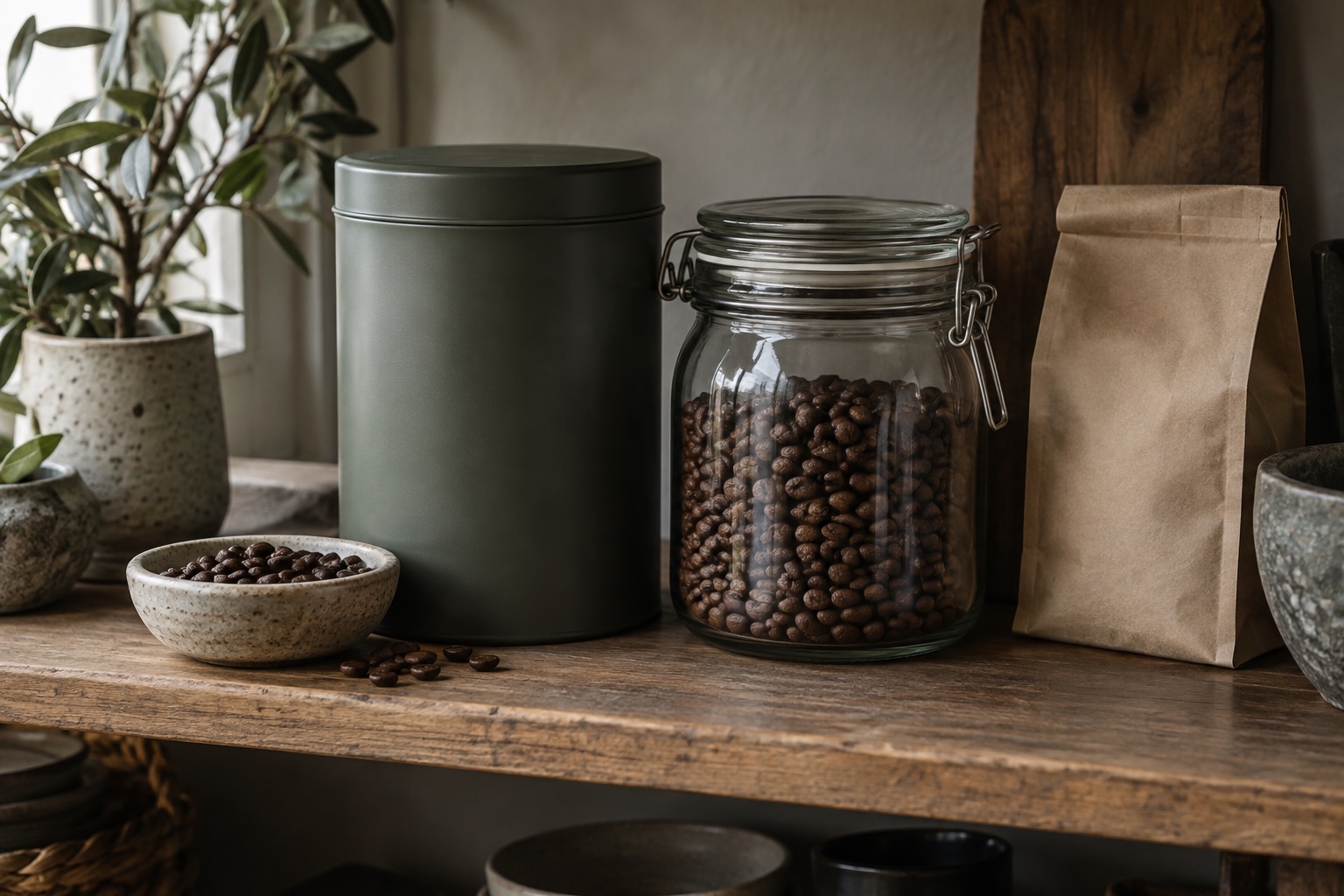
A 250g bag finished quickly creates a different need from a bulk bag opened for weeks.
An opaque bag or tin in a cupboard is preferable to clear glass on a sunny sill.
Choose for the actual bag weight; bean volume varies with roast and variety.
A moving lid is another part to clean and maintain.
The useful shortlist
Two canisters, plus the free baseline
A resealable original bag is a serious option, not a placeholder until you buy something. The canisters answer different day-to-day problems.
Stainless steel
- Stainless steel
- Inner plunger lid
- Capacity varies
Air-displacement alternative
Airscape Classic Coffee Canister
Best for: whole-bean storage without a pump lid
A steel canister whose internal plunger lid pushes air down toward the beans. Match the selected size to the bags you usually buy and hand-wash its parts.
Why it earns a place
- Opaque steel
- Air-displacing inner lid
- Stackable
What to weigh up
- Two lids
- Size variants
- Hand wash
Skip it if Your roaster bag already reseals well in a dark cupboard.
Check the official specification →Manual, matte black, 1.2L
- 1.2L
- Manual vacuum lid
- Whole beans
Whole-bean vacuum storage
Fellow Atmos Vacuum Canister
Best for: a regular whole-bean buyer wanting an opaque vacuum canister
A twist-to-pump vacuum canister for whole beans. Its opaque body blocks light, but the lid is a mechanism to maintain and is not recommended for grounds.
Why it earns a place
- Vacuum lid
- Opaque body
- Large option
What to weigh up
- Manual pumping
- Not for grounds
- Costs more than the original bag
Skip it if You store ground coffee or prefer a resealable bag.
Check the official specification →| Route | Seal approach | Best reason | Limitation |
|---|---|---|---|
| Original opaque bag | Resealable closure | No new purchase | Closure quality varies |
| Airscape Classic | Push-down inner lid | Simple air displacement | Two lids to handle |
| Fellow Atmos | Twist-pump vacuum | Whole-bean vacuum storage | Pump upkeep and no grounds |
Coffee storage is a balance of buying fresh beans in a sensible quantity, limiting air and light exposure, and using the coffee before it has sat around for a long time. A premium canister cannot restore beans that were already stale. If you finish a well-sealed 250g bag promptly, your money may do more in fresh beans or a better grinder.
First choice: the original resealable bag
Many roaster bags are opaque, resealable and convenient to squeeze down before closing. Keep the bag away from heat, moisture and direct sunlight. If the closure works and the bag lives in a cupboard, do not assume a countertop jar is an automatic upgrade. Label roast or purchase dates if you rotate several coffees. Our bean-storage method covers daily handling.
Airscape Classic: push down the air space
The Planetary Design Airscape Classic uses an internal plunger-style lid designed to move down toward the contents, plus an outer lid. That can be a simple way to reduce the headspace above beans without pumping. Its stainless body is opaque and the maker describes small and medium formats around 250g and 500g, but Amazon variations can differ: read the selected capacity rather than relying on a photograph.
The trade-off is handling two lids and cleaning the mechanism. It does not make a bag of old beans young again. Choose for: a reusable opaque tin with a straightforward push-down routine. Skip if: the original bag seals well and you do not want another object on the worktop.
Fellow Atmos: a manual vacuum lid
Fellow's Atmos requires twisting the lid to remove air, with an indicator to show a seal. The matte black steel version protects beans from light. Fellow says the 1.2L size holds up to around 16 US ounces of light/medium roast beans, with variation for larger or darker beans; this is not a guaranteed exact 500g fit. Fellow also advises maintaining the seal periodically and specifically recommends whole beans only, because grounds can clog the intake valve.
The mechanism is more involved than folding a bag or pressing down an Airscape lid. Choose for: a whole-bean household happy with that routine. Skip if: you buy ground coffee, dislike maintaining a seal or need the simplest possible container.
Match the container to how quickly you finish a bag
Start with your actual buying pattern. A small bag opened most mornings and finished while still fresh has less to gain from a complicated container than a larger purchase repeatedly opened over a longer period. If you buy several coffees at once, leave unopened bags sealed and decant only the one in use. Avoid pouring fresh beans on top of older leftovers: it hides which coffee needs using first and makes the container harder to clean between bags.
Do not equate a canister's litre figure with a guaranteed bean weight. Darker roasts and different bean sizes occupy different volumes, and a lid mechanism may need space to work. Check the manufacturer's stated usable capacity, then compare it with the bag size you normally buy. If your usual bag is 250g, a huge display jar may add space and headroom without solving a real problem. If you buy 500g, make sure the selected variant genuinely accommodates it rather than inferring capacity from a product photo.
Keep the seal useful in daily life
A container only helps if it is closed properly after each dose. Airscape's inner lid should move down as the bean level falls; Atmos needs its vacuum lid operated and the seal maintained as Fellow directs. Neither belongs next to a sunny window or warm hob just because it looks good on a counter. Keep it cool and dark, wipe it dry before refilling, and follow the maker's lid-cleaning instructions. For infrequent bulk purchases, the freezing approach may be more relevant than buying a second countertop canister.
Is freezing better than a canister?
For beans you will not use soon, portioning into airtight, moisture-resistant packs and freezing can be sensible, but repeated opening of a cold bulk bag invites condensation. Do not treat the refrigerator as a middle ground: it brings moisture and odour exposure. We give a step-by-step approach in how to store coffee beans. For a regularly opened small bag, a dark cupboard is simpler.
Frequently asked questions
Should I decant beans into a clear jar?
Only if it will be kept away from light and has a good seal. A clear jar on a sunny counter prioritises display over storage.
Does vacuum storage keep beans fresh forever?
No. It can reduce exposure to air but cannot stop all change, repair old beans or override poor buying and storage habits.
Can Atmos hold ground coffee?
Fellow advises against it because fine particles may clog the valve. Use a different suitable airtight container for grounds.
Sources and scope
Mechanisms, capacities and care were checked against Planetary Design Airscape Classic, Fellow Atmos and Fellow's grounds guidance. Compare capacity and lid care before choosing.