
Buying guide · Scales
Best coffee scales for UK home brewing
Compare three coffee scales by footprint, timer, power source and brewing job. Find the right scale for espresso, V60 or a shared filter setup.
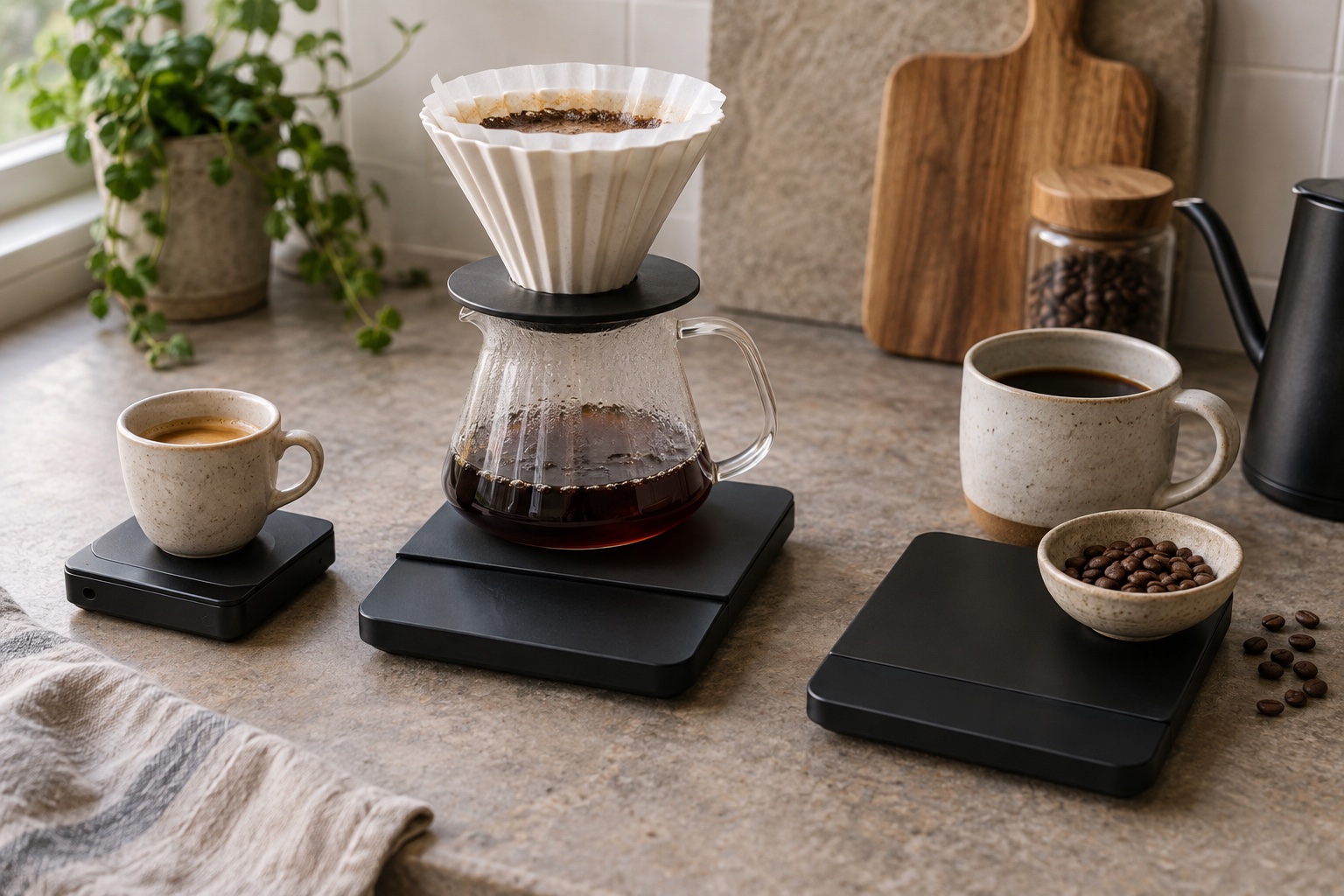
Measure the usable drip-tray width and cup clearance, not just the worktop.
A timer and 0.1g steps are more useful than a long menu of modes for most homes.
Rechargeable is convenient; replaceable cells avoid another charging cable.
Weigh coffee in and beverage out for espresso; weigh dose and poured water for filter.
The useful shortlist
Three scales for three practical routines
Compare the platform size, timer, power source and UK model details against the place and method you actually brew.
Exagram
- 77×124×24mm
- 0.3g–2kg
- 2 AAA batteries
Compact espresso fit
Wacaco Exagram
Best for: small drip trays and a simple timed dose
A narrow 77mm-wide scale with timer, tare and 0.1g steps up to 999.9g. Useful beneath an espresso cup but less comfortable for a wide filter server.
Why it earns a place
- Compact width
- Timer and tare
- Silicone pad
What to weigh up
- AAA batteries required
- Small platform
Skip it if You regularly weigh a large pour-over server.
Check the official specification →VST-2000B
- 0.1g increments
- Integrated timer
- VST-2000B
Straightforward filter scale
Hario V60 Drip Scale
Best for: pour-over brewers who want dose and brew time on one display
A simple coffee scale with 0.1g display steps and integrated timer. Its platform suits a dripper and server, but it occupies more space than a compact espresso scale.
Why it earns a place
- Integrated timer
- 0.1g increments
- Clear workflow
What to weigh up
- Broad footprint
- No complex brew modes
Skip it if You need a scale for a narrow espresso drip tray.
Check the official specification →Basic 2.0
- Basic 2.0
- Rechargeable
- Flow-rate display
Rechargeable all-rounder
Timemore Black Mirror Basic 2
Best for: one scale for filter and a sufficiently wide espresso tray
A rechargeable scale with timer and flow-rate display. Check its footprint against your espresso drip tray before treating it as dual-purpose.
Why it earns a place
- Rechargeable
- Timer
- Flow-rate display
What to weigh up
- Can be too large for drip trays
- More modes than some need
Skip it if You need the smallest scale beneath a low espresso group.
Check the official specification →| Scale | Best fit | Power | Useful feature | Watch for |
|---|---|---|---|---|
| Wacaco Exagram | Tight espresso tray | AAA cells | Compact timed shot | Small platform |
| Hario V60 Drip Scale | V60 and server | Replaceable cells | Simple timer | Broad footprint |
| Timemore Basic 2 | Filter plus roomier tray | Rechargeable | Flow-rate readout | Check tray fit |
Coffee scales are helpful because a “scoop” does not describe a repeatable dose, and the same-looking mug may receive a different quantity of coffee each morning. You do not need a specialist scale to discover this: a kitchen scale that reads grams can establish a first coffee-to-water ratio. A dedicated coffee scale earns its space when you want a timer, finer small-dose steps or a platform that fits where you brew.
Wacaco Exagram: for a cramped espresso machine
Wacaco specifies a 77 × 124 × 24mm body, 0.3g–2kg range, tare and timer. The display steps are 0.1g below 1kg; that is a resolution specification, not a promise that every real-world pour is accurate to a tenth of a gram. Its narrow body is the reason to choose it. Put a cup on the tray, check there is enough height for coffee to flow from the spouts, then tare and time the shot. Two AAA cells are required and are not supplied.
The small top is less agreeable under a wide glass server. Do not buy it simply because it sounds more “espresso” than a kitchen scale if your machine's cup platform already has ample room. Best for: limited tray space. Skip if: you mostly brew a full filter server.
Hario V60 Drip Scale: the calm pour-over choice
Hario's V60 scale has an integrated timer and 0.1g steps. Its straightforward controls make it easy to set a server and dripper on the platform, tare, add coffee, then track poured water. This is the logical option for a regular V60 routine where you do not want to learn automatic brew modes. The trade-off is footprint: check where it will live, and avoid assuming it fits beneath an espresso cup on a small drip tray.
Best for: manual filter with a server. Skip if: the scale must also fit beneath a compact espresso machine.
Timemore Black Mirror Basic 2: one richer filter scale
Timemore's Basic 2.0 adds a flow-rate display to the expected timer and weighing functions and charges rather than using replaceable cells. Flow feedback can help when you are practising a steady V60 pour. It is not a prerequisite for good filter coffee: record dose and final water first, then change just one variable if the cup tastes wrong. The scale may also serve espresso on a generous tray, but measure width and cup height at home before ordering. The Amazon listing and manufacturer's specification should refer to Basic 2, not an older Basic or newer Basic 3.
Best for: regular pour-over and someone who will use the extra readout. Skip if: a simple timer is all you need.
How to use a scale without making breakfast complicated
For filter, start with the ratio guide, weigh dry coffee, tare the brewer and add the chosen water mass. For espresso, weigh the dry dose and finished drink, then note the time. The weight of the liquid in the cup is more informative than stopping when a cup looks “about half full”. Keep the scale dry, use any protective pad as directed, and do not assume a splash-resistant listing means waterproof.
The most consequential buying error is physical: an espresso scale that leaves no cup clearance, or a tiny platform that will not safely hold your server. Draw the footprint on paper if the machine's tray is awkward.
One scale for both espresso and filter?
It can work if the platform is stable under your filter server and the whole scale plus cup fits under the espresso spouts. Measure the usable tray, not the machine's advertised width, and include the height of the cup you use. A wide filter scale may overhang a compact drip tray; a narrow espresso scale may support a mug but not a loaded server safely. If your kitchen alternates between the two methods, this physical check is more useful than a list of automatic modes.
The power source is another everyday choice. Replaceable cells avoid a charging routine, while a rechargeable model avoids keeping spare batteries. Neither makes coffee taste better. Check whether controls are legible with a cup on the platform and whether you can tare without bumping the brewer. If a kitchen scale already does those jobs, use it until a specific limitation—tray fit, timing or small-dose readability—becomes irritating enough to justify a specialist scale. Our do-you-need-scales guide offers that decision first.
Read resolution and accuracy separately
A display that changes in 0.1g steps is useful for small doses, but it does not prove the scale measures every change to 0.1g in a busy kitchen. Vibration, an uneven tray, a warm vessel and liquid touching the housing can all disturb a reading. Place the scale level, tare the vessel, and use the same weighing sequence each time. For espresso, record dose, beverage weight and elapsed time together; for pour-over, record dry coffee and total water before worrying about flow-rate features. Those notes give you a repeatable route to adjust taste without pretending that a more expensive display removes technique.
Frequently asked questions
Is 0.1g necessary?
It is useful for small espresso doses and tweaks, but the display increment is not the whole story. Stable readings, sensible placement and a repeatable routine matter. For a large cafetière batch, whole-gram readings can be adequate.
Do I need a scale with a timer?
Not necessarily. A phone timer plus a reliable kitchen scale can work. A built-in timer simply keeps both numbers in one place.
Can I put a hot brewer directly on it?
Follow the maker's heat and moisture guidance. Use the supplied mat where applicable and avoid allowing boiling water to spill into controls.
Sources and scope
Specifications were checked against Wacaco Exagram, Hario UK V60 scale and Timemore Basic 2.0.