
Buying guide · Cafetières
Best cafetières for everyday coffee in the UK
Compare exact 1L Bodum Brazil and Chambord cafetières for UK homes, including real mug capacity, sediment, cleaning and whether a press is right for you.
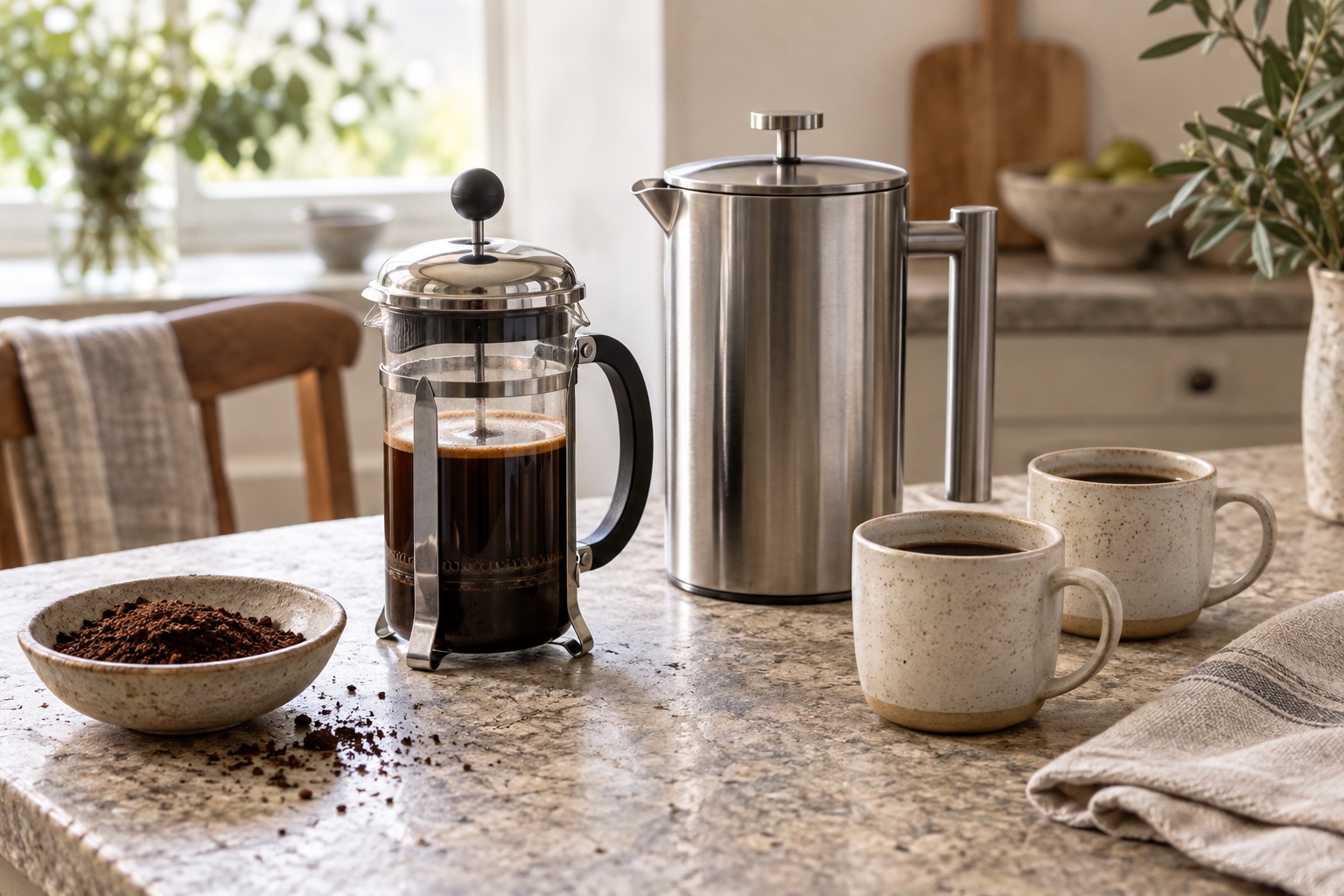
A 1L pot is roughly three large mugs before grounds retain water.
Borosilicate glass needs careful handling; neither of these is insulated.
A metal mesh allows a fuller, sometimes more sedimented cup.
Empty grounds and wash the plunger parts after brewing.
The useful shortlist
Two classic presses and one useful grinder
The grinder is optional if you buy appropriately ground coffee, but a burr grinder lets you adjust a cafetière brew without changing the dose each time.
1548-01, 1L black
- 1L
- Eight maker-size cups
- 1548-01
Lower-cost cafetière
Bodum Brazil
Best for: a practical larger press without a metal frame
A 1L borosilicate-glass press in a protective plastic frame with a reusable metal filter. It covers the same batch size as the Chambord with simpler styling.
Why it earns a place
- 1L capacity
- Reusable filter
- Protective frame
What to weigh up
- Glass still breakable
- Not insulated
- Sediment remains possible
Skip it if You want a paper-filtered low-sediment cup or an insulated vessel.
Check the official specification →1928-16, 1L
- 1L
- Eight maker-size cups
- 1928-16
Classic cafetière
Bodum Chambord
Best for: a shared, full-bodied cafetière brew
A 1L glass-and-stainless French press with a reusable metal plunger. The maker's eight cups are small servings, not eight large mugs.
Why it earns a place
- Reusable filter
- 1L batch
- Replacement-part ecosystem
What to weigh up
- Glass can break
- More sediment than paper
- Coffee keeps extracting if left in pot
Skip it if You dislike sediment or need a shatter-resistant pot.
Check the official specification →ZCG485 / 485-230V-G
- 40 settings
- 40mm steel burrs
- 300g hopper
Best simple filter grinder
Baratza Encore
Best for: filter, pour-over and cafetière without screen or dosing extras
A straightforward hopper grinder with 40 steps and strong UK parts support. It keeps controls simple and puts the budget into a well-established filter-brewing platform.
Why it earns a place
- Straightforward controls
- Replacement parts available
- Compact footprint
What to weigh up
- Not our pick for unpressurised espresso
- No timer or dose display
Skip it if You use a traditional non-pressurised espresso basket; move to the Encore ESP.
Check the official specification →| Model | Nominal volume | Frame | Paper needed | Most useful for |
|---|---|---|---|---|
| Bodum Brazil 1548-01 | 1L | Black protective plastic | No | Lower-cost shared pot |
| Bodum Chambord 1928-16 | 1L | Chrome-look steel | No | Classic metal-frame preference |
“Best cafetière” rarely turns on an extra feature. A press steeps coffee and water together, then a mesh screen holds most grounds back while you pour. The meaningful differences are capacity, ease of taking the plunger apart, breakage risk and how it fits your kitchen. Our two chosen Bodum models are stable, exact 1L variants with a clear choice between a simpler frame and the classic Chambord look. Neither promises a sediment-free paper-filter cup.
Bodum Brazil 1548-01: the straightforward shared press
The black Brazil uses a borosilicate glass beaker within a protective plastic frame and a reusable steel plunger filter. Bodum's 2025 catalogue identifies the 1548-01 as the 1L/eight-cup version; the Amazon UK listing matches that model. The frame is useful to grip and the press does not need paper filters. It is a practical route when you want coffee for two or three people and would rather store a press than an electrical machine.
Protective plastic does not make the glass unbreakable. Keep the beaker away from the edge of the sink, and follow Bodum's instructions for washing. The coffee will continue contacting grounds after you press, so pour the entire brew into cups or a separate jug promptly. Choose for: a simple 1L press at the lower end of this shortlist. Skip if: you need insulation or a clear, low-oil paper-filtered drink.
Bodum Chambord 1928-16: classic metal frame, same core method
The chrome-look Chambord has a glass beaker and reusable steel filter in a metal frame. Its 1L/eight-cup designation is the same small-portion convention as the Brazil. It does not brew more merely because the frame looks substantial. Choose the frame if you prefer its construction and parts ecosystem, not on an unsupported claim that it tastes better than the Brazil. Check the exact 1928-16 listing; three-cup and four-cup Chambords are quite different in size.
There is no timer, heater or sealed lid. Brew, settle, plunge gently and serve. The metal mesh can be disassembled for cleaning, and a spare beaker may be available for the range—verify compatibility with the exact size before buying one. Choose for: an established 1L design you are happy to keep on the breakfast table. Skip if: glass breakage worries you or you need coffee to wait hot.
What “eight cups” means in a UK kitchen
One litre divided by eight is 125ml. That is closer to an espresso-sized manufacturer serving than a modern 250–300ml mug. Grounds also retain a little water, so the poured volume is lower than the water added. For two 300ml mugs, a 1L press has comfortable room. For a couple of small cups, it may be bigger than necessary; brewing a small dose in a large press can make plunging awkward if the screen does not sit well above the coffee bed.
Measure your household's usual cups and use the coffee-to-water ratio guide to choose dose. A starting point of around 60g of coffee per litre of water is easier to scale than scoops. For 600g water, that means roughly 36g of coffee. Your preferred strength may differ; change one variable at a time.
Mesh, sediment and grinder choice
A mesh press leaves coffee oils in the drink and may admit fine particles, especially if the grind is uneven or you pour the last muddy centimetre. If you prefer a cleaner cup, look at a V60 or Chemex or a filter machine. Do not buy a cafetière because “coarse grind” sounds easy while expecting it to taste like paper-filter coffee.
The Baratza Encore is one filter-capable grinder example if you are buying whole beans. It is not essential to own a grinder before trying this method: ask a roaster for a cafetière grind and use the coffee while fresh. The grind-size guide explains why fixed labels are only a starting point. Grind coarser if a brew tastes harsh and silty; do not expect the plunger to repair very fine, muddy grounds.
Frequently asked questions
How long should cafetière coffee brew?
Four minutes is a useful first steep, followed by a gentle plunge and immediate serving. The step-by-step method explains how to adjust for taste and avoid disturbing settled fines.
Is a stainless-steel cafetière better than glass?
An insulated steel vessel can resist breakage and hold heat, but changes visibility and cleaning. This shortlist compares two glass presses; we do not claim either is insulated. Buy by your real needs, not material alone.
Can I leave coffee in the cafetière after pressing?
It keeps contacting the grounds and may become harsher. Decant the remainder into mugs or another vessel after brewing.
Are Bodum replacement parts universal?
No. Check the model and capacity when buying a spare beaker or mesh. A 1L part may not fit a smaller press.
Sources and scope
The model, size and material details follow Bodum's Chambord and Brazil records. Both are 1L presses; their frame materials and handling are the meaningful differences for a household purchase.