
Buying guide · Cold brew
Best cold-brew coffee makers for UK kitchens
Compare a simple one-litre Hario fridge pitcher with the larger OXO concentrate brewer. Choose by fridge space, batch strength, filter and cleaning.
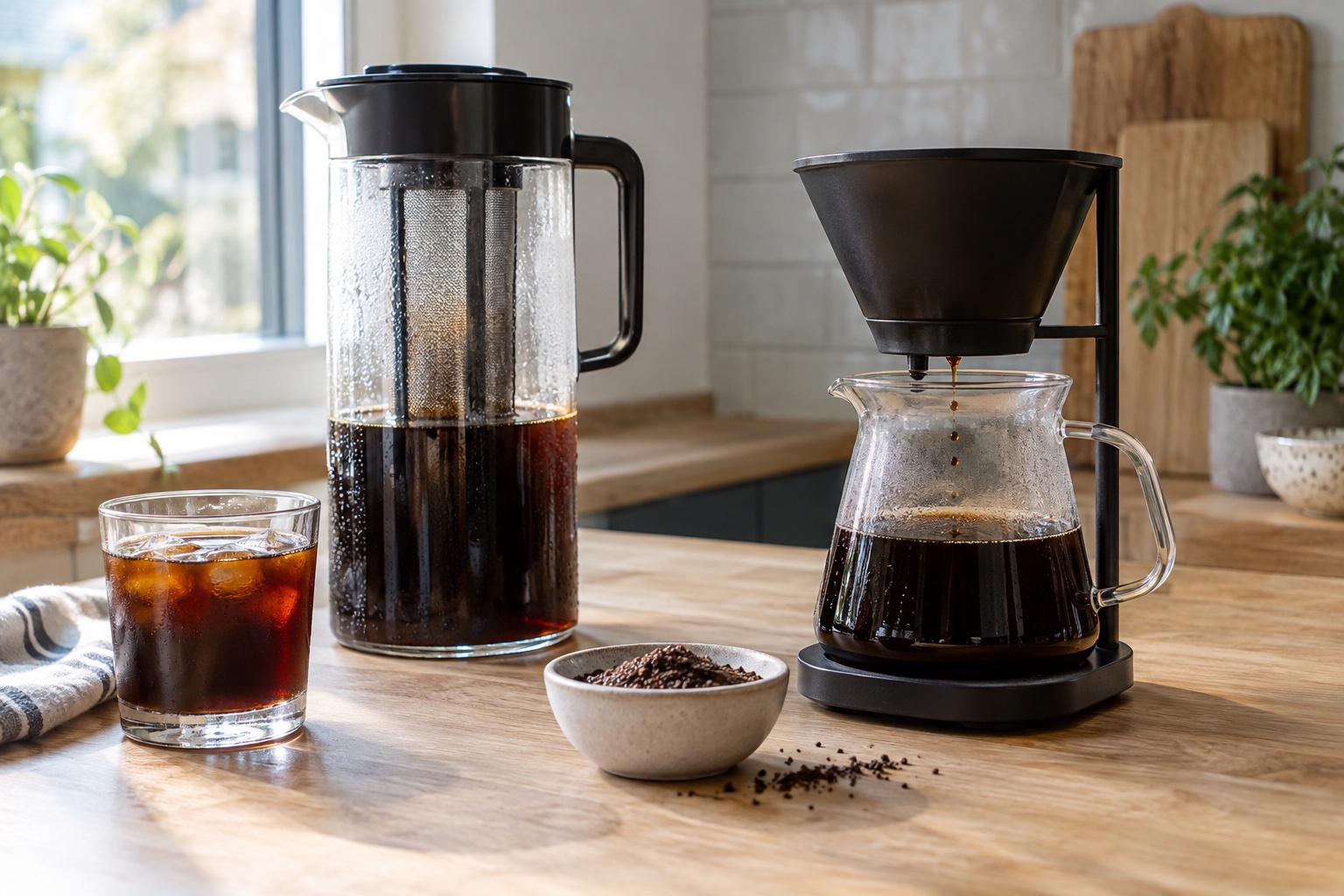
Measure shelf height and door space before choosing a pitcher.
Ready-to-drink coffee and concentrate need different recipes and dilution.
Reusable mesh saves paper but can pass fines.
A two-vessel station adds parts compared with a single pot.
The useful shortlist
Two useful but different systems
The first is a fridge pitcher; the second drains a larger brew vessel into a separate carafe.
MCPN-14CBR, brown 1L
- 1L nominal
- MCPN-14CBR
- Reusable mesh
Easy fridge pitcher
Hario Mizudashi Cold Brew Coffee Pot
Best for: a household making a pitcher of ready-to-drink cold coffee
A glass one-litre cold-brew pot with removable reusable mesh basket; steep in the fridge for at least eight hours.
Why it earns a place
- One-litre nominal capacity
- Reusable basket
- Easy pour-and-store workflow
What to weigh up
- Glass needs care
- Mesh may pass fine sediment
- Needs fridge space
Skip it if Fridge shelf height is tight or you need an especially clear, sediment-free paper-filtered drink.
Check the official specification →1272880
- 1272880
- Reusable mesh
- Glass carafe
Dedicated concentrate station
OXO Brew Cold Brew Coffee Maker
Best for: concentrated batches with a separate switch-release glass carafe
A countertop brewer with rainmaker lid, reusable mesh, release switch and lidded glass carafe. It occupies more space than a fridge pitcher.
Why it earns a place
- Release switch
- Reusable mesh
- Separate carafe
What to weigh up
- Multiple parts to clean
- Large counter footprint
- Current UK listing had no featured offer
Skip it if You want one compact pitcher or the current UK marketplace offer is unusually high.
Check the official specification →| Brewer | Workflow | Filter | Storage | Best fit |
|---|---|---|---|---|
| Hario Mizudashi 1L | Steep and lift mesh basket | Permanent mesh | Fridge pitcher | Simple daily serving |
| OXO Brew 1272880 | Steep then open release switch | Reusable mesh | Brewer plus carafe | Regular concentrate batches |
Cold brew is coffee extracted in cool water over hours, then separated from the grounds. It can be a ready-to-drink batch or a stronger concentrate diluted later. That distinction is more important than a product's advertised litre figure. The method guide gives measured starting recipes and storage steps.
Hario Mizudashi one-litre: one pot, one basket
The brown MCPN-14CBR has a one-litre nominal glass pot and reusable mesh insert. Put coarsely ground coffee in the basket, wet it thoroughly with water, refrigerate for at least eight hours and lift the basket out. You can then pour from the same vessel. Hario's practical recipe uses roughly 50g coffee to 600ml water for its smaller version; scaling a recipe is better than assuming the one-litre marking equals one litre of finished drink.
This is the easy choice for a household that will drink the batch over the next day or two. It occupies fridge space throughout the steep and after filtration, and the fine mesh may pass a little sediment. Check that the pot fits your shelf and wash the mesh promptly so old grounds do not lodge in it. Choose for: an uncomplicated cold pitcher with few moving parts. Skip if: you need exceptionally clear paper-filtered coffee or a compact bottle for a crowded fridge.
OXO Brew Cold Brew Maker: a concentrate workstation
The OXO 1272880 has a broad brewing chamber, perforated rainmaker lid for wetting grounds, reusable mesh and a release switch that drains into a separate glass carafe. Its nominal vessel capacity is not a promise of the same quantity of finished concentrate: coffee absorbs water and the brew is meant for dilution. The shut-off arrangement is convenient when you make strong batches regularly.
The trade-off is footprint, care and availability. It needs counter or cupboard room for the brewer plus carafe, and each part must be cleaned and dried. Compare its current offer with the Hario before buying. Similarly named OXO compact and rapid brewers are different products. Choose for: routine concentrate preparation and controlled draining at a sensible current offer. Skip if: a single pitcher would cover your needs.
Do you need a dedicated maker at all?
No. A clean lidded jar, coarse grounds, water and a suitable strainer or paper filter can prove that you enjoy the method. The dedicated pot mainly makes separation and storage tidier. If you do buy one, decide where the grounds go: a metal-mesh pitcher may need a secondary paper filtration pass for an especially clear cup. Do not pour a large batch through a tiny AeroPress filter in one go.
Choose a grinder capable of a fairly coarse, repeatable setting if you use whole beans; filter coffee grinders are more relevant than a specialised espresso grinder. A scale helps record coffee-to-water ratios but a new scale is not compulsory if you are still trying the method. For a quick chilled drink, brewing hot filter coffee over ice is a separate technique; it does not become cold brew merely because it is served cold.
A realistic batch and storage routine
For a ready-to-drink starting point, try 60g coffee with 750g cool potable water in a vessel with enough headroom. Refrigerate, ensure all grounds are wet, and filter after roughly 12 hours; taste and adjust next batch. For concentrate, a stronger ratio needs planned dilution, so label the carafe. Put filtered coffee in a clean covered container in the fridge and make batches you can finish promptly. Do not leave damp grounds in the finished drink indefinitely. See our cold-brew recipe for the full sequence and troubleshooting.
Frequently asked questions
Does a cold-brew maker need a paper filter?
Not necessarily. Both listed makers use reusable mesh. Paper can be added as a second filtration step if you dislike fines, but must fit the equipment you use.
Is one litre one litre of drink?
No. A nominal pitcher capacity is vessel volume; grounds retain water and a concentrated batch may be diluted into more servings.
Can I make cold brew in a cafetière?
Yes, if the vessel can be covered and refrigerated safely. Its mesh plunger may let fines through, so pour gently or filter again.
How long should I steep?
Hario specifies at least eight refrigerated hours for the Mizudashi. Around 12 hours is a practical baseline; grind, strength and taste can move it either way.
Sources and scope
The pitcher capacity and steep instructions follow Hario's Mizudashi product page and Hario's cold-brew recipe. OXO's layout, switch, mesh and model number follow its 1272880 product specification; the recipes are starting points, not product-performance promises.