
Buying guide · Machines with grinders
Best coffee machines with built-in grinders UK
Compare coffee machines with built-in grinders across manual espresso, bean-to-cup and grind-and-brew filter. Four exact UK models, workflows and trade-offs.
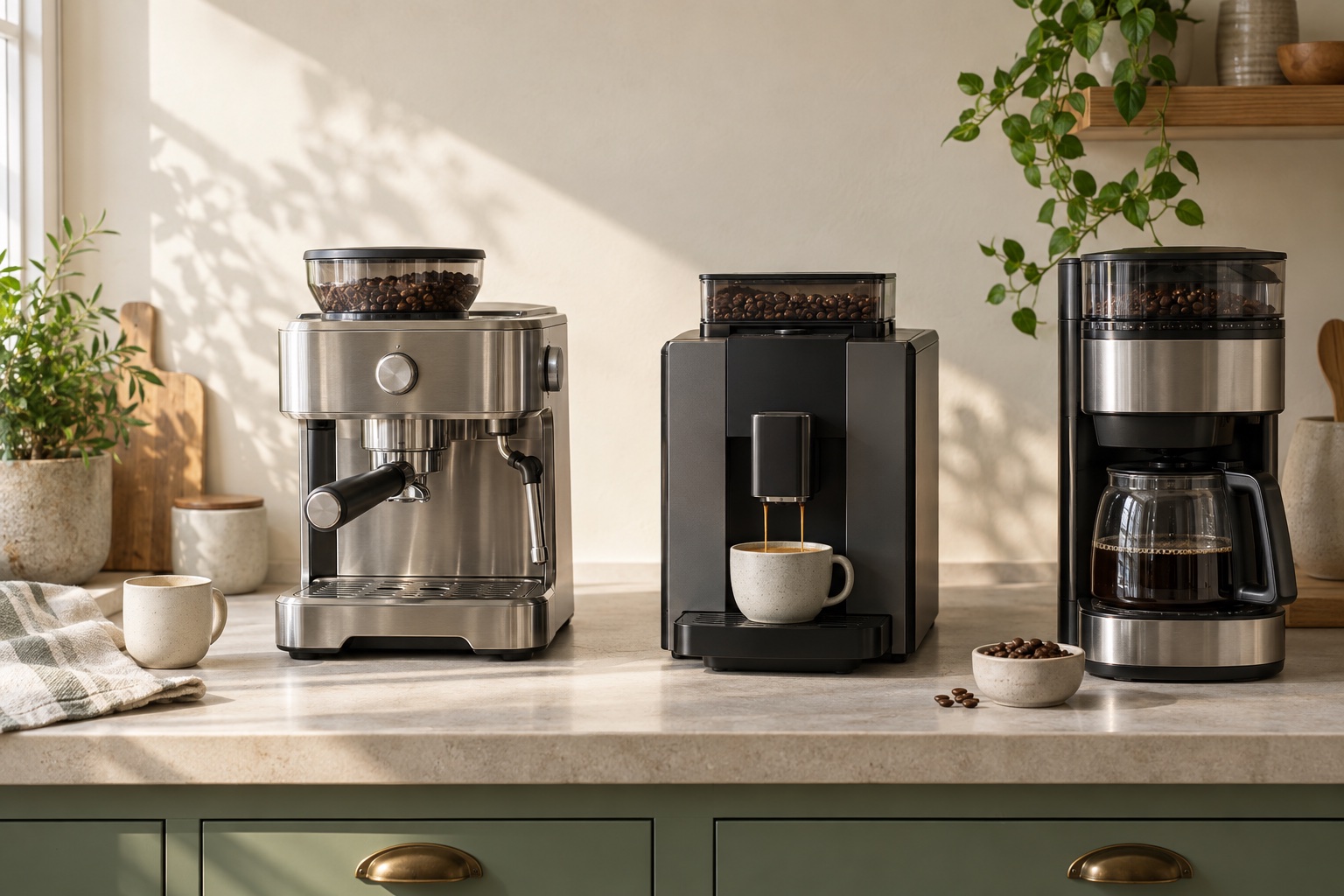
Short espresso and milk drinks need a different machine from a pot of black filter coffee.
An integrated grinder does not necessarily mean automatic brewing.
Choose manual wand, automatic carafe or no milk hardware by the drinks you actually make.
Measure depth and hopper-filling height as well as the saved grinder width.
The useful shortlist
Four models across three grinder-machine systems
“Coffee machine with grinder” describes three different products. These exact models are grouped by workflow, not treated as interchangeable competitors.
BES875UK
- BES875UK
- 31.8 × 35.1 × 40.4cm
- 250g hopper
Hands-on espresso with grinder
Sage Barista Express
Best for: someone who wants manual espresso control without a separate grinder body
A manual espresso machine with an integrated conical-burr grinder, 54mm portafilter and manual steam wand. It saves the width of a separate grinder but not the work of dosing, tamping, dialling in and steaming.
Why it earns a place
- Integrated grinder
- Manual dose and extraction control
- 54mm portafilter and steam wand
What to weigh up
- Still needs dialling in and cleaning
- Tall hopper needs overhead access
- One chassis links grinder and machine replacement
Skip it if You want one-touch coffee or automatic milk rather than a hands-on routine.
Check the official specification →ECAM22.110.B
- ECAM22.110.B
- Traditional milk frother
Manual-milk automatic
De’Longhi Magnifica S
Best for: fresh-bean espresso with a manual milk wand
A built-in grinder and automatic brewer, paired with a traditional milk frother. Milk still takes hands-on work.
Why it earns a place
- Built-in grinder
- Manual milk control
- Two-cup dispensing
What to weigh up
- Milk is not one-touch
- Regular brew-unit and wand care
Skip it if You want one-touch milk drinks.
Check the official specification →ECAM220.61.GB
- 250g bean container
- Four one-touch recipes
- ECAM220.61.GB
One-touch bean-to-cup
De’Longhi Magnifica Start
Best for: a household that wants fresh beans and automatic milk drinks
This exact Magnifica Start variant includes an integrated grinder and LatteCrema Hot automatic milk system, with one-touch espresso, coffee and latte macchiato. It removes daily puck preparation but adds milk-system cleaning.
Why it earns a place
- Integrated grinder
- Automatic milk drinks
- Removable cleaning components
What to weigh up
- Large counter footprint
- Milk system needs regular cleaning
- Less direct control than separate equipment
Skip it if You enjoy dialling in separate grinder and espresso settings, or have a very shallow counter.
Check the official specification →1030-05
- 1030-05
- 11 grinder settings
- 26.8 × 25.2 × 46.3cm
Grind-and-brew filter machine
Melitta AromaFresh II
Best for: several mugs of fresh-ground filter coffee from one timed batch
A glass-jug filter machine with an integrated ceramic grinder, 11 grind settings, timer and a 1.25L water tank. It makes a pot rather than espresso and can also use pre-ground coffee.
Why it earns a place
- Integrated ceramic grinder
- Timer and adjustable strength
- Two to ten maker-size cups
What to weigh up
- Glass jug relies on a hotplate
- Tall body needs hopper access
- Not an espresso machine
Skip it if You mainly make one short coffee at a time or want espresso-based drinks.
Check the official specification →| Model | System | What remains manual | Batch | Best fit |
|---|---|---|---|---|
| Sage Barista Express BES875 | Integrated-grinder manual espresso | Dose adjustment · tamping · portafilter · milk steaming | One or two espresso shots | Learning and controlling espresso |
| De’Longhi Magnifica S ECAM22.110.B | Automatic bean-to-cup + manual frother | Milk texturing and wand cleaning | One or two black coffees | Convenient fresh-bean coffee with manual milk |
| De’Longhi Magnifica Start ECAM220.61.GB | Automatic bean-to-cup + milk carafe | Milk-carafe storage and cleaning | One drink at a time | One-touch milk drinks |
| Melitta AromaFresh II 1030-05 | Grind-and-brew filter | Paper filter · jug care · coffee-strength setup | Two to ten maker-size cups | A scheduled pot of black filter coffee |
A built-in grinder can remove one appliance from the counter, but it does not define how the coffee is made. Search results often mix portafilter machines, automatic bean-to-cup machines and filter machines with grinders as though the only difference were price. In daily use they ask for completely different amounts of work and make different drinks.
The Sage Barista Express grinds into a portafilter. You take control from there. The De’Longhi Magnifica S and Magnifica Start grind and brew inside the machine, with manual or automatic milk respectively. The Melitta AromaFresh II grinds into a paper filter and brews a jug. Start with that distinction; only then compare features.
Which type of coffee machine with grinder do you need?
| If you want… | Choose this system | What you give up |
|---|---|---|
| Hands-on espresso with fewer separate boxes | Integrated-grinder manual espresso | One-touch convenience and independent grinder upgrades |
| Fresh-bean black coffee at a button press | Bean-to-cup with manual frother | Portafilter control and easy switching between beans |
| One-touch cappuccino or latte macchiato | Bean-to-cup with milk carafe | Simpler cleaning and manual milk control |
| Several mugs of black coffee from one brew | Grind-and-brew filter | Espresso-style pressure and short milk drinks |
The term “bean-to-cup” is often used loosely in retail titles. On this page it means the machine grinds, doses and brews internally. The Barista Express has an integrated grinder, but it is still a manual portafilter machine. The AromaFresh is literally bean to a finished jug, but its drink is filter coffee rather than espresso.
Sage Barista Express BES875: best for hands-on espresso
The Barista Express places a conical-burr grinder, dosing cradle, 54mm group and manual steam wand in one 31.8cm-wide body. Sage publishes 16 grinder settings for the BES875 and a 250g hopper. Turn the grind dial, set the dose, grind into the portafilter, distribute and tamp, then lock in and brew. Milk is steamed manually.
That workflow is the reason to choose it. You can adjust grind, dose and extraction rather than asking an automatic machine to decide how the puck is prepared. It is also the reason to skip it if the household expects coffee at one touch. “Built in” saves a separate grinder chassis; it does not remove learning, mess or hand movements.
The body measures 31.8 × 35.1 × 40.4cm in width × depth × height. Its bare counter area is about 1,116cm². For context, the compact Sage Bambino Plus beside a 13cm-wide Baratza Encore ESP adds to 32.4cm of body width before any gap. The two-piece route is easier to upgrade independently; the Barista Express keeps the workflow in one unit. Use our espresso machine size guide to draw both options.
Choose it for: someone who wants to learn espresso and manually texture milk without finding room for a separate grinder body. Skip it for: one-button drinks, frequent decaf switching or a household that wants the grinder and machine upgraded independently.
De’Longhi Magnifica S ECAM22.110.B: best for automatic coffee with manual milk
The Magnifica S automates the coffee side. Beans stay in the hopper, the machine grinds and doses internally, and the front controls dispense espresso or a longer coffee. Its traditional frother still asks you to texture milk and wipe the wand after use.
This is a useful middle route. A black-coffee drinker avoids portafilter preparation, while someone who occasionally makes cappuccino is not storing and washing a separate milk carafe. De’Longhi lists a 1.8L tank, 14-portion grounds container and a 23 × 43 × 34cm body. The 43cm depth deserves more attention than its fairly slim 23cm width.
Bean-to-cup adjustment is not identical to a separate grinder dial. Change the internal grind setting only as the manual directs, normally while the grinder is operating, and allow more than one drink for the new setting to work through retained coffee. Strength and drink volume then need to be balanced together. Our weak bean-to-cup coffee guide gives a controlled adjustment order.
Choose it for: straightforward fresh-bean espresso and longer black coffee, with occasional manually frothed milk. Skip it for: automatic milk drinks or direct portafilter control.
De’Longhi Magnifica Start ECAM220.61.GB: best when milk must be automatic
The exact suffix matters here. ECAM220.61.GB is the dark-grey UK Magnifica Start with LatteCrema Hot milk carafe, a 250g bean container and four one-touch recipes: espresso, coffee, latte macchiato and hot water. Other Magnifica Start variants can have a manual frother or a different drink panel.
The automatic carafe shortens drink preparation but creates a second cleaning system. Milk left in the carafe must be handled as the manual specifies; connectors, lid channels and removable parts need more than an automatic rinse. The machine itself measures 24 × 44 × 35cm, so check counter depth, top hopper access and the side or front path needed for removable components.
The exact Amazon product offer can disappear while similarly named variants remain. The product button therefore searches the exact ECAM220.61.GB model rather than sending you to an unavailable offer. Check the suffix and pictured milk system before buying.
Choose it for: a shared kitchen where one-touch milk drinks justify the cleaning routine. Skip it for: black coffee only, limited counter depth or anyone happy to steam milk manually.
Melitta AromaFresh II 1030-05: best for a fresh-ground filter batch
The AromaFresh II is the answer when “coffee brewer grinder” means a pot of filter coffee. Model 1030-05 combines an 11-setting ceramic grinder, a 1.25L removable tank, timer, strength selection, 1×4 paper filter holder and glass jug. It brews two to ten manufacturer cup markings, not ten full UK mugs.
This workflow can be simpler for a household that drinks several black coffees across breakfast. Load beans and water, fit a paper, set the timer if useful and brew one batch. There is no espresso puck, portafilter or steam wand. Coffee left on a hotplate changes over time, so brew a realistic quantity rather than treating the maximum marking as the target.
At 26.8 × 25.2 × 46.3cm, it is shallow but tall. Measure the space needed to open and fill the top grinder beneath a wall cupboard. The grinder can be switched off for pre-ground coffee, which is useful for occasional decaf without emptying the hopper.
Choose it for: timed, fresh-ground black filter coffee for more than one cup. Skip it for: espresso, one short cup at a time or a kitchen where the 46.3cm body leaves no filling access.
Built-in grinder or separate grinder and machine?
| Question | Built-in grinder | Separate grinder |
|---|---|---|
| Counter arrangement | One body and one plug | Two bodies, but they can be placed apart |
| Upgrade path | Grinder and brewer stay linked | Either component can change independently |
| Switching beans | Hopper emptying or pre-ground bypass | Easier with a single-dose grinder |
| Repair impact | One fault may interrupt the whole setup | The other component can remain usable |
| Workflow | Can be integrated and guided | More choice over grinder type and dose path |
| Buying decision | One headline price | Complete budget must include both items |
An all-in-one machine is not automatically smaller. Compare the body against the combined width, depth and height of the exact separate setup. It is not automatically cheaper either: a capable integrated-grinder manual machine may cost more than an entry manual machine plus a modest grinder, while a premium separate grinder can reverse that comparison.
Five checks before buying
- Name the finished drink. A jug of filter coffee, a short black espresso and a one-touch latte need different systems.
- Count the manual steps. Built-in grinding can still leave dosing, tamping, steaming and cleanup to you.
- Measure filling height. Every machine here loads beans from above; a body that fits under a cupboard may not be refillable there.
- Plan bean changes. A hopper is convenient for one regular coffee. Decaf and frequent bag changes favour a bypass chute or a separate single-dose grinder.
- Read the cleaning path. Grinder chutes stay dry, while brew units, steam wands, milk carafes, filter baskets and jugs have different routines.
Frequently asked questions
Is a coffee machine with a grinder the same as bean-to-cup?
Not always. A bean-to-cup machine grinds, doses and brews internally. A machine such as the Sage Barista Express has a grinder but delivers grounds into a portafilter for manual preparation. A grind-and-brew filter machine makes a jug rather than espresso.
Which machine with a grinder is easiest for black coffee?
The Magnifica S is the simplest one-cup fresh-bean route in this shortlist. The AromaFresh II is easier when the household wants several mugs from one batch. Choose by volume and drink style, not automation alone.
Can I use pre-ground coffee?
The Magnifica models and AromaFresh II include a pre-ground route, subject to their exact instructions. The Barista Express can brew correctly ground coffee placed in its basket, though bypassing its grinder removes much of the reason to choose that machine.
Does a built-in grinder make better coffee?
Not by itself. Beans, grind adjustment, dose, water, recipe and cleaning all matter. The practical benefit is an integrated workflow; the trade-off is that grinder and brewer are tied together.
Sources and scope
Specifications and workflow are based on the exact manufacturer pages for Sage Barista Express BES875, De’Longhi Magnifica S ECAM22.110.B, De’Longhi Magnifica Start ECAM220.61.GB and Melitta AromaFresh II 1030-05. Dimensions are normalised to width × depth × height. The four products represent three systems; recommendation order reflects the stated routine rather than a claim that espresso, bean-to-cup and filter coffee are directly comparable.