
Buying guide · Filter grinders
Best filter coffee grinders for UK homes
Four filter coffee grinders for pour-over, batch brew, AeroPress and cafetière, compared by range, dosing, capacity and value.
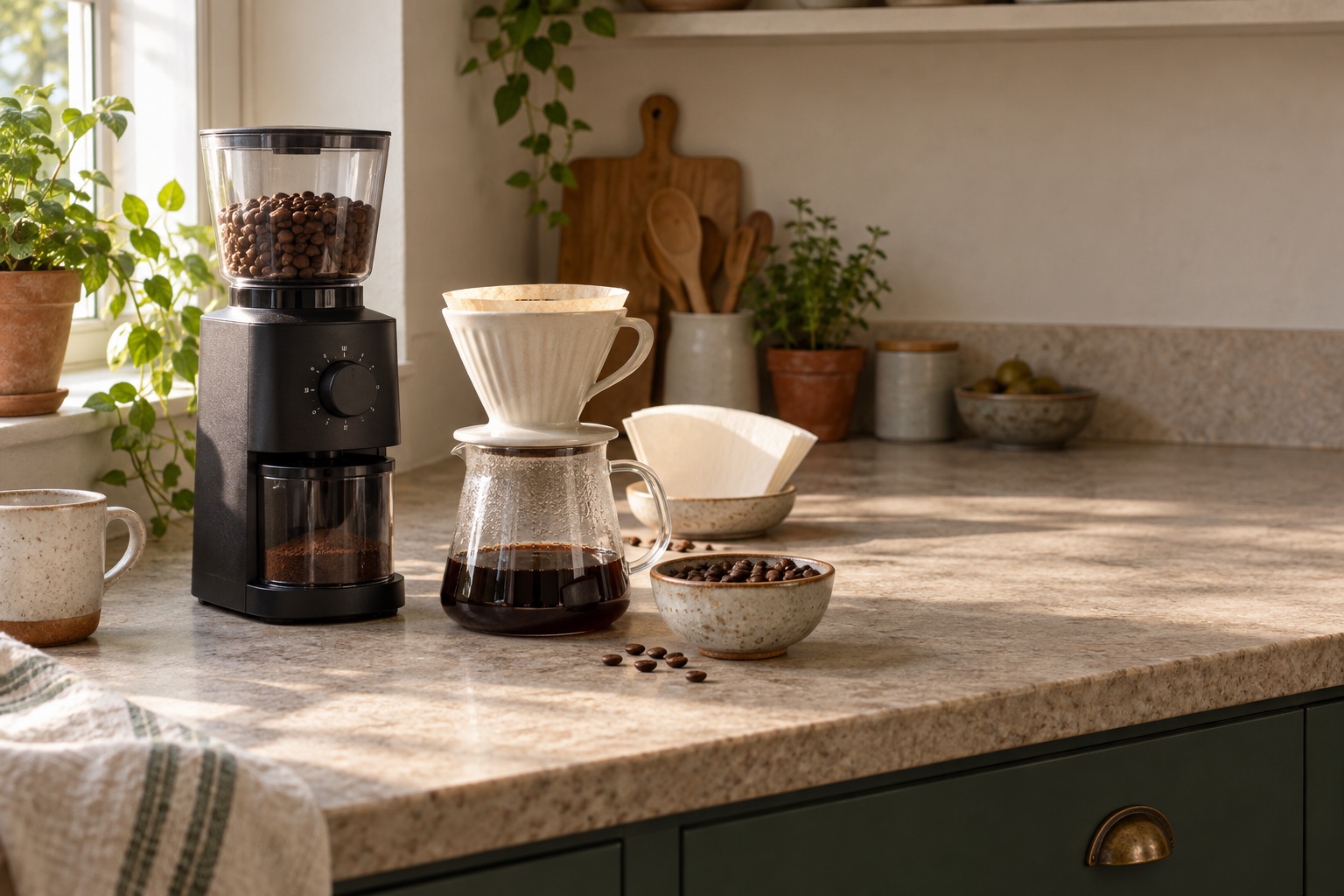
Pour-over rewards finer control than a forgiving cafetière routine.
One 15g cup and a 60g batch demand very different capacities.
Choose hopper convenience or weigh one dose and keep the main bag sealed.
A hand grinder is quiet; motor speed and body design shape the electric experience.
The useful shortlist
Four filter grinders at sensible price points
The shortlist spans a durable entry electric, a premium flat-burr design, an inexpensive motorised option and a genuinely portable manual grinder.
ZCG485 / 485-230V-G
- 40 settings
- 40mm steel burrs
- 300g hopper
Best simple filter grinder
Baratza Encore
Best for: filter, pour-over and cafetière without screen or dosing extras
A straightforward hopper grinder with 40 steps and strong UK parts support. It keeps controls simple and puts the budget into a well-established filter-brewing platform.
Why it earns a place
- Straightforward controls
- Replacement parts available
- Compact footprint
What to weigh up
- Not our pick for unpressurised espresso
- No timer or dose display
Skip it if You use a traditional non-pressurised espresso basket; move to the Encore ESP.
Check the official specification →WSFB-100S
- 41 settings
- 58mm flat burrs
- Model WSFB-100S
Best premium filter choice
Wilfa Uniform
Best for: people prioritising pour-over and filter clarity
The 58mm flat burrs, slow motor and automatic stop suit a measured filter routine, with a metal grounds container that avoids some of the static of lightweight plastic bins.
Why it earns a place
- 58mm flat burrs
- Automatic stop
- Five-year domestic warranty
What to weigh up
- Costs much more than entry filter grinders
- Espresso range is not the main reason to buy it
Skip it if Forgiving cafetière coffee is your daily drink; a sound entry grinder already does that job.
Check the official specification →1019-01
- 17 settings
- 200g hopper
- 2–14 cup selector
Low-cost electric choice
Melitta Molino
Best for: filter and cafetière drinkers who want electric convenience below £100
A simple electric disc grinder with 17 settings, a 200g hopper and a 2–14 cup selector. It is a convenience buy for filter and immersion, not our route into serious espresso.
Why it earns a place
- Low electric entry price
- 2–14 cup selector
- Removable burr and containers
What to weigh up
- Only 17 settings
- Not our recommendation for traditional espresso
Skip it if You use a non-pressurised espresso basket or want to weigh and switch beans for every brew.
Check the official specification →Q Air
- 365g weight
- 15–20g capacity
- 30 clicks per turn
Best compact travel grinder
1Zpresso Q Air
Best for: AeroPress, pour-over and travel where low weight matters
A slim 365g hand grinder with a 15–20g capacity and heptagonal steel burr, intended primarily for portable pour-over and immersion brewing.
Why it earns a place
- Light and compact
- Fits inside an AeroPress plunger
- Numbered internal dial
What to weigh up
- Small 15–20g capacity
- Not the first choice for espresso
Skip it if You need large cafetière doses or a grinder centred on regular espresso.
Check the official specification →| Model | Best for | Range and burrs | Capacity style | Main limitation |
|---|---|---|---|---|
| Baratza Encore | Best overall filter fit | 40 settings · 40mm steel burrs | 300g hopper | No timer |
| Wilfa Uniform | Enthusiast pour-over and filter | 41 settings · 58mm flat burrs | Weigh one dose · automatic stop | High price |
| Melitta Molino | Low-cost electric convenience | 17 settings · disc burr | 200g hopper · 2–14 cup selector | Limited fine control |
| 1Zpresso Q Air | One cup and travel | 30 clicks per turn · steel burr | 15–20g manual dose | Too small for large batches |
Filter coffee does not need an espresso grinder in disguise. It needs a grinder that is consistent through the medium and coarse range, holds the dose you actually brew and does not make the morning unnecessarily awkward. For most UK homes, the Baratza Encore is the clearest answer: simple adjustment, established documentation and no paid-for espresso features that go unused.
Spend more on the Wilfa Uniform when filter coffee is the hobby as well as the drink. Spend less on the Melitta Molino when electric convenience is the main requirement and cafetière or a basic drip machine is forgiving. Choose the 1Zpresso Q Air when one cup, quiet operation and portability matter more than batch capacity.
What “filter grinder” means here
We include pour-over drippers, automatic filter machines, AeroPress and cafetière because their useful settings overlap, although they do not use one universal grind. A cone dripper may need a different starting point from a flat-bottom brewer; a small AeroPress recipe can work across a particularly wide range; a cafetière generally starts coarser.
Grind labels are approximate. The Specialty Coffee Association has documented example particle sizes for research, but “medium” on one grinder is not a calibrated match for “medium” on another. Bean density, roast, dose, brewer geometry and filter paper all change the useful setting. Treat our grind-size guide as a starting map, then adjust by taste and drawdown.
Baratza Encore: best filter grinder for most homes
The Encore keeps the interaction almost deliberately plain. Rotate the hopper through 40 settings, use the front pulse button for short runs or the side switch for continuous grinding, and catch the coffee in the supplied bin. Baratza specifies 40mm conical steel burrs and a 300g hopper for the current UK ZCG485 model.
That is enough range for common manual and automatic filter methods. It is not our recommendation for a traditional non-pressurised espresso basket; that limitation is useful because it keeps this guide honest. Buy the Encore when filter is the real job, not when espresso is an unbudgeted future promise.
Baratza’s published manuals and replacement-parts route strengthen the long-term case. Parts availability does not eliminate wear, static or noise, but it gives the owner more options if a component eventually needs attention.
Best for: a household making V60-style pour-over, AeroPress, filter machine coffee and cafetière in ordinary quantities. Not for: somebody who needs timed dosing or true espresso adjustment.
Wilfa Uniform: best premium filter grinder
The Uniform uses a 58mm flat burr set, 41 settings and an automatic-stop routine. Weigh a dose, add the beans and start the grinder; it stops when the chamber empties. The metal grounds container is intended to reduce the static that can make lightweight plastic bins untidy.
This is a calmer single-dose-like process than leaving a full hopper in place. It suits a household that buys different coffees, weighs water and pays attention to recipe changes. Wilfa also states a five-year domestic warranty for the UK model.
The limitation is value. A larger burr set and slower measured workflow are not proportionally more useful to everybody. If you brew a big dark-roast cafetière, add milk and never adjust the recipe, the less expensive Encore or Molino may solve the practical problem just as well.
Best for: keen pour-over and batch-filter drinkers who will use the adjustment and single-dose workflow. Not for: a tight budget or espresso-first kitchen.
Melitta Molino: best low-cost electric filter grinder
The Molino brings motorised burr grinding to a much lower price. Melitta specifies 17 grind settings, a 200g hopper and a rotary 2–14 cup selector. The removable disc and containers make routine access clearer than on a sealed blade grinder.
Seventeen settings are adequate for broad moves across cafetière, filter machine and some manual brewing, but provide less room for fine recipe corrections. Melitta describes a wide range that includes espresso; editorially, we would buy this model for filter and immersion. A serious single-wall espresso basket deserves closer fine adjustment.
The cup selector is a time-based convenience, not a coffee scale. Calibrate the output for your beans before assuming the printed cup position matches the dose your recipe needs.
Best for: somebody replacing supermarket pre-ground coffee who wants an affordable electric routine. Not for: a pour-over enthusiast making small daily adjustments or a demanding espresso setup.
1Zpresso Q Air: best compact manual filter grinder
At a stated 365g with a 15–20g capacity, the Q Air is designed around one portable brew. Its slim body fits inside an AeroPress plunger, while the heptagonal steel burr and 30-click-per-turn internal adjustment cover common pour-over and immersion settings.
The plastic outer casing is a deliberate weight and price decision, not a sign that the burr is plastic. The compromise is capacity: a 30g two-cup pour-over or 60g batch needs multiple fills. For travel, an office drawer or one mug before work, that same small size is the reason to buy it.
Best for: one-cup AeroPress and pour-over, travel and quiet kitchens. Not for: large cafetières, batches or an espresso-centred routine.
Burr grinder or blade grinder for filter coffee?
A blade grinder repeatedly chops coffee in an open chamber. The user controls fineness mainly by time, and the pieces pass through the blades unpredictably. A burr grinder feeds beans through a defined gap, making the setting easier to repeat.
Filter coffee is more forgiving than espresso, but repeatability still matters. If yesterday’s dose drains in three minutes and today’s takes five, it is difficult to learn whether grind, pouring or coffee caused the change. Read our full burr versus blade grinder guide before choosing the cheapest powered option.
How fine should filter coffee be ground?
Start around medium for many automatic brewers and pour-over recipes, medium-fine for a small cone dripper or short AeroPress recipe, and medium-coarse to coarse for cafetière. Those are visual bands, not universal settings.
If a pour-over drains very quickly and tastes sharp or thin, try finer. If it stalls and tastes dry or bitter, try coarser—while keeping dose and pouring consistent. With cafetière, excessive sediment can come from fine particles, agitation and the filter design, so grinding dramatically coarser is not the only lever.
Hopper or single-dose filter workflow?
A hopper is convenient for a busy household using one coffee. A single-dose routine makes it easier to change bags, keep the rest sealed and know the exact input. Retention matters when small amounts remain in the grinder and emerge in a later dose; it matters less when the same coffee runs through daily.
The Encore and Molino are traditional hopper designs that can still be fed one dose at a time. The Uniform is closer to a purpose-led one-dose routine. The Q Air is inherently single-dose because its capacity is small. Compare the practical differences in our single-dose versus hopper explainer.
Capacity, speed and the hidden batch question
Check your real dry dose. A single 250ml cup might use roughly 15g; a one-litre batch may use around 60g, depending on recipe. That makes a 20g hand grinder elegant for one person and tedious for a family brunch.
Electric grinder speed is useful, but a very fast motor is not automatically a quality marker. More important is whether the grounds bin holds the full dose, fits cleanly under the chute and can be emptied without static spreading chaff across the counter.
Cleaning a filter grinder
Old grounds and coffee oils accumulate around burrs, chutes and containers. Empty loose beans, unplug an electric grinder and follow the manual before removing the hopper or upper burr. Brush dry parts; wash only components the maker identifies as washable, and let them dry completely. Never put the motor body or burr carrier in water. Our step-by-step grinder cleaning guide covers the routine.
Frequently asked questions
Is a coffee grinder worth it for cafetière?
Yes, if it means grinding just before brewing and using a repeatable setting. The improvement over stale pre-ground coffee can be more noticeable than moving between two already competent burr grinders.
Can I use an espresso grinder for pour-over?
Often, but a specialist stepless espresso dial can be slow to move across a large range and difficult to return precisely. An all-round grinder such as the Encore ESP is more convenient when both methods are regular.
Are flat burrs better for filter coffee?
Not by definition. Burr shape is one part of the design. Alignment, geometry, speed, adjustment and the complete workflow matter, so choose a documented grinder rather than a shape label.
What size grinder do I need for two cups?
Check the recipe’s dry dose, not the marketing cup count. If two cups require 30g, a 15–20g travel grinder will need two loads; most electric grounds bins handle that comfortably.
Which grinder should I buy under £100?
Manual grinders generally provide stronger adjustment at that budget; the Melitta Molino is the electric convenience pick. See our dedicated under-£100 shortlist for exact trade-offs.
How we chose
We defined four distinct filter routines, confirmed exact current UK listings and cross-checked model specifications with manufacturers. Recommendations prioritise method fit, capacity, adjustment, support and daily usability; prices and stock remain retailer-controlled and can change.