
Buying advice · Grinder budgets
How much should you spend on a coffee grinder?
A realistic UK coffee-grinder budget guide, from entry hand grinders to electric espresso specialists, with the useful upgrades in each price band.
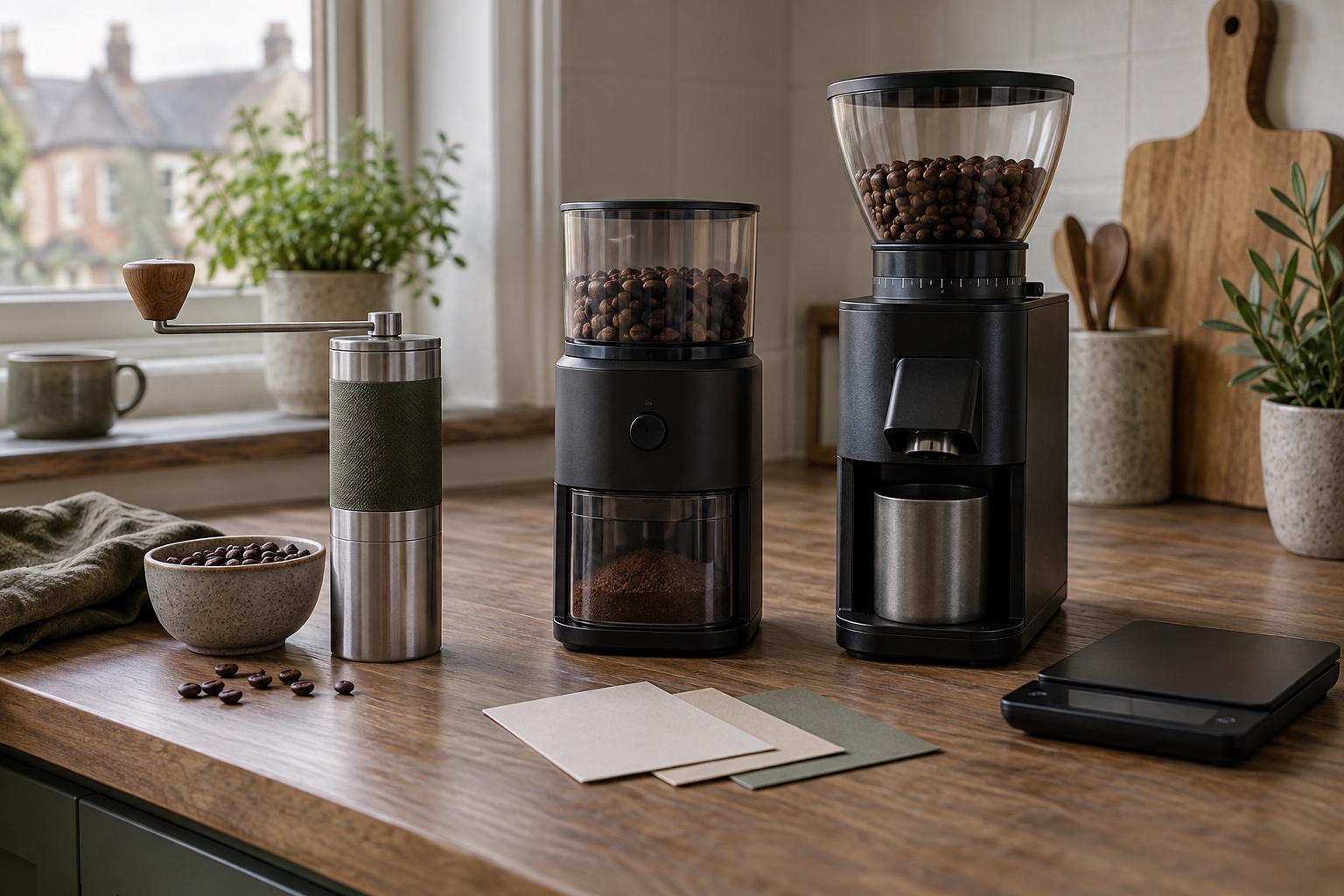
Under £100, manual grinders generally provide stronger adjustment than electric models.
The first meaningful upgrade is repeatable grind control; displays and metal bodies come later.
Budget for a scale, coffee and maintenance rather than spending every pound on the grinder.
A higher price can improve workflow and serviceability without guaranteeing a preferred flavour.
There is no percentage of a coffee-machine budget that works for everyone. The grinder must meet the most demanding brew method in regular use. Cafetière is forgiving; pour-over rewards repeatability; non-pressurised espresso requires close fine adjustment. Start there, then pay for the convenience the household will actually notice.
For many homes, £100–£250 is the useful electric range. It includes established filter grinders and entry espresso-capable all-rounders. Below £100, a manual grinder usually offers better grind control. Above £250, the gains increasingly involve espresso specialisation, quieter operation, dosing, build and workflow.
Under £50: basic manual or electric convenience
This band can replace pre-ground coffee, but expectations need discipline. A compact ceramic-burr hand grinder can work for occasional AeroPress or pour-over. A low-cost electric disc grinder can make a cafetière or filter-machine routine easier.
What you should not expect is refined espresso adjustment, fast manual grinding, low retention, premium bearings and long-term parts support in one product. Avoid anonymous blade grinders marketed as espresso tools. The mechanism may produce powder, but it cannot make small, repeatable corrections around a shot setting.
Buy in this band when the volume is low, the method is forgiving and it is genuinely the available budget. If daily manual grinding sounds likely to fail, a straightforward electric filter model is better than a theoretically superior hand grinder left in a drawer.
£50–£100: the manual-grinder sweet spot
This is where modern hand grinders become compelling. Steel burrs, more stable shafts and finer stepped adjustment can support pour-over and, on the right model, espresso. External adjustment may appear near the top of the band.
The trade is labour. Espresso is slowest and most demanding. A large household batch may exceed the chamber capacity. Our best grinders under £100 includes the K6 and K2 because they use the budget on grind control rather than a motor.
Electric models in this band are more naturally aimed at filter and cafetière. They are not automatically bad; they solve a different problem.
£100–£200: established filter electrics and entry all-rounders
Here you begin to find documented electric burr grinders from brands with UK support, useful hoppers, clearer adjustment and replaceable components. This is the sensible target for a household making filter coffee daily without wanting to hand grind.
Near the upper part of the band, espresso-capable designs appear. Look for a fine adjustment zone rather than relying on total setting count. Timers and portafilter holders may also enter the picture.
For filter-only use, the Baratza Encore is the reference kind of product: simple controls, a broad useful range and a parts path. Paying more for an espresso label is unnecessary if the kitchen never uses that method.
£200–£400: better espresso control and workflow
This band can buy credible motorised espresso adjustment, timed dosing and stronger construction. It is appropriate for a single-wall espresso machine used most days, especially when several people need a repeatable routine.
The Baratza Encore ESP may sit below or within this range depending on retailer pricing, while grinders such as the Sage Smart Grinder Pro trade single-dose simplicity for timed portafilter convenience. Evaluate the exact feature you will use: close steps, stepless control, timer, quieter drive, lower retention or easier cleaning.
Do not let the grinder budget silently expand because the espresso machine looked affordable on its own. Machine, grinder, scale, tamper and milk routine form one system.
£400 and above: specialist territory
Higher spending can bring large burrs, stepless mechanisms, quieter motors, premium materials, commercial-derived parts, gravimetric or sophisticated timed dosing and lower-retention single-dose designs.
Those are real features, but value becomes personal. A dedicated espresso drinker changing coffees may appreciate a precise single-dose grinder. A family filling one hopper with the same medium roast may benefit more from a reliable timer. A cafetière drinker is unlikely to recover the cost through practical improvement.
At this level, investigate warranty, UK repair route, replacement burr cost and the exact model voltage. Avoid importing an incompatible electrical model to save a small amount.
What the first £100 should buy
Prioritise burrs, a stable mechanism and a usable adjustment range. Then consider capacity and ergonomics. A display, polished body or app should not displace the mechanism that controls the coffee.
For manual grinders, check handle, body diameter and dial access. For electric models, check hopper clearance, grounds path, UK plug, duty cycle and cleaning instructions. For espresso, look at how small each adjustment is in the fine region.
When spending more is worth it
Spend more when the present grinder prevents a repeatable result: espresso jumps from fast to stalled, filter brews vary despite stable technique, or batch capacity turns one brew into several loads.
Spend for accessibility when a motor or clearer controls enable the household to use fresh coffee. Spend for serviceability when published parts and documentation extend the likely ownership path. Spend for lower noise if early-morning grinding genuinely disturbs the home.
Do not spend more solely for a larger setting number, bigger burr diameter or metal shell. Those facts need context.
When to keep the grinder you have
Keep it if the setting changes predictably, the capacity fits and the workflow is used. Before replacing it, clean the chute and accessible burr area according to the manual, inspect wear and recalibrate if the maker provides a procedure.
Technique problems can look like grinder problems. Uneven espresso distribution, inconsistent pour-over technique and unweighed doses all create variation. A scale and a notebook may reveal that the existing grinder is more capable than the routine.
Do not forget the supporting budget
Reserve money for a reliable 0.1g scale, fresh coffee and appropriate water. Espresso owners may need a correctly sized tamper and basic distribution tools; filter brewers need papers and a suitable kettle only if the method benefits.
Maintenance has a cost too. Replacement burrs, cleaning products approved by the maker and eventual repair matter more than decorative accessories. Our cleaning guide helps avoid damaging a new purchase.
Frequently asked questions
Should the grinder cost as much as the espresso machine?
Sometimes. An affordable machine with a capable grinder can be more controllable than an expensive machine fed inconsistent coffee. Match both to the basket and desired workflow rather than using a fixed ratio.
Is £100 enough for an espresso grinder?
It can buy a capable manual model. It rarely buys the same adjustment plus a strong motor and polished electric workflow. See our espresso grinder choices.
How long should a coffee grinder last?
There is no responsible universal figure. Use, burr material, motor duty, maintenance and parts support vary. Look for replaceable wear parts and a manufacturer support route rather than an unsupported lifespan promise.
Is an expensive grinder wasted on cafetière?
Not necessarily if quieter operation, capacity or build matters, but the extraction demands do not require espresso-level adjustment. A sound entry burr grinder is enough for many homes.
Should I buy used?
Used grinders can offer value when the model is serviceable and the seller can demonstrate safe operation. Budget for burrs, inspect cables and plug, and avoid equipment with unknown electrical damage or missing safety parts.
Helpful products
Three reference points in the budget
A value hand grinder, a filter-focused electric and an espresso-capable all-round electric show what the useful spending steps buy.
K2 straight-handle
- Stainless-steel burr
- Internal adjustment
- Aluminium body
Strong manual value
KINGrinder K2
Best for: filter and occasional espresso on a tighter manual-grinder budget
A sturdy aluminium-bodied hand grinder that brings a steel burr set and a wide published brew range below the K6's price.
Why it earns a place
- Steel burr set
- Solid aluminium body
- Broad published brew range
What to weigh up
- Internal adjustment
- Less convenient for repeated method changes
Skip it if You switch settings several times a day; the K6's external adjustment is easier to live with.
Check the official specification →ZCG485 / 485-230V-G
- 40 settings
- 40mm steel burrs
- 300g hopper
Best simple filter grinder
Baratza Encore
Best for: filter, pour-over and cafetière without screen or dosing extras
A straightforward hopper grinder with 40 steps and strong UK parts support. It keeps controls simple and puts the budget into a well-established filter-brewing platform.
Why it earns a place
- Straightforward controls
- Replacement parts available
- Compact footprint
What to weigh up
- Not our pick for unpressurised espresso
- No timer or dose display
Skip it if You use a traditional non-pressurised espresso basket; move to the Encore ESP.
Check the official specification →ZCG495 / 495W-230V-G
- 40 settings
- 40mm steel burrs
- 230V UK model
Best fit for most homes
Baratza Encore ESP
Best for: households switching between espresso and filter
Its adjustment range is deliberately divided between finer espresso settings and broader filter settings, so it is the most convincing one-grinder answer here for a mixed routine.
Why it earns a place
- Dedicated espresso and filter ranges
- Simple hopper adjustment
- Dosing cup included
What to weigh up
- Manual dosing rather than a timed display
- Plastic-led body
Skip it if Timed portafilter dosing is the feature that would make everybody else in the house use the setup.
Check the official specification →