
Troubleshooting · Taste
Why does my coffee taste bitter?
Diagnose bitter, harsh or drying coffee by separating roast, extraction, strength, stale residue and water—then adjust one variable at a time.
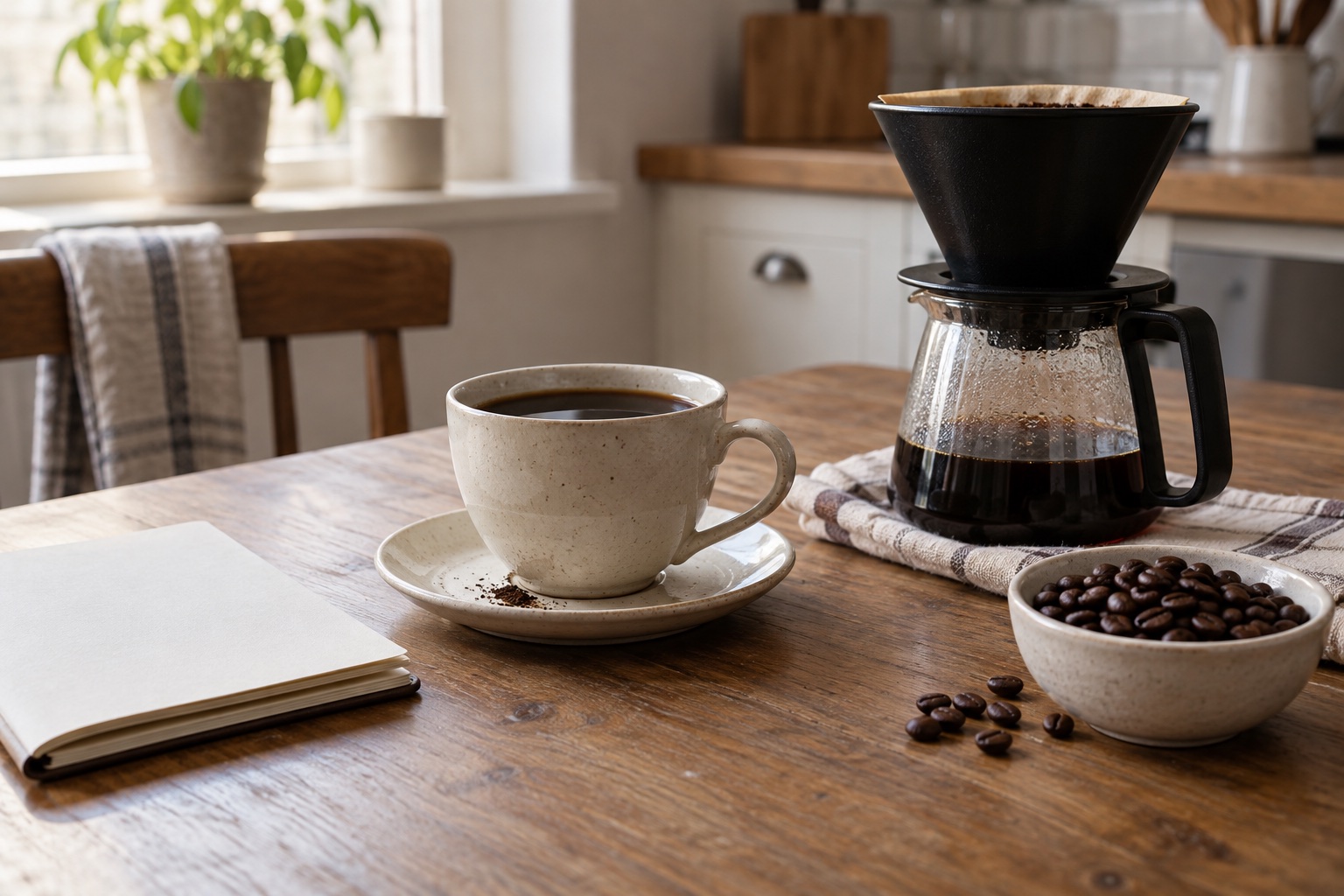
Bitter and strong are not synonyms.
Change one variable per brew so the result teaches you something.
Clean old oil from contact parts before diagnosing the beans.
Do not descale solely because a cup tastes bitter.
Bitterness is not a single fault code. Coffee naturally includes bitter compounds; a dark roast may taste pleasingly chocolatey to one person and burnt to another. A harsh, drying finish in a cup that used to taste balanced suggests a process change. The practical question is whether the flavour belongs to the coffee itself, the extraction, or residue in the equipment.
Start with a controlled cup
Keep the same beans, dose, water amount and brewer. For filter coffee, our coffee-to-water ratio guide gives a 60g-per-litre starting point; it is not a target for espresso. Note the grind setting, brew time and taste. If you are currently using unmeasured scoops, measure once before changing anything else. A stronger dose can make a cup taste more intense without proving that it is over-extracted.
The Specialty Coffee Association's brewing-chart discussion distinguishes extraction from strength and associates high extraction with bitter impressions. That is a useful model, not a guarantee that every bitter cup has one cause. Roast development and personal preference matter.
Adjust extraction without chasing your tail
If a pour-over or filter cup is harsh and takes unusually long to drain, move the grinder a little coarser while holding dose and water steady. If a cafetière steeps much longer than intended, try a shorter controlled time and decant promptly rather than leaving the coffee sitting with the grounds. A very fine grind in a long-contact brewer can increase unpleasant extraction and sediment. Use our grind-size guide for method-appropriate starting textures, then tune by taste.
In espresso, a very slow shot can be bitter and heavy, but a dark blend can taste bitter even at a conventional shot time. Record dry dose and beverage yield rather than judging by crema alone. If a shot is simultaneously weak and bitter, uneven flow or channeling is possible; look at puck preparation and grind consistency rather than simply grinding coarser forever.
Check the less glamorous causes
Old coffee oils: a dirty basket, group head, carafe or grinder can taint a fresh brew. Follow the espresso cleaning guide or grinder cleaning guide as appropriate. Water: local mineral composition changes taste and extraction; check UK water hardness without assuming one filter solves everything. Coffee choice: try a fresh medium roast from a reputable roaster if you find dark, smoky notes unpleasant. That is a preference experiment, not proof your machine is broken.
Do not use descaler as a taste-reset button. It addresses mineral scale, not stale coffee oils. If the machine has a maintenance prompt, follow the manual separately.
A three-brew experiment
Brew A is your current recipe. Brew B is the same recipe with one small coarser grind change. Brew C returns to A's grind but shortens contact time or flow exposure slightly. Compare after the cups cool enough to taste clearly. If B improves the harsh finish without turning thin, keep it. If none improves it, compare a different bean using the same brewer and ratio. This approach is cheaper and more informative than buying a new machine.
Frequently asked questions
Why is my coffee bitter even when it is weak?
Strength and extraction differ. A cup can be dilute overall yet include harsh extracted flavours from uneven wetting, long contact with fines or old residue. Check dose, grind distribution and cleanliness rather than only adding coffee.
Is boiling water the cause?
Water temperature affects extraction, but bean, grind and recipe matter too. Follow your brewer or roaster's range and change temperature only after measuring the current brew; do not assume an arbitrary temperature fixes all bitterness.
Are dark beans always bitter?
No, but darker roasting can emphasise bitter and smoky notes. If the flavour persists across sensible recipes, choose a roast profile you enjoy.
Helpful products
When grind control is the limiting factor
A stepped burr grinder is useful if inconsistent blade chopping prevents repeatable filter adjustments. It is not a cure for a roast you simply dislike.
ZCG485 / 485-230V-G
- 40 settings
- 40mm steel burrs
- 300g hopper
Best simple filter grinder
Baratza Encore
Best for: filter, pour-over and cafetière without screen or dosing extras
A straightforward hopper grinder with 40 steps and strong UK parts support. It keeps controls simple and puts the budget into a well-established filter-brewing platform.
Why it earns a place
- Straightforward controls
- Replacement parts available
- Compact footprint
What to weigh up
- Not our pick for unpressurised espresso
- No timer or dose display
Skip it if You use a traditional non-pressurised espresso basket; move to the Encore ESP.
Check the official specification →Sources and scope
The distinction between brew strength, extraction and bitter perception follows the SCA brewing-chart research discussion. Equipment hygiene guidance is model-dependent.