
Manual brewing · Measurements
Coffee-to-water ratio: grams for your mug, pot or dripper
Use a clear coffee-to-water ratio chart for a 250ml mug, two-person brew or 1L pot. Learn how to adjust strength without confusing brew water with finished coffee.
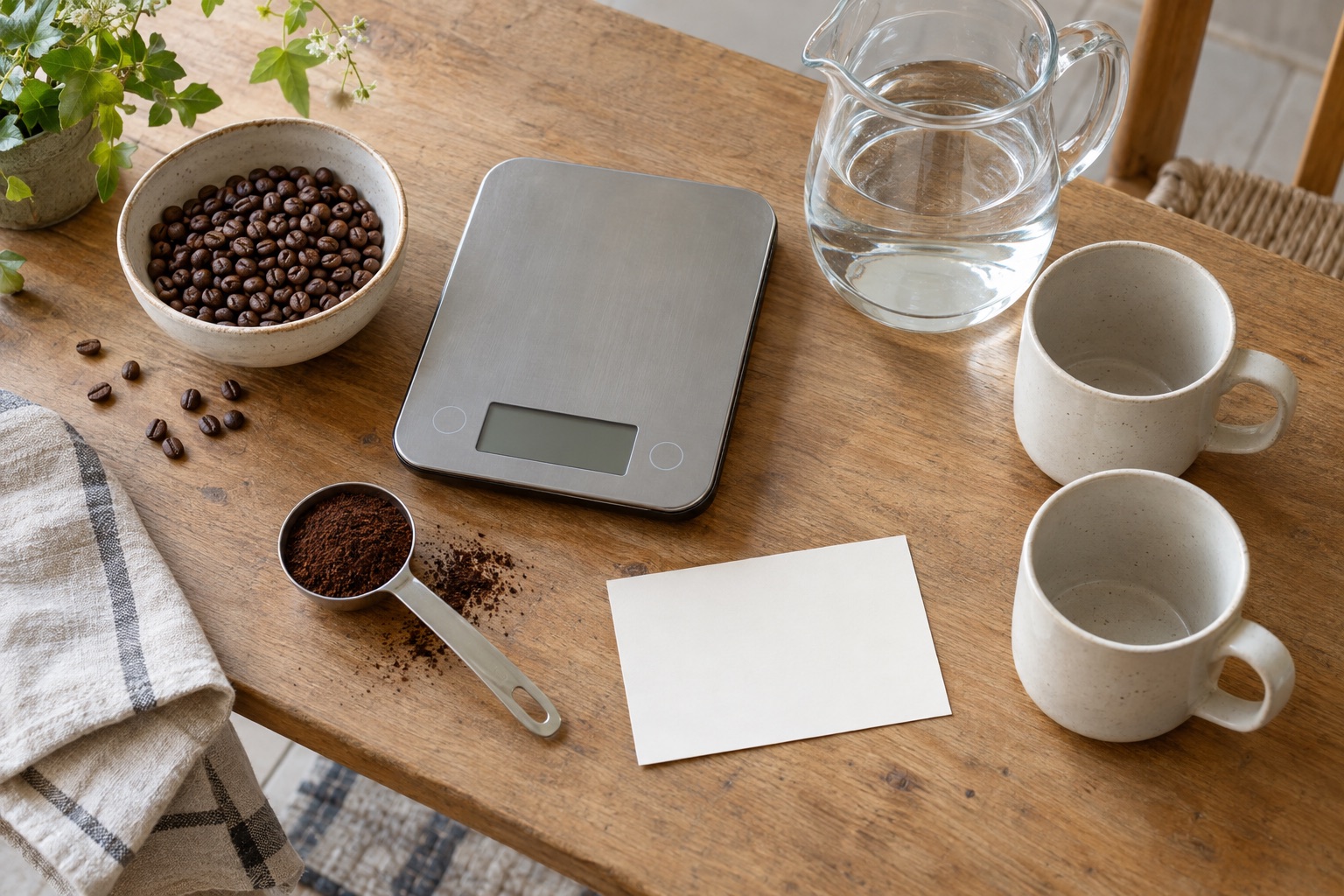
A ratio compares dry coffee mass with water added, not the drink served.
Water is roughly 1g per ml for ordinary kitchen measurement.
Use the same ratio before changing grind or steep time.
Stronger coffee needs more coffee per water; extraction and strength are different.
The ratio is the simplest way to make a repeatable pot of coffee. “Two scoops per mug” is ambiguous because scoops, beans and mugs differ. Weigh dry coffee, then weigh the water you add. A 1:16.7 recipe means one gram of coffee for about 16.7 grams of water. Multiply either side to fit your actual cup. The table below starts at 60g/L, a useful everyday strength that matches Hario UK's 15g/250ml V60 example. It is not a single perfect answer for every method or bean.
The quick ratio chart
| Water added | Coffee | Typical use |
|---|---|---|
| 250g ≈ 250ml | 15g | One modest mug |
| 300g ≈ 300ml | 18g | One larger mug |
| 500g ≈ 500ml | 30g | Two modest cups |
| 600g ≈ 600ml | 36g | Two larger cups |
| 750g ≈ 750ml | 45g | Small shared pot |
| 1,000g ≈ 1L | 60g | Full-size cafetière or batch machine |
These are water input figures. Coffee grounds retain some of that water, and paper or a brewer may retain a little more. If you need exactly two filled 300ml mugs, allow for loss rather than expecting 600g poured in to become 600g served. The manufacturer “cup” markings on a machine or cafetière usually do not represent a large mug.
How to calculate any amount
At 60g per litre, divide the water grams by about 16.7. For 400g water, 400 ÷ 16.7 is about 24g coffee. If the dose is fixed at 20g, multiply by 16.7 for about 334g water. Kitchen scales that read whole grams are precise enough. Weigh water directly as you pour into a dripper or vessel rather than trusting a kettle's printed marks.
Another common starting point is 55g/L, roughly 1:18.2. The Specialty Coffee Association uses 55g/L as an initial test ratio for certified home brewers before adjusting for grind and contact time. That is a testing starting point, not a command that every household must prefer it. At 1L, the difference between 55g and 60g is only 5g of coffee; taste both before arguing over a universal ideal.
Ratio by brewing method
For a V60 pour-over, 15g/250g is a convenient first cup. You then tune grind and pour to avoid a thin or harsh result. For a cafetière, 36g/600g makes two medium mugs and gives room for the grounds to steep. An automatic filter machine can use the same 60g/L starting dose, but consult its basket capacity and minimum batch size. Do not fill above the maker's stated maximum.
AeroPress recipes vary much more, including short concentrates subsequently diluted with water. You cannot compare the chamber ratio with a full served mug without accounting for dilution. Espresso is also a different measurement: baristas often compare dry coffee dose with beverage yield, not the water put into a machine's tank. This article's table is not an espresso recipe.
If the coffee is weak, sour or bitter
First check whether you measured correctly. Weak can mean too much water for the dose, or poor extraction caused by a grind that is too coarse or a brew that finishes too soon. Add a little coffee if you want a stronger drink, but if it is simultaneously sour and watery, tune extraction too. Bitter or drying flavours can come from over-extraction or the coffee itself; simply removing coffee may make it thin without solving the cause.
Change one variable at a time and write down the result. Keep the dose and water fixed while altering the grind size, or hold the grind fixed while trying 1:16 instead of 1:16.7. If you alter dose, grind, temperature and time together, you will not know what helped. Water quality and roast also matter, but a repeatable ratio makes the next diagnosis possible.
Measuring without specialist equipment
A basic digital kitchen scale is enough if it reads grams and is stable under your brewer. A timer on a phone is fine. If you have no scale today, use the same level scoop and a measured jug consistently, then weigh that scoop once when you can. Consistency is the immediate goal.
Frequently asked questions
Is 1:15 stronger than 1:18?
Yes, as a recipe it uses more coffee for the same water, though extraction and actual cup strength also depend on grind and method. A lower second number means a stronger input ratio.
Is 250ml water equal to 250g?
Close enough for normal home coffee brewing. Use grams on a scale so you can stop pouring at the target without relying on a jug's markings.
Why did my 1L cafetière not fill four 250ml mugs?
Some water stays in the grounds and at the bottom of the vessel. The litre is the input capacity, not guaranteed poured yield.
Can I use this ratio for espresso?
No. Espresso recipes usually track coffee dose and beverage mass in the cup. Use a dedicated espresso guide rather than filling the tank by this table.
Helpful products
Two ways to use the same starting maths
A V60 and a cafetière differ in filtration, but weighing coffee and brew water helps you compare recipes without guessing at scoops.
VD-02T, clear size 02
- Size 02
- 1–4 maker-size cups
- VD-02T
Flexible first pour-over
Hario V60 Plastic Dripper
Best for: one or two cups with a low-cost, durable dripper
The size-02 cone is light, inexpensive and takes widely available V60 02 papers. Its open flow makes pouring and grind choice matter.
Why it earns a place
- Light and robust
- Common 02 paper format
- Works over a mug or server
What to weigh up
- Paper filters sold separately
- Pouring technique matters
- Not an immersion brewer
Skip it if You want a brewer that controls steeping time for you or dislike buying filters.
Check the official specification →1548-01, 1L black
- 1L
- Eight maker-size cups
- 1548-01
Lower-cost cafetière
Bodum Brazil
Best for: a practical larger press without a metal frame
A 1L borosilicate-glass press in a protective plastic frame with a reusable metal filter. It covers the same batch size as the Chambord with simpler styling.
Why it earns a place
- 1L capacity
- Reusable filter
- Protective frame
What to weigh up
- Glass still breakable
- Not insulated
- Sediment remains possible
Skip it if You want a paper-filtered low-sediment cup or an insulated vessel.
Check the official specification →Sources and scope
The 15g/250ml example is from Hario UK's V60 method. The SCA certified-home-brewer requirements describe 55g/L as an initial test ratio, with adjustment permitted. The table is arithmetic and a practical starting recipe; no one ratio will suit every bean and taste.