
Troubleshooting · Fast shot
Espresso running too fast? Find the cause
Diagnose fast espresso with dose, beverage yield, grind, basket type and puck preparation before replacing your machine or grinder.
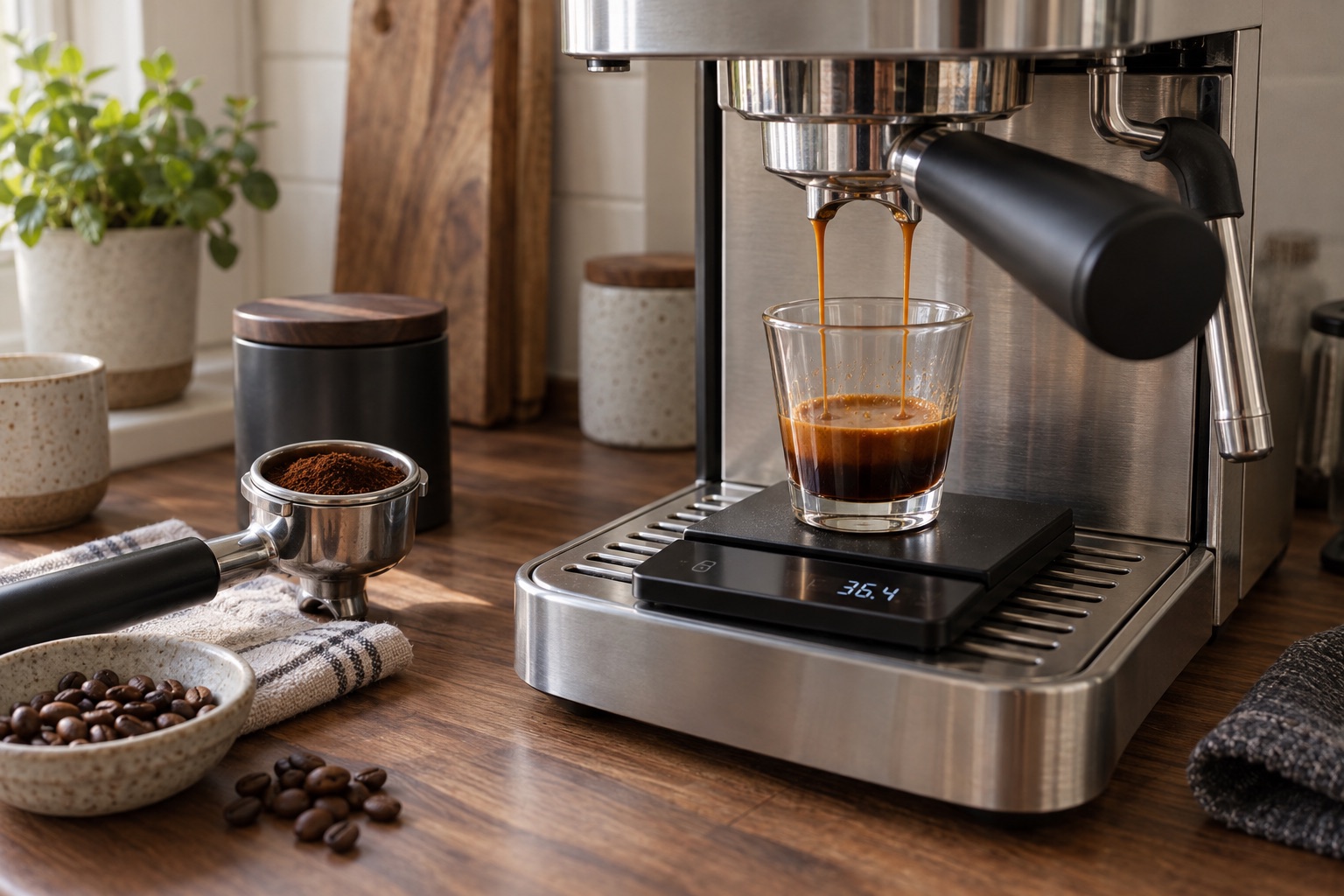
A time alone is not a diagnosis; record dose and final beverage mass.
With single-wall baskets, coarse grind and low dose are common causes.
Even distribution matters; one narrow channel can make a shot seem fast.
Stop if the machine leaks or behaves abnormally; use its manual or support.
If espresso gushes into the cup and tastes thin or sharp, start by writing down three things: dry coffee dose, beverage weight and approximate time from pump start. The popular 18g-in, 36g-out, roughly 25–30-second example is a starting experiment, not a mandatory recipe. A smaller basket may not accommodate 18g, and some coffee tastes better outside that time band.
Work through the causes in order
- Check the basket. A pressurised basket adds resistance at its outlet and may not respond to grind changes like a single-wall basket. Confirm what is installed.
- Check the intended dose. A severely underfilled basket can run quickly. Use the basket maker's range and measure rather than adding random scoops.
- Check the programmed volume. If a button is delivering a long drink, stop by beverage weight for a trial. A large final yield can look like a fast extraction when the desired shot should have ended earlier.
- Adjust grind finer, one small step at a time if using a single-wall basket and suitable grinder. Keep dose and target yield the same while testing.
- Prepare evenly. Break up obvious clumps, distribute across the basket and tamp level and consistently. Extreme force will not cure a much-too-coarse grind.
If the first drops appear from one side and spray elsewhere, uneven preparation or channeling may be involved. A bottomless portafilter can reveal this but is not needed to begin diagnosis. A normal spouted handle, scale and repeatable notes are enough.
A two-shot diagnostic example
Suppose your basket's supported dose is 16g and a trial produces 32g in the cup much faster than expected. First confirm that you actually used 16g, that 32g was the stopping point, and that the machine did not simply run its programmed long-volume button. On a single-wall basket, prepare a second 16g dose the same way, choose one small finer grinder setting and stop again at 32g. Compare flow and taste. If it slows but tastes worse, the time change alone is not a win; return toward the previous setting and consider yield or puck preparation next.
Do not use that example as a target for a different basket. A pressurised basket has an engineered outlet, and a double-wall result cannot be interpreted exactly like a single-wall puck. With a fresh coffee or different roast, record a new baseline rather than assuming last week's grinder number will transfer.
| What you observe | Check before buying anything | Useful next change |
|---|---|---|
| Long programmed volume, thin final cup | Beverage mass at your intended stop point | Stop at a smaller yield and taste |
| Single-wall shot runs freely from the start | Dose, grind range and basket fit | One small finer grind step |
| Spraying or uneven streams | Clumps, distribution and level tamp | Make preparation more repeatable |
| Fast despite finest clean grinder setting | Grinder's supported espresso range | Read the grinder-limit guide below |
If the grinder is already at its finest setting
Do not keep increasing dose beyond basket capacity. Clean the grinder as its manual allows and verify that it is designed for non-pressurised espresso. Some grinders labelled “fine” are principally filter grinders. Our grinder-not-fine-enough guide helps separate adjustment limits, misassembly and stale coffee. Consider a forgiving pressurised basket while deciding whether an espresso-capable grinder is worthwhile.
What taste tells you
Fast flow plus sour, sharp flavour often points toward too little extraction. A finer grind can increase contact and slow flow; a slightly longer beverage yield may also help, but change one variable per shot. Fast flow that nevertheless tastes harsh could mean uneven extraction or a roast you dislike. Use the taste-led dial-in guide rather than chasing a stopwatch at the expense of a pleasant cup. For thin drinks, see watery espresso.
Frequently asked questions
Should I tamp harder to slow a shot?
A level, repeatable tamp matters. Once the puck is compacted consistently, grind and dose are more useful levers than trying to press harder each time.
Why did the same setting become faster?
Bean age, a changed coffee, humidity, dose or grinder retention can alter flow. Recheck actual dose and yield before moving the setting.
Is a fast shot always sour?
No. It may be weak, sharp, balanced or harsh depending on coffee, yield and uneven flow. Taste is the reason to adjust; the timer helps you compare trials.
Could the machine pump be too strong?
Do not infer a pressure fault from fast flow alone. If water leaks, the pump sounds abnormal or the machine faults without coffee, consult the exact manual and manufacturer support.
Helpful products
Only if your current tools block diagnosis
A small scale measures the actual yield. An espresso-range grinder becomes relevant if your filter-only grinder cannot make a useful fine adjustment for a single-wall basket.
ZCG495 / 495W-230V-G
- 40 settings
- 40mm steel burrs
- 230V UK model
Best fit for most homes
Baratza Encore ESP
Best for: households switching between espresso and filter
Its adjustment range is deliberately divided between finer espresso settings and broader filter settings, so it is the most convincing one-grinder answer here for a mixed routine.
Why it earns a place
- Dedicated espresso and filter ranges
- Simple hopper adjustment
- Dosing cup included
What to weigh up
- Manual dosing rather than a timed display
- Plastic-led body
Skip it if Timed portafilter dosing is the feature that would make everybody else in the house use the setup.
Check the official specification →Exagram
- 77×124×24mm
- 0.3g–2kg
- 2 AAA batteries
Compact espresso fit
Wacaco Exagram
Best for: small drip trays and a simple timed dose
A narrow 77mm-wide scale with timer, tare and 0.1g steps up to 999.9g. Useful beneath an espresso cup but less comfortable for a wide filter server.
Why it earns a place
- Compact width
- Timer and tare
- Silicone pad
What to weigh up
- AAA batteries required
- Small platform
Skip it if You regularly weigh a large pour-over server.
Check the official specification →Sources and scope
Sage's dial-in guidance treats grind, dose and yield as adjustable variables; Gaggia's Classic guidance notes that too-coarse grinding can cause rapid flow. Examples here are diagnostic starting points, not measured targets for every machine.