
Care · Descaling
How to descale a coffee machine without guessing
A practical descaling sequence for UK espresso, bean-to-cup and filter machines, with model-specific cautions, rinsing and the difference between scale and coffee oils.
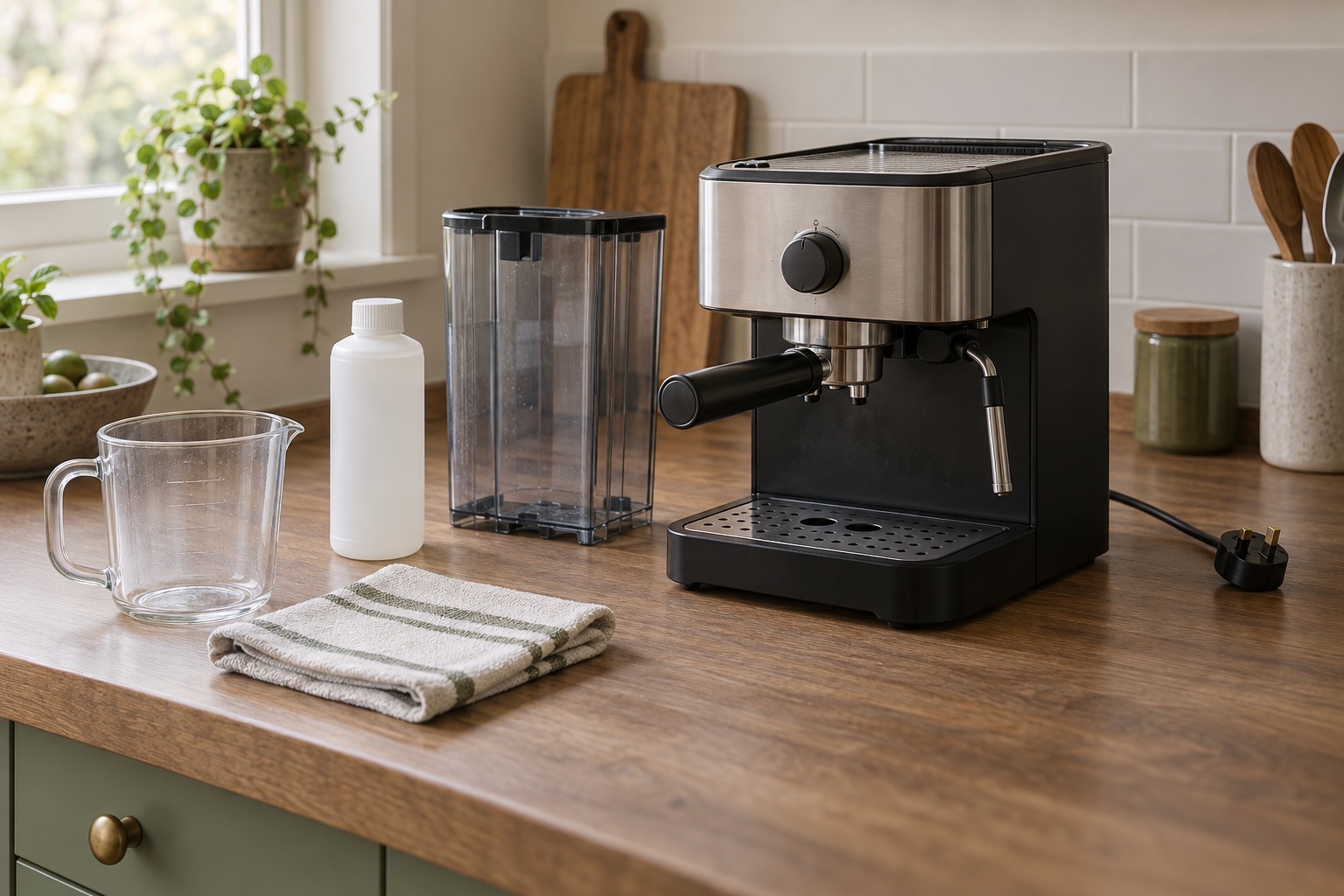
A cleaning tablet and a descaler solve different problems.
Remove a water filter only if your model tells you to.
Keep chemical solution out of cups, food and reach of children.
Finish every rinse the machine requests before brewing again.
White deposits around a kettle are an easy visual clue to mineral-rich water. Inside a coffee maker, scale can build where you cannot see it. Slower flow or a descaling prompt can be reasons to check the maintenance programme, but neither proves that scale is the only cause of a fault. First distinguish a planned descale from a repair problem. A leaking, sparking, damaged or unusually noisy machine needs the manufacturer's support route, not repeated chemicals.
Before you add anything to the tank
Find the model number on the machine or its manual. Search the manufacturer's support page for descale, not just “clean”. Note the required product, concentration, tank fill line, whether a water filter is removed, where to place a collecting vessel, whether the steam circuit participates, and the number of rinse cycles. Different machines sequence these differently. For example, De’Longhi's pump-machine guidance ties the prompt to water-hardness settings and describes a specific programme rather than a universal button combination.
Read the descaler's own safety and dilution instructions too. Measure it as directed. More concentrate does not mean a safer or faster clean. Do not mix descalers with detergent, bleach or another product. We do not advise vinegar or citric-acid recipes as universal substitutes: seals, metal parts and warranty instructions vary by model.
The safe general sequence
- Let the machine finish any brew, empty the drip tray and remove coffee or capsules. Where the manual says so, remove the tank filter. Make sure you can safely collect all discharge from coffee and hot-water outlets.
- Add the approved descaler and water in the precise order and quantities specified for this model. Do not fill past the instructed line.
- Start the descaling programme from the manual or display. Do not improvise a series of normal coffee cycles when a dedicated programme exists. Stay nearby because the output may be hot and acidic.
- Empty the collecting vessel safely. Rinse the tank and perform every clean-water rinse requested by the machine or manual. Some programmes pause and ask for a refill.
- Refit a water filter only when instructed, restore the machine's normal setting and discard any first output if the manual directs. If a warning remains, check whether the rinse stage actually finished before repeating the chemical stage.
The above is a map, not a substitute for the on-screen or printed sequence. A capsule machine, filter machine and manual espresso machine can use different flow paths. Melitta's filter-machine powder instructions, for instance, do not become instructions for its automatic bean-to-cup range.
Descaling is not cleaning coffee residue
Scale forms from minerals in heated water. Coffee oils and grounds collect at the group head, shower screen, portafilter, brew unit or basket. A machine can need both jobs at different times. Sage's Barista Express manual has distinct cleaning and descaling procedures. Putting an oil-removing tablet into a water tank, or descaler into a backflush basket, is the wrong route unless the exact instructions explicitly direct it. See our espresso-machine cleaning guide for the other half of maintenance.
How often, and what if the alert returns?
There is no UK-wide monthly rule. Scale exposure varies with local water hardness, water treatment, filter use and litres run through the machine. Set the hardness level from a proper test or supplier information if your model asks for it, then follow its prompt. Our frequency guide explains the decision.
If the alert returns immediately, do not keep adding descaler. Check the manual for an incomplete rinse, a reset step, incorrect hardness setting or a filter setting. If flow remains poor or the machine leaks, seek the manufacturer's fault guidance. Some blockages need service rather than a stronger solution.
Frequently asked questions
Can I use any coffee-machine descaler?
No. Match the exact machine type and manufacturer guidance. “Universal” on a bottle does not override a model manual. Our descaler shortlist is organised by compatibility rather than a fictional overall winner.
Can I make coffee immediately afterwards?
Only once the required fresh-water rinse and any reset are complete. The machine should have no active descaling prompt and no chemical smell or taste. Follow any extra discard instruction in the manual.
Is a water filter enough to avoid descaling?
Not automatically. Filter performance and replacement timing vary. Many machines still require descaling; use the setting and schedule for your exact combination.
Helpful products
Descalers for two different machine routes
These are not interchangeable. EcoDecalk is for supported De’Longhi machines; Melitta's powder is for compatible filter coffee machines and kettles.
DLSC500, 500ml
- DLSC500
- 500ml
- Descaler, not detergent
For supported De’Longhi machines
De’Longhi EcoDecalk
Best for: De’Longhi owners whose manual specifies EcoDecalk
De’Longhi’s own 500ml descaling liquid for supported coffee machines. Follow the machine’s dose, water fill, cycle and rinse instructions rather than treating the bottle as a universal recipe.
Why it earns a place
- Manufacturer-backed for supported models
- Liquid format
- 500ml bottle
What to weigh up
- Not a universal cleaner
- Model-specific dosing
- Must be stored securely
Skip it if Your machine specifies a different product or you need cleaner for coffee oils rather than mineral scale.
Check the official specification →192632, six 20g sachets
- Six 20g sachets
- Filter machine and kettle
- 192632
For filter machines
Melitta Anti Calc Filter Machine Powder
Best for: compatible filter coffee machines and kettles, especially Melitta models
A portioned powder sold for filter coffee machines and kettles. Use only in a compatible machine, mixing and rinsing exactly as its instructions and the machine manual require.
Why it earns a place
- Portioned sachets
- Designed for filter machines
- Maker publishes instructions
What to weigh up
- Not for every machine type
- Irritant handling precautions
- Still requires full rinse
Skip it if You have a bean-to-cup or espresso machine requiring its own descaler.
Check the official specification →Sources and scope
The process distinction comes from Sage's Barista Express manual. Model-specific cycle and hardness cautions are grounded in De’Longhi's pump-machine FAQ and Melitta's filter-descaler instructions. The current manual remains authoritative.