
Manual brewing · Practical method
How to make cold-brew coffee at home
Make a measured cold-brew batch in a jar or filter pitcher, with ready-to-drink and concentrate ratios, refrigeration, filtration and fixes for weak or muddy cups.
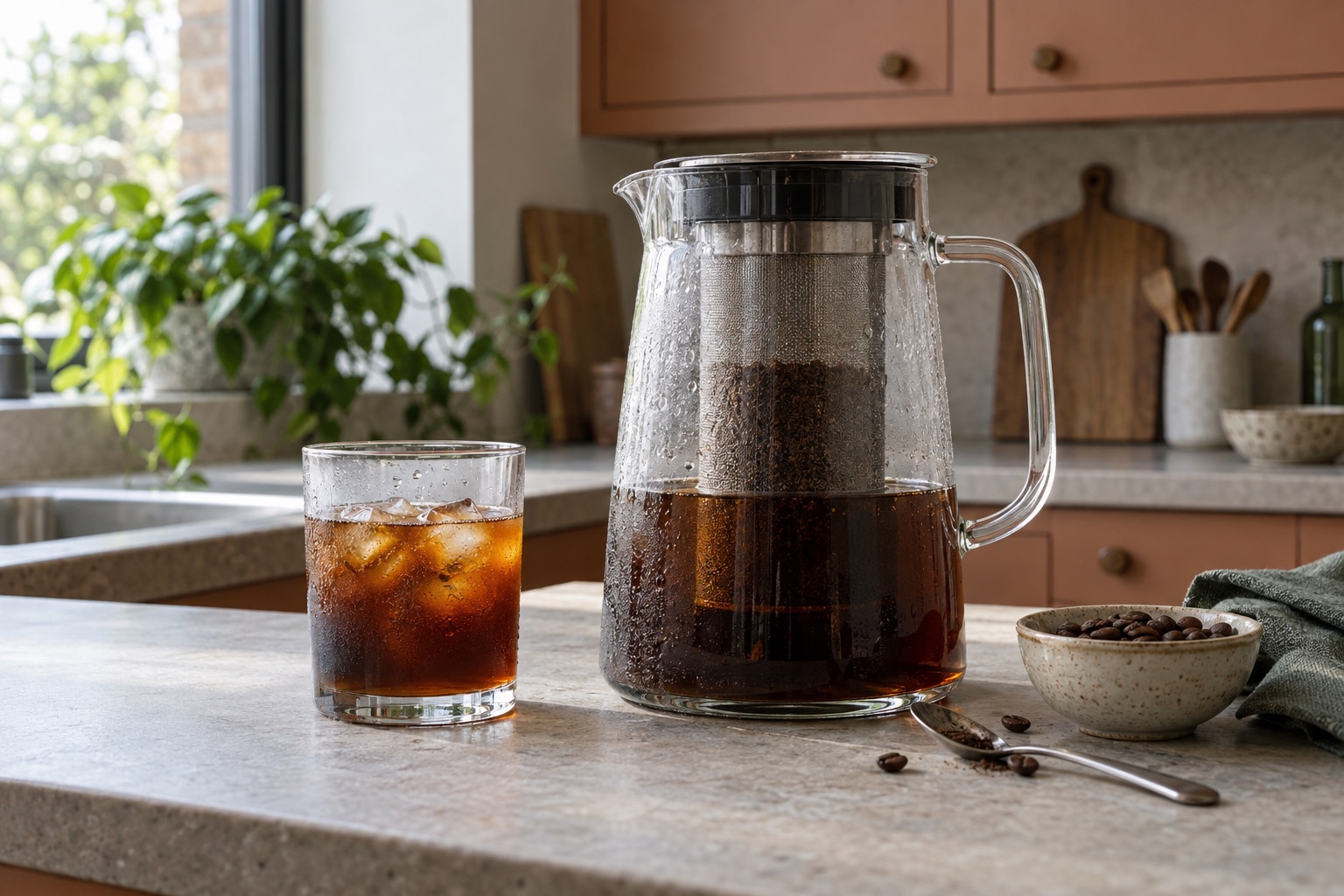
Use grams of water and coffee, not a vessel's nominal litre size.
Keep steeping grounds in the fridge for a predictable routine.
Remove grounds before storing the finished brew.
Label a concentrate so it is diluted deliberately.
Cold brew is made with cool water over hours, not hot coffee poured over ice. You can make it in a clean jar and filter it later, or use a pitcher with a removable mesh basket. The fundamentals are dose, water, contact time and removing the grounds. Our cold-brew maker comparison helps choose equipment; this page is the recipe.
The starting ratio: drink now or dilute later?
For a gentle ready-to-drink baseline, try 60g coffee to 750g water, a 1:12.5 brew-water ratio. The grounds retain liquid, so the final volume will be lower than 750ml. Taste it over ice before adding milk or water. If you want to keep concentrate, try 100g coffee to 500g water, a 1:5 ratio, then start serving with roughly equal parts filtered concentrate and water or milk. That dilution is only a starting point; the strength of the concentrate varies with coffee and extraction.
These ratios describe water added, not the amount collected. A one-litre nominal pitcher might not accommodate an arbitrary one-litre recipe once its mesh basket and coffee are inside. Stay below the manufacturer's fill line and scale the weights down if necessary. A coffee scale makes it easy to repeat what worked.
Make the batch in a jar or mesh pitcher
- Clean and dry the vessel and filter. Use medium-coarse to coarse grounds; a very fine grind makes mesh filtration muddy.
- Weigh coffee and water for your chosen ratio. Put coffee into the mesh basket if using a pitcher, or into a clean lidded jar.
- Add cool potable water gradually, ensuring all grounds are wet. A gentle stir or swirl helps break dry clumps. Do not exceed a product's marked capacity.
- Cover and refrigerate. Start tasting after about eight hours; around 12 hours is a useful overnight baseline. Hario specifies at least eight hours for its Mizudashi.
- Lift out the basket or strain from the jar. Let it drain gently; avoid aggressively pressing fines through the mesh. For a cleaner cup, pass a small amount through an appropriate paper filter.
- Put the filtered coffee into a clean covered container and keep it in the fridge. Serve over ice, dilute concentrate and label the recipe for next time.
If you use the OXO release-switch brewer, its chamber sits on the worktop for the steep according to its instructions, then drains into the carafe. Follow its manual for the chosen recipe and handling; the jar/pitcher approach above deliberately refrigerates throughout. Do not leave a prepared batch warm for an extended improvised steep when you intend to store it for later.
How to fix the next batch
Weak and watery? First check whether you accidentally made ready-to-drink coffee and then diluted it again over melting ice. Try a slightly higher coffee dose or a longer steep next time. Strong but rough? Dilute in the glass before changing the full recipe; then try a shorter steep or coarser grind. Silty? Use coarser grounds, drain without squeezing and add a paper pass. A stale, dull flavour may be the beans or lengthy storage rather than the brewer.
Cold extraction does not mean caffeine-free or automatically lower caffeine. The dose and serving dilution matter. If you are comparing it with hot pour-over, change one variable and note the result instead of treating every cold brew as a fixed flavour profile.
Storage and cleaning
Remove wet grounds when the steep is complete, refrigerate finished coffee promptly in a closed clean container, and make modest batches you can finish over the next couple of days. There is no reliable universal shelf-life promise for every vessel, water source and cleaning routine; discard a batch that smells or looks wrong. Clean a mesh basket before residue dries, rinse all crevices and dry thoroughly. Avoid leaving glass where it can be knocked from a crowded fridge shelf.
Frequently asked questions
Can I use ordinary ground coffee?
Yes, but fine grounds are harder to filter and can produce more sediment. A coarser grind makes a mesh pitcher easier to use.
Does cold brew need 24 hours?
Not necessarily. Start near 12 refrigerated hours and taste. Hario's Mizudashi guidance says at least eight hours; more time is not automatically better.
Can I use a cafetière?
Yes, if it fits safely in the fridge and can be covered. Press and pour gently, then paper-filter if you dislike fines. See best cafetières for vessel differences.
How much concentrate should I pour?
Begin with one part filtered concentrate to one part water or milk, then change to taste. Record the batch ratio so next time is repeatable.
Helpful products
A filter pitcher, a concentrate station or a finishing paper
Choose one brewer, not both. A matching V60 paper can polish a small amount of mesh-filtered brew if you already own a cone.
MCPN-14CBR, brown 1L
- 1L nominal
- MCPN-14CBR
- Reusable mesh
Easy fridge pitcher
Hario Mizudashi Cold Brew Coffee Pot
Best for: a household making a pitcher of ready-to-drink cold coffee
A glass one-litre cold-brew pot with removable reusable mesh basket; steep in the fridge for at least eight hours.
Why it earns a place
- One-litre nominal capacity
- Reusable basket
- Easy pour-and-store workflow
What to weigh up
- Glass needs care
- Mesh may pass fine sediment
- Needs fridge space
Skip it if Fridge shelf height is tight or you need an especially clear, sediment-free paper-filtered drink.
Check the official specification →1272880
- 1272880
- Reusable mesh
- Glass carafe
Dedicated concentrate station
OXO Brew Cold Brew Coffee Maker
Best for: concentrated batches with a separate switch-release glass carafe
A countertop brewer with rainmaker lid, reusable mesh, release switch and lidded glass carafe. It occupies more space than a fridge pitcher.
Why it earns a place
- Release switch
- Reusable mesh
- Separate carafe
What to weigh up
- Multiple parts to clean
- Large counter footprint
- Current UK listing had no featured offer
Skip it if You want one compact pitcher or the current UK marketplace offer is unusually high.
Check the official specification →VCF-02-100W, white 100
- Size 02
- 100 white papers
- VCF-02-100W
Correct V60 paper
Hario V60 Paper Filters
Best for: size-02 V60 and Switch users replacing filter papers
White paper filters sized for Hario's V60 02 drippers. Buying the correct size avoids poor seating and needless leaks.
Why it earns a place
- Correct 02 fit
- 100-sheet pack
- Widely available
What to weigh up
- Repeat purchase
- Not a Chemex filter
- Paper disposal
Skip it if Your brewer is size 01 or a Chemex; those filters are different.
Check the official specification →Sources and method note
Hario's Mizudashi instructions give the minimum fridge steep; its 50g/600ml example is a neighbouring baseline. OXO's 1272880 product and manual describe its separate concentrate-drain workflow. The two measured recipes here are adaptable home starting points.