
Buying guide · Manual grinders
Best manual coffee grinders in the UK
Four manual coffee grinders for espresso, pour-over, AeroPress, travel and low-cost brewing, compared by adjustment, capacity and daily effort.
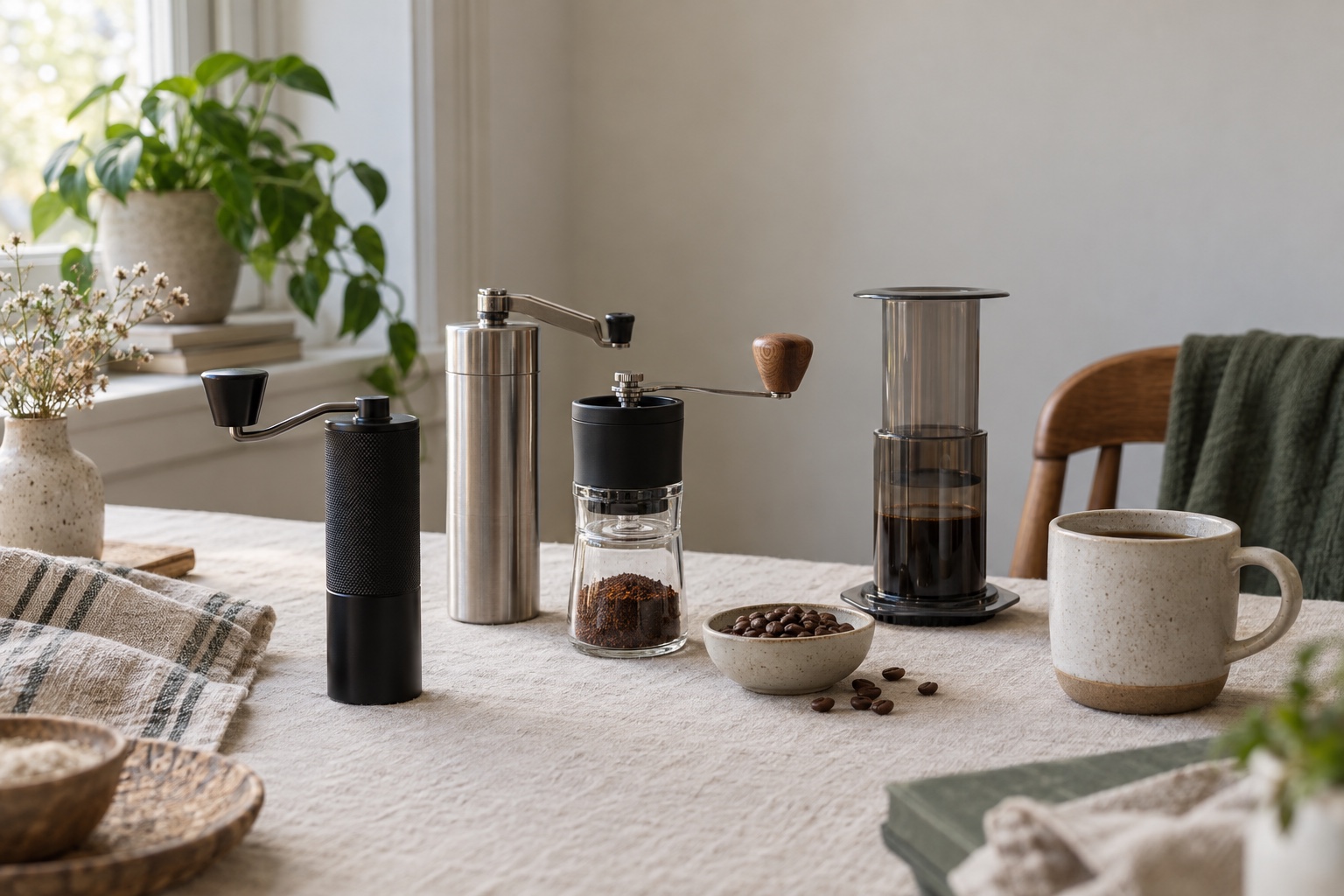
Espresso needs closer adjustment and more turning effort than filter coffee.
Match the chamber to the dry dose you use
External adjustment is faster when you change methods; internal dials keep the body simple.
Body width
The useful shortlist
Four hand grinders with genuinely different jobs
The list moves from espresso-capable versatility to refined filter use, compact travel and a low-cost ceramic-burr starting point.
K6 straight-handle
- 60 clicks per turn
- 16µm per click
- 25–35g capacity
Most versatile manual choice
KINGrinder K6
Best for: brewers who want one external-adjustment hand grinder for espresso and filter
External 16-micron adjustment, a large stainless-steel burr and a 25–35g capacity give it an unusually broad manual workflow without removing the catch cup to change settings.
Why it earns a place
- External numbered adjustment
- Fine 16-micron clicks
- Broad espresso-to-filter range
What to weigh up
- Manual espresso takes effort
- Heavier than compact travel grinders
Skip it if Hand grinding a fine espresso dose every day sounds like friction you will quickly resent.
Check the official specification →C3S Pro
- 38mm conical burrs
- 20g capacity
- Folding handle
Fast, polished hand grinder
TIMEMORE Chestnut C3S Pro
Best for: manual brewers wanting an all-metal body and folding handle
The integrated metal body, 38mm S2C burr set and folding handle make this a compact, quick-feeling manual grinder for filter coffee with some espresso range.
Why it earns a place
- All-metal body
- Folding handle
- 38mm S2C stainless burrs
What to weigh up
- Internal adjustment means removing the catch cup
- List price can exceed £100
Skip it if Traditional espresso is the main job and you want the easiest external adjustment.
Check the official specification →Q Air
- 365g weight
- 15–20g capacity
- 30 clicks per turn
Best compact travel grinder
1Zpresso Q Air
Best for: AeroPress, pour-over and travel where low weight matters
A slim 365g hand grinder with a 15–20g capacity and heptagonal steel burr, intended primarily for portable pour-over and immersion brewing.
Why it earns a place
- Light and compact
- Fits inside an AeroPress plunger
- Numbered internal dial
What to weigh up
- Small 15–20g capacity
- Not the first choice for espresso
Skip it if You need large cafetière doses or a grinder centred on regular espresso.
Check the official specification →MSS-1DTB
- Ceramic burrs
- Up to two cups
- SKU MSS-1DTB
Best low-cost manual option
Hario Mini Mill PLUS
Best for: one or two filter cups, travel and quiet kitchens
This compact ceramic-burr hand grinder holds enough grounds for roughly two cups and dismantles easily, making it a sensible low-cost start for occasional manual brewing.
Why it earns a place
- Low entry cost
- Quiet and easy to pack
- Official UK stock and spares route
What to weigh up
- Manual effort
- Small 24g-style two-cup capacity
Skip it if You make several back-to-back cups, or limited grip makes hand grinding uncomfortable.
Check the official specification →| Model | Best for | Adjustment | Capacity | Main compromise |
|---|---|---|---|---|
| KINGrinder K6 | Espresso and filter versatility | External · 16µm clicks | 25–35g | Heavy and demanding at fine settings |
| TIMEMORE C3S Pro | Refined everyday filter workflow | Internal stepped dial | 20g | Remove catch cup to adjust |
| 1Zpresso Q Air | Travel and one-cup brewing | Internal · 30 clicks per turn | 15–20g | Small for two cups |
| Hario Mini Mill PLUS | Low-cost occasional use | Internal coarse-to-fine dial | Roughly 24g two-cup markers | Slower and less precise |
A good manual grinder can outperform a cheap electric appliance where it matters because the budget is not paying for a motor, power supply and display. The catch is obvious but often minimised: you are the motor. The right hand grinder is therefore the one whose capacity, adjustment and effort fit the coffee you actually make.
The KINGrinder K6 is our all-round choice. Its external numbered adjustment is unusually convenient when moving from espresso to filter, and its fine clicks give room to correct a shot. The TIMEMORE Chestnut C3S Pro is a neater filter-first design with an all-metal body and folding handle. The 1Zpresso Q Air prioritises low weight and one-cup travel. The Hario Mini Mill PLUS is slower and less precise, but remains an accessible step away from pre-ground coffee.
Who should buy a hand grinder?
Manual grinding makes most sense for one or two drinks at a time. It is quiet, needs no socket and stores easily. It can also put a capable steel burr mechanism within a sub-£100 budget, where electric espresso claims should be treated cautiously.
It makes less sense for large batches, limited grip, or a household producing several consecutive milk drinks. A 15g pour-over dose and a 60g filter-machine batch are not the same task. Before buying, time yourself turning an empty pepper mill for a minute: the comparison is imperfect, but it reveals whether the ritual is likely to feel calming or irritating.
Roast also changes effort. Dense light-roasted beans and fine espresso settings take more torque than darker coffee ground for cafetière. A long handle and secure body help, but they cannot remove the work.
KINGrinder K6: best manual grinder overall
The K6 uses an external numbered collar with 60 clicks per revolution and a published 16-micron movement per click. External adjustment is the decisive feature. You can record a setting, move across brew methods and return without removing the grounds cup or turning the grinder upside down.
Its stated 25–35g capacity covers a common double espresso, generous AeroPress recipe or two modest filter cups. The larger stainless-steel burr is designed for a broad range, so this is the hand grinder we would choose when espresso is a real requirement rather than a label on the box.
The K6 is not especially light, and fine grinding demands work. Somebody making four flat whites each morning should price the time and effort as honestly as the hardware.
Choose it if: you want one hand grinder across espresso, AeroPress and pour-over. Skip it if: portability means minimum weight, or manual espresso already sounds tiresome.
TIMEMORE C3S Pro: best polished filter workflow
TIMEMORE’s C3S Pro combines an integrated all-metal body, 38mm S2C stainless burrs and a folding handle. The handle makes the grinder tidier in a drawer or travel bag, while the textured body offers a secure hold.
Adjustment is beneath the burr, so the catch cup must come off. That is perfectly manageable when you use one filter recipe and make occasional changes; it becomes less elegant if you alternate espresso and cafetière several times a day. TIMEMORE publishes a range from espresso to French press, but the 20g capacity and adjustment style make one-cup filter brewing its most natural role.
Choose it if: you value a compact metal build and usually brew a single AeroPress or pour-over. Skip it if: external, quickly repeatable espresso adjustment is the priority.
1Zpresso Q Air: best travel manual grinder
The Q Air strips the idea back to a slim 365g body and 15–20g capacity. 1Zpresso says it fits inside an AeroPress plunger, which is a useful real-world measurement for travellers. Its steel heptagonal burr and numerical internal adjustment give a more considered mechanism than a basic camping mill.
The plastic casing keeps cost and weight down. Capacity is the governing limit: many one-cup recipes fit, but two cups may require a refill. 1Zpresso positions the Q series around pour-over and portable brewing rather than sustained espresso use.
Choose it if: your grinder lives in a travel kit, office drawer or very small kitchen. Skip it if: you regularly grind more than 20g or need an espresso-first tool.
Hario Mini Mill PLUS: best low-cost manual grinder
The Mini Mill PLUS uses ceramic burrs, a compact clear body and simple internal coarse-to-fine adjustment. Hario marks the grounds container at roughly one- and two-cup doses, making the intended scale clear.
Ceramic burrs stay inexpensive and do not rust, but this mechanism is slower and less precisely supported than the metal grinders above. At coarse settings the particle range can be broader, and fine grinding takes time. That does not make it useless. For an occasional V60 or AeroPress, it provides fresh burr-ground coffee with little cost or storage commitment.
Choose it if: the alternative is continuing with stale pre-ground coffee for one or two cups. Skip it if: you brew daily, make large batches or want repeatable espresso control.
Steel versus ceramic burrs in a hand grinder
Material alone does not determine quality. Steel burrs in these newer designs tend to cut quickly and can use sharper, more complex geometries. Ceramic is inexpensive, corrosion-resistant and proven in simple grinders, but basic ceramic assemblies can be slower and less stable.
Support, alignment, bearing design and burr shape matter alongside material. Do not buy a grinder because “steel” sounds premium without checking capacity, adjustment and the manufacturer’s intended brew range.
External versus internal adjustment
An external collar lets you see and change the number while the grinder stays assembled. This is excellent for switching methods and recording espresso changes. An internal dial keeps the outside clean and is often cheaper, but usually requires removing the grounds cup.
For one fixed pour-over recipe, internal adjustment is no hardship. For decaf espresso in the evening and AeroPress in the morning, it adds friction. The best system is the one that supports the changes you really make.
How to choose capacity
Weigh the dry coffee in your normal recipe. If it is 18g, a 20g chamber is adequate but leaves little room for unusually light beans or a slightly larger dose. If it is 30g, choose the K6’s larger range or expect two fills. Published capacity varies with bean size, so treat it as a guide rather than a guaranteed mass.
Cup counts are less useful because a “cup” can mean a 125ml machine measure or a large mug. Grams make product comparisons clearer.
Is a manual grinder good for espresso?
Yes, when the burr and adjustment are designed for it. The K6 is the espresso-capable choice here because its small external steps make corrections manageable. Hand grinding also has low retention and no motor noise.
The limitation is labour. Grinding fine creates more resistance, and dialling in a new bag may require several doses. A low-cost ceramic grinder can physically produce fine grounds without offering the close, stable adjustments a single-wall basket needs. See our focused espresso grinder guide before assuming every hand grinder is suitable.
Static, retention and the water-drop question
Small amounts of ground coffee can cling to the catch cup through static. Some coffee users add a tiny droplet of water to beans before grinding, but do this only if the manufacturer permits it. Never introduce water into the burr chamber or motorised equipment, and avoid turning an internet tip into a wet cleaning method.
Retention is usually low in a simple hand grinder, but grounds can remain around the burr and adjustment area. A light tap and regular dry brushing help without aggressive dismantling.
Cleaning a manual grinder
Empty it, note the current setting and dismantle only the parts described in the manual. Use a soft brush on burrs and threads. Many steel burr assemblies should stay dry; ceramic and plastic parts may have different instructions. If any part is washed, dry it fully before reassembly. Our cleaning guide separates routine brushing from deeper maintenance.
Frequently asked questions
How long does it take to grind coffee by hand?
There is no universal time. Dose, roast, grind size, burr diameter and turning speed all matter. A small filter dose may be comfortably quick; the same grinder at an espresso setting takes longer and more force.
Is a manual grinder cheaper than an electric grinder of the same quality?
Often at entry and mid-range prices, because there is no motor or electronics. It is only better value if you are willing and able to use it consistently.
Can I take a coffee grinder in hand luggage?
Airline and security rules can change, so check the carrier and airport guidance before travel. Keep the grinder clean, empty and accessible for inspection.
Which manual grinder fits inside an AeroPress?
1Zpresso states that the Q Air’s slim body fits inside the plunger. Fit can depend on the exact brewer generation and any sleeve or grip, so verify dimensions if packing space is critical.
Should I buy the K6 or C3S Pro?
Choose the K6 for external adjustment, larger capacity and more serious espresso use. Choose the C3S Pro for a compact folding handle and a mainly filter-focused routine.
How we chose
We compared published burr, adjustment, capacity and body specifications and assigned each grinder a distinct job. Current price is left to the retailer because it changes; value judgements use documented features and each buyer's live price.