
Buying guide · Grinders under £100
Best coffee grinders under £100 in the UK
Five coffee grinders under £100 for espresso, filter, AeroPress, cafetière and travel, with live-price caveats and clear compromises.
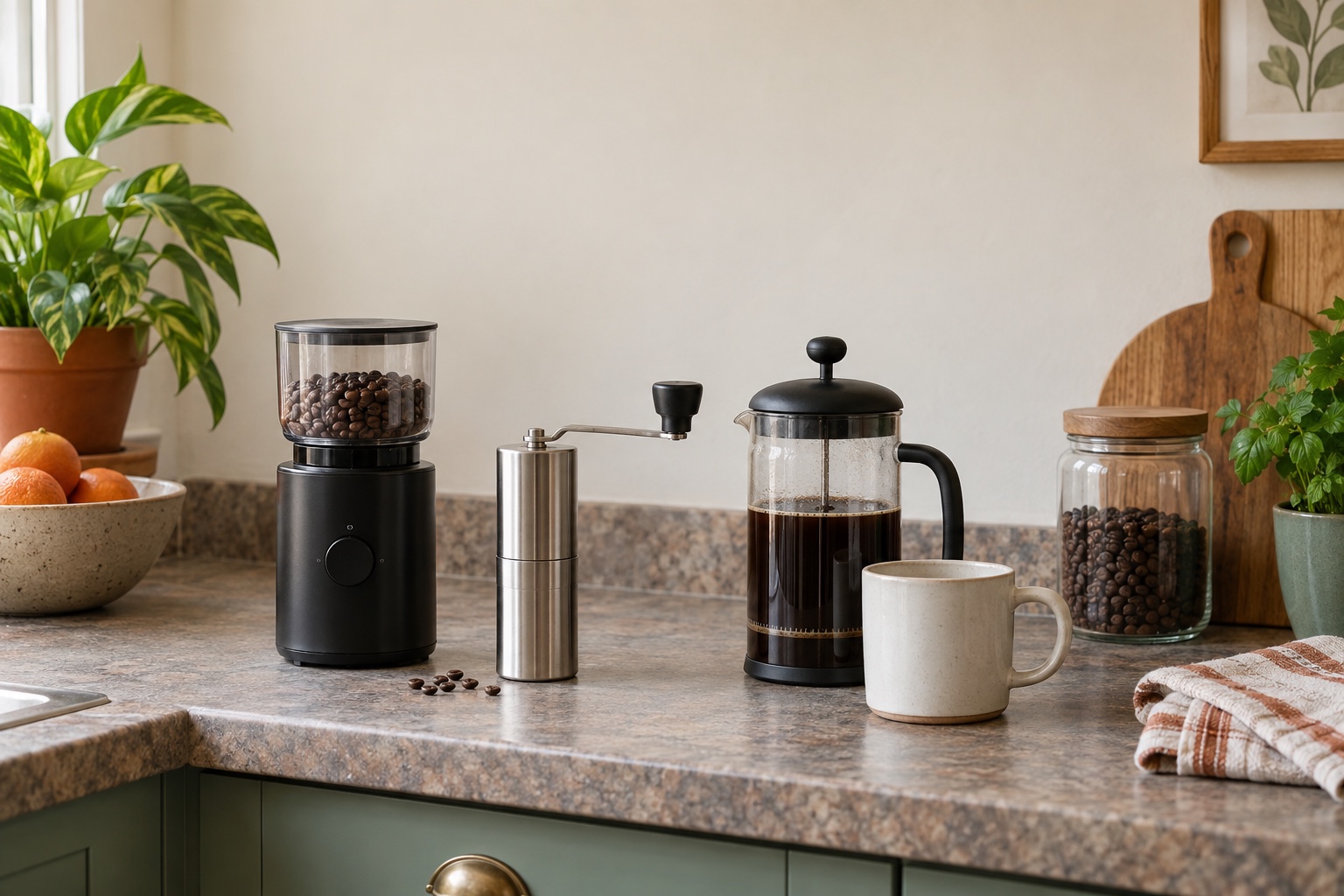
A model qualifies only while its live retailer price is £100 or less; promotions move.
Under £100
Traditional espresso narrows the safe shortlist sharply.
Compact 20g grinders suit one cup
The useful shortlist
Five sub-£100 grinders without pretending they are equal
Prices can change. If a listed product rises above £100, treat it as a comparison point rather than a current budget pick.
K6 straight-handle
- 60 clicks per turn
- 16µm per click
- 25–35g capacity
Most versatile manual choice
KINGrinder K6
Best for: brewers who want one external-adjustment hand grinder for espresso and filter
External 16-micron adjustment, a large stainless-steel burr and a 25–35g capacity give it an unusually broad manual workflow without removing the catch cup to change settings.
Why it earns a place
- External numbered adjustment
- Fine 16-micron clicks
- Broad espresso-to-filter range
What to weigh up
- Manual espresso takes effort
- Heavier than compact travel grinders
Skip it if Hand grinding a fine espresso dose every day sounds like friction you will quickly resent.
Check the official specification →Q Air
- 365g weight
- 15–20g capacity
- 30 clicks per turn
Best compact travel grinder
1Zpresso Q Air
Best for: AeroPress, pour-over and travel where low weight matters
A slim 365g hand grinder with a 15–20g capacity and heptagonal steel burr, intended primarily for portable pour-over and immersion brewing.
Why it earns a place
- Light and compact
- Fits inside an AeroPress plunger
- Numbered internal dial
What to weigh up
- Small 15–20g capacity
- Not the first choice for espresso
Skip it if You need large cafetière doses or a grinder centred on regular espresso.
Check the official specification →K2 straight-handle
- Stainless-steel burr
- Internal adjustment
- Aluminium body
Strong manual value
KINGrinder K2
Best for: filter and occasional espresso on a tighter manual-grinder budget
A sturdy aluminium-bodied hand grinder that brings a steel burr set and a wide published brew range below the K6's price.
Why it earns a place
- Steel burr set
- Solid aluminium body
- Broad published brew range
What to weigh up
- Internal adjustment
- Less convenient for repeated method changes
Skip it if You switch settings several times a day; the K6's external adjustment is easier to live with.
Check the official specification →1019-01
- 17 settings
- 200g hopper
- 2–14 cup selector
Low-cost electric choice
Melitta Molino
Best for: filter and cafetière drinkers who want electric convenience below £100
A simple electric disc grinder with 17 settings, a 200g hopper and a 2–14 cup selector. It is a convenience buy for filter and immersion, not our route into serious espresso.
Why it earns a place
- Low electric entry price
- 2–14 cup selector
- Removable burr and containers
What to weigh up
- Only 17 settings
- Not our recommendation for traditional espresso
Skip it if You use a non-pressurised espresso basket or want to weigh and switch beans for every brew.
Check the official specification →MSS-1DTB
- Ceramic burrs
- Up to two cups
- SKU MSS-1DTB
Best low-cost manual option
Hario Mini Mill PLUS
Best for: one or two filter cups, travel and quiet kitchens
This compact ceramic-burr hand grinder holds enough grounds for roughly two cups and dismantles easily, making it a sensible low-cost start for occasional manual brewing.
Why it earns a place
- Low entry cost
- Quiet and easy to pack
- Official UK stock and spares route
What to weigh up
- Manual effort
- Small 24g-style two-cup capacity
Skip it if You make several back-to-back cups, or limited grip makes hand grinding uncomfortable.
Check the official specification →| Model | Best for | Drive | Main compromise |
|---|---|---|---|
| KINGrinder K6 | Espresso plus filter | Manual · external adjustment | Heavy and requires effort |
| 1Zpresso Q Air | Travel and one cup | Manual · internal adjustment | 15–20g capacity |
| KINGrinder K2 | Strong everyday manual value | Manual · internal adjustment | Less convenient switching |
| Melitta Molino | Low-cost electric filter | Electric · 17 settings | Not our traditional espresso pick |
| Hario Mini Mill PLUS | Occasional one- or two-cup brewing | Manual · ceramic burrs | Slow and less precise |
The £100 line creates a useful choice: spend the money on a motor, or on the burr mechanism and adjustment. At this budget you rarely get both at an enthusiast level. If espresso or careful pour-over is the priority, choose a capable hand grinder. If the real problem is that nobody will turn a handle at 7am, accept less adjustment and buy a sensible electric filter grinder.
Our first choice is the KINGrinder K6, provided its live price is still £100 or less. It brings external fine adjustment and a broad brew range right to the budget ceiling. The 1Zpresso Q Air is smaller and lighter for one cup. The KINGrinder K2 retains a solid steel-burr proposition for less. The Melitta Molino is the affordable electric answer for filter and cafetière. The Hario Mini Mill PLUS is the basic, compact starting point.
A necessary note about the £100 limit
Retail prices change by colour, seller, promotion and stock. Use the product button to confirm the current figure, seller, plug and delivery terms.
If the K6 costs more than £100, the K2 may be the clearer in-budget all-round manual choice. Check its current price too. A temporary discount does not turn a model with a normal list price above £100 into a permanently sub-£100 recommendation.
KINGrinder K6: best grinder under £100 overall
The K6 offers external numbered adjustment, 60 clicks per turn and a published 16-micron movement for each click. This is unusually useful at the price because it supports small espresso corrections and quick movement back to a recorded filter setting.
Its 25–35g capacity is enough for common espresso and one- or two-cup manual recipes. The body is substantial rather than ultralight, which helps stability but makes it less attractive for minimalist travel.
This is the best use of £100 when grind control is more valuable than a motor. It is not the best use when limited hand strength, a large household or several milk drinks turn manual grinding into a daily obstacle.
Best for: espresso-capable versatility and people who switch methods. Watch for: a live price over the budget and the effort of fine grinding.
1Zpresso Q Air: best for travel and one cup
The Q Air weighs a stated 365g, holds roughly 15–20g and is slim enough to fit inside an AeroPress plunger. It combines a light plastic outer body with a stainless-steel heptagonal burr and numerical internal adjustment.
That mix is purposeful: money and weight go into the grinding mechanism rather than a heavy shell. The small chamber is perfect for a typical one-cup recipe and poor for a large cafetière. It is also not the espresso-first grinder in this list.
Best for: AeroPress, pour-over, office drawers and travel. Watch for: two fills when the dry dose exceeds its capacity.
KINGrinder K2: best manual value below the ceiling
The K2 removes the K6’s external adjustment but keeps a metal body, stainless burr and published range across common brew methods. The setting changes beneath the burr, so switching from espresso to filter requires removing the cup and keeping clearer notes.
If you mainly use one brew method, that inconvenience matters less. The saving can buy a scale, fresh coffee and filters—all of which may improve the actual routine more than a nicer outer finish.
Best for: somebody who wants robust manual grinding and usually stays within one part of the range. Watch for: friction when alternating methods frequently.
Melitta Molino: best electric grinder under £100
The Molino is the choice for people who need a button more than micro-adjustment. It has 17 settings, a 200g hopper and a 2–14 cup timer-style selector. For an automatic filter machine or cafetière, that can be a meaningful step up from buying large bags of pre-ground coffee.
We would not choose it for a traditional single-wall espresso basket. Seventeen broad steps leave less space to correct shot flow, and the cup control estimates output by run time rather than weight. It is an honest electric filter recommendation, not a miraculous all-purpose grinder.
Best for: low-cost electric convenience and repeatable filter batches. Watch for: limited adjustment and beans sitting in a full hopper.
Hario Mini Mill PLUS: best low-cost starting point
Hario’s Mini Mill PLUS uses ceramic burrs and a transparent grounds cup marked around one- and two-cup quantities. It is quiet, light and simple to dismantle according to the maker’s instructions.
It is also the slowest and least precise grinder here. The shaft and ceramic burr arrangement do not offer the stable, close adjustment of the K6 or K2. For occasional AeroPress or pour-over, it still solves the central problem: grinding a small amount immediately before brewing.
Best for: the lowest-commitment move away from pre-ground coffee. Watch for: large batches, frequent use and demanding espresso.
Manual versus electric below £100
Choose manual when you want the strongest burr and adjustment proposition for the money, make one or two cups and are physically comfortable grinding. Choose electric when speed, accessibility or household volume would make a hand grinder go unused.
Do not compare feature counts without valuing the motor. An electric grinder needs a safe power supply, motor, switches and casing before any budget reaches the burr assembly. A manual grinder can devote more of the bill of materials to bearings, burr and adjustment, but converts the saved hardware into your labour.
Can a grinder under £100 do espresso?
The K6 is the clear yes here, and the K2 is the lower-cost qualified option. Both still require patient hand grinding. The Q Air is designed more naturally for pour-over, and neither the Molino nor Mini Mill PLUS is our recommendation for frequent non-pressurised espresso.
If your machine uses a pressurised basket, the grinder requirement is more forgiving. Before spending, read our best espresso grinder guide and identify the basket rather than relying on the machine’s marketing category.
What not to buy
Avoid anonymous listings whose only evidence is a large setting count and borrowed lifestyle photography. Look for a named model, official specification, UK plug where relevant, clear returns and replacement or support information.
A blade grinder is cheap and powered, but its time-controlled chopping is harder to repeat than a burr gap. It can be useful for spices if the maker permits, but it is not our budget route to controlled coffee. See burr versus blade grinders for the mechanism difference.
Avoid buying too small a chamber for the recipe. A beautifully made 20g travel grinder is poor value if every morning requires 45g. Avoid paying for an espresso range if the household only uses cafetière. And avoid buying solely from an old sale price shown in a search result.
The rest of the £100 setup
Leave room for a basic 0.1g coffee scale, fresh coffee and the brewer’s consumables. An £80 grinder plus a reliable £15 scale can produce a more repeatable routine than spending the whole amount on a grinder and guessing the dose.
Store beans sealed, away from heat and direct light. Grind just before brewing where practical. Clean the grinder on a routine proportionate to use; our grinder cleaning guide explains what should stay dry.
Frequently asked questions
Is a £50 coffee grinder worth buying?
Yes when it has burrs, a usable adjustment and a routine you will follow. At that level, a manual grinder generally provides better control; an electric model prioritises convenience.
What is the cheapest grinder here for espresso?
The K2 is the lower-priced espresso-capable candidate, but the K6’s external finer adjustment is easier to dial in. Exact prices move, so check both live listings.
Are cheap electric grinders bad?
Not automatically. A model such as the Molino can be entirely appropriate for cafetière or basic filter coffee. The problem is expecting broad settings and a timer to behave like a specialist espresso grinder.
Should I save for a more expensive grinder?
Save if you need motorised espresso adjustment, large batch capacity, lower noise or a more serviceable electric platform. Buy now if a manual grinder fits the volume and method. Our spending guide maps the useful price jumps.
Do these prices include sales?
Promotions change the shortlist. Confirm the current price before treating any product as under £100.
How we chose
We started with the hard ceiling, checked exact UK listings and then judged whether each model earns a role through documented adjustment, burr type, capacity and workflow. Temporary above-budget products are excluded from the core list. Affiliate buttons do not change recommendation order.