
Brewing fundamentals
Coffee grind-size guide for every common brew method
A practical coffee grind-size chart for espresso, moka pot, AeroPress, pour-over, filter machines, cafetière and cold brew, plus adjustment advice.
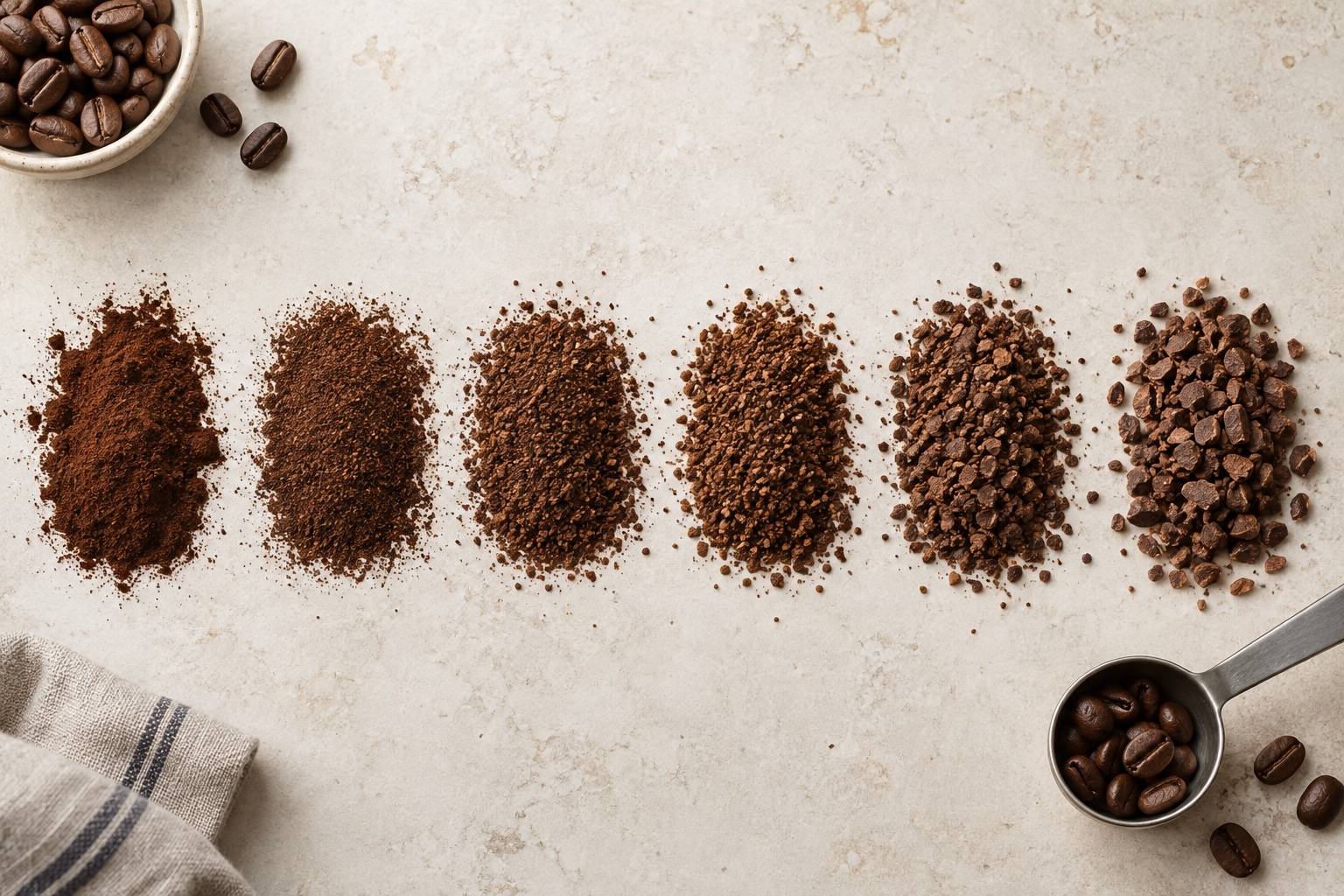
Never copy another grinder's exact setting unless it is the same calibrated model.
Keep dose, water and technique steady while changing grind.
Time helps diagnose flow, but taste decides whether the change worked.
Espresso and filter need different levels of adjustment precision.
Coffee grind size controls two connected things: how much surface is exposed to water, and how easily water moves through or around the particles. Finer coffee generally extracts faster and can slow a percolation brew; coarser coffee generally extracts more slowly and allows easier flow.
The simple labels—fine, medium, coarse—are useful only as starting points. They are not standards printed identically across grinders. A study cited by the Specialty Coffee Association used measured particle sizes to compare brews, illustrating why two visually similar labels can still represent different distributions. At home, learn the region on your own grinder, record it and adjust by the cup.
Grind-size chart
Extra fine: Turkish-style coffee
Texture: powder-like, finer than typical espresso.
Use for brewing methods specifically designed to leave extremely fine grounds in the cup. Many domestic burr grinders do not reach this texture consistently; do not assume the finest click is suitable without checking the method and grinder instructions.
Fine: traditional espresso
Texture: finer than table salt, able to clump lightly when pressed.
Use for non-pressurised espresso baskets. The exact setting depends on basket, dose, coffee, roast, age and machine. Espresso needs close adjustment because a small change alters resistance and flow. If one click runs quickly and the next nearly stalls, the grinder’s steps may be too broad.
Medium-fine: moka pot, small pour-over and some AeroPress recipes
Texture: between fine sand and table salt.
This is a common bridge region. Moka pots need finer coffee than cafetière but should not be packed with powder-fine espresso coffee. Cone pour-over recipes and shorter AeroPress brews often begin here, then move according to drawdown and taste.
Medium: automatic filter and many pour-over recipes
Texture: broadly similar to ordinary sand.
Start here for many flat-bottom and cone filter brewers and for domestic drip machines. Larger doses and deeper coffee beds may need a coarser setting to maintain sensible flow; small doses may need finer. Filter shape matters as well as grind.
Medium-coarse: steep-and-release and some cafetière recipes
Texture: visibly chunky but not rock-like.
Use this as a starting point for longer immersion brews, large pour-overs or cafetière recipes where very coarse grinding produces a hollow cup. Because immersion does not rely on water passing through the bed in the same way, it can tolerate a wider range.
Coarse: cafetière and cold brew
Texture: coarse sea salt to small breadcrumbs.
Start coarse for a long cafetière steep or cold brew measured in hours. Do not assume coarser is always cleaner: fines come from the grinder’s particle distribution, and aggressive plunging or pouring can carry sediment into the cup.
Why grinder numbers cannot be copied blindly
Setting 12 on one grinder has no necessary relationship to setting 12 on another. Even two units of the same model may differ slightly through calibration, wear and reassembly. Burr replacement can shift the useful range.
Recipe authors’ settings are therefore clues. Use them only when the model matches, begin cautiously and observe the brew. Record your own setting beside coffee, dose and brewer rather than relying on the printed label “medium”.
How to adjust by taste and flow
Use a two-part diagnosis: what did the brew do, and how did it taste?
For pour-over, a fast drawdown combined with a thin, sharp or underdeveloped cup suggests trying finer. A slow drawdown with dryness, harshness or astringency suggests trying coarser. Channeling and pouring technique can mimic either problem, so change one variable and keep the rest steady.
For immersion, flow time matters less. If the cup is weak or sharp at a sensible ratio and steep time, grind finer. If it is heavy, dry or unpleasantly bitter, try coarser or shorten contact time.
For espresso, use dose and preparation consistently, then observe yield and time. A fast shot generally points finer; a stalled shot points coarser. Taste remains the final judge. Baratza’s espresso guidance similarly treats grind as a primary control while recognising that beans and dose change the result.
Espresso grind size
Traditional espresso occupies a narrow fine region. The coffee bed must create resistance without becoming impermeable. Particle-size research shows that puck resistance and flow change with the distribution, which is why stable adjustment matters more than a generic “fine” claim.
Pressurised baskets are more forgiving because the basket outlet creates additional resistance. A grind that works there may run too quickly in a single-wall basket. Before buying, identify the basket and read our espresso grinder guide.
Pour-over grind size
Begin medium-fine to medium. A small cone dripper often starts finer than a large flat-bottom batch, but the filter paper, number of pours, agitation and coffee bed depth all matter.
If changing grind does not fix an erratic drawdown, inspect pouring. Water repeatedly hitting one spot can disturb the bed, while an uneven pour can create bypass. Grind is a powerful control, not an excuse to ignore technique.
AeroPress grind size
AeroPress recipes span fine to coarse because contact time and agitation vary dramatically. A short press may use fine coffee; a long immersion can use medium or coarser. Start from the recipe author’s band, not a universal AeroPress setting.
The brewer’s flexibility makes it a good match for a compact hand grinder. Our manual grinder shortlist includes one-cup options and explains their real capacities.
Cafetière grind size
Medium-coarse is a more useful starting point than automatically choosing the coarsest possible setting. Extremely large particles can leave the cup weak unless steep time or agitation changes. Let grounds settle, plunge gently and pour deliberately to manage sediment.
If the cup tastes muddy, clean the mesh, reduce agitation and inspect the grinder’s fine-particle output before moving several settings coarser.
Cold-brew grind size
Use coarse coffee for long room-temperature or refrigerated steeps, then adjust the time and ratio. A finer grind can increase extraction but makes filtration harder and may add sediment. Food-safety and storage matter: keep equipment clean, follow a trusted recipe and refrigerate finished concentrate promptly.
When to change grind for a new coffee
Expect to adjust when bean, roast, age or environmental conditions change. Dense light roasts often behave differently from brittle dark roasts. Espresso can need changes as a bag ages; filter settings may also shift.
Return to a known starting point, make a brew and change one step at a time. A grinder with numbers makes logging easier, but a pencil mark or simple notebook works with any repeatable dial.
Frequently asked questions
What grind size is supermarket ground coffee?
There is no single size. “Filter”, “espresso” and “cafetière” packs target broad methods, but the exact distribution varies. Check the label and match it to the brewer.
What does under-extracted coffee taste like?
It can taste thin, sharp, sour or undeveloped. Those words are not laboratory diagnoses; water, ratio, temperature and technique can produce similar symptoms.
What does over-extracted coffee taste like?
It can taste dry, harsh, bitter or astringent. Dark roast character may be naturally bitter, so compare changes within the same coffee and recipe.
Should I grind finer for stronger coffee?
Strength is mainly the concentration created by coffee-to-water ratio. Finer grinding can increase extraction and change flow, but adding more coffee or using less water is the more direct strength control.
Why are there fine particles in a coarse grind?
Coffee fractures into a distribution, so every grinder produces some smaller particles. Excessive wobble, worn components or an unsuitable grinder can broaden it further.
Helpful products
Grinders that make size changes repeatable
One electric all-rounder, one filter specialist and one externally adjusted hand grinder cover the most common routes through this guide.
ZCG495 / 495W-230V-G
- 40 settings
- 40mm steel burrs
- 230V UK model
Best fit for most homes
Baratza Encore ESP
Best for: households switching between espresso and filter
Its adjustment range is deliberately divided between finer espresso settings and broader filter settings, so it is the most convincing one-grinder answer here for a mixed routine.
Why it earns a place
- Dedicated espresso and filter ranges
- Simple hopper adjustment
- Dosing cup included
What to weigh up
- Manual dosing rather than a timed display
- Plastic-led body
Skip it if Timed portafilter dosing is the feature that would make everybody else in the house use the setup.
Check the official specification →ZCG485 / 485-230V-G
- 40 settings
- 40mm steel burrs
- 300g hopper
Best simple filter grinder
Baratza Encore
Best for: filter, pour-over and cafetière without screen or dosing extras
A straightforward hopper grinder with 40 steps and strong UK parts support. It keeps controls simple and puts the budget into a well-established filter-brewing platform.
Why it earns a place
- Straightforward controls
- Replacement parts available
- Compact footprint
What to weigh up
- Not our pick for unpressurised espresso
- No timer or dose display
Skip it if You use a traditional non-pressurised espresso basket; move to the Encore ESP.
Check the official specification →K6 straight-handle
- 60 clicks per turn
- 16µm per click
- 25–35g capacity
Most versatile manual choice
KINGrinder K6
Best for: brewers who want one external-adjustment hand grinder for espresso and filter
External 16-micron adjustment, a large stainless-steel burr and a 25–35g capacity give it an unusually broad manual workflow without removing the catch cup to change settings.
Why it earns a place
- External numbered adjustment
- Fine 16-micron clicks
- Broad espresso-to-filter range
What to weigh up
- Manual espresso takes effort
- Heavier than compact travel grinders
Skip it if Hand grinding a fine espresso dose every day sounds like friction you will quickly resent.
Check the official specification →