
Buying guide · Grinders
Best coffee grinders for UK homes
Five coffee grinders for espresso, filter and mixed home routines, compared by adjustment, dosing, space and effort.
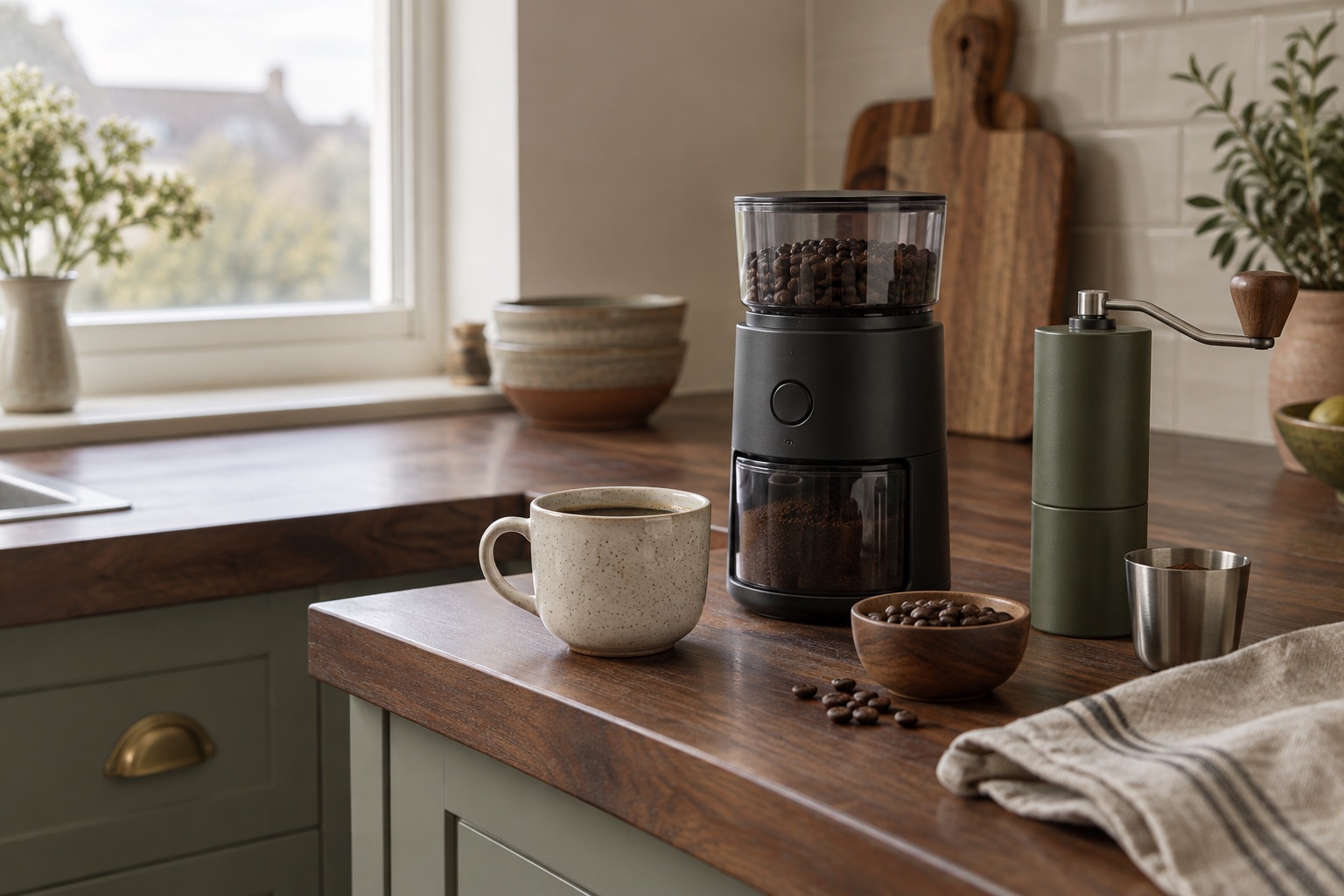
Espresso needs a finer
Choose between timed hopper convenience and weighing each single dose.
A hand grinder suits one cup better than a large cafetière for four.
Measure the full height and the clearance needed to lift the hopper lid.
The useful shortlist
Five grinders for five different routines
These are not interchangeable winners. Each earns its place by solving a distinct home-coffee job with a current UK model and support route.
ZCG495 / 495W-230V-G
- 40 settings
- 40mm steel burrs
- 230V UK model
Best fit for most homes
Baratza Encore ESP
Best for: households switching between espresso and filter
Its adjustment range is deliberately divided between finer espresso settings and broader filter settings, so it is the most convincing one-grinder answer here for a mixed routine.
Why it earns a place
- Dedicated espresso and filter ranges
- Simple hopper adjustment
- Dosing cup included
What to weigh up
- Manual dosing rather than a timed display
- Plastic-led body
Skip it if Timed portafilter dosing is the feature that would make everybody else in the house use the setup.
Check the official specification →BCG820BSSUK
- 60 settings
- 0.2-second dosing
- 450g hopper
Best for timed dosing
Sage Smart Grinder Pro
Best for: espresso drinkers who want repeatable timed doses
The screen, portafilter cradles and 0.2-second dosing adjustment make the daily workflow unusually clear, while 60 settings cover espresso through cafetière.
Why it earns a place
- Clear LCD dose display
- Direct-to-portafilter grinding
- Large 450g hopper
What to weigh up
- Takes more counter height
- Large hopper encourages beans to sit out
Skip it if You change beans often and prefer weighing one fresh dose before every brew.
Check the official specification →ZCG485 / 485-230V-G
- 40 settings
- 40mm steel burrs
- 300g hopper
Best simple filter grinder
Baratza Encore
Best for: filter, pour-over and cafetière without screen or dosing extras
A straightforward hopper grinder with 40 steps and strong UK parts support. It keeps controls simple and puts the budget into a well-established filter-brewing platform.
Why it earns a place
- Straightforward controls
- Replacement parts available
- Compact footprint
What to weigh up
- Not our pick for unpressurised espresso
- No timer or dose display
Skip it if You use a traditional non-pressurised espresso basket; move to the Encore ESP.
Check the official specification →WSFB-100S
- 41 settings
- 58mm flat burrs
- Model WSFB-100S
Best premium filter choice
Wilfa Uniform
Best for: people prioritising pour-over and filter clarity
The 58mm flat burrs, slow motor and automatic stop suit a measured filter routine, with a metal grounds container that avoids some of the static of lightweight plastic bins.
Why it earns a place
- 58mm flat burrs
- Automatic stop
- Five-year domestic warranty
What to weigh up
- Costs much more than entry filter grinders
- Espresso range is not the main reason to buy it
Skip it if Forgiving cafetière coffee is your daily drink; a sound entry grinder already does that job.
Check the official specification →MSS-1DTB
- Ceramic burrs
- Up to two cups
- SKU MSS-1DTB
Best low-cost manual option
Hario Mini Mill PLUS
Best for: one or two filter cups, travel and quiet kitchens
This compact ceramic-burr hand grinder holds enough grounds for roughly two cups and dismantles easily, making it a sensible low-cost start for occasional manual brewing.
Why it earns a place
- Low entry cost
- Quiet and easy to pack
- Official UK stock and spares route
What to weigh up
- Manual effort
- Small 24g-style two-cup capacity
Skip it if You make several back-to-back cups, or limited grip makes hand grinding uncomfortable.
Check the official specification →| Model | Best for | Burrs and range | Dosing style | Main limitation |
|---|---|---|---|---|
| Baratza Encore ESP | Espresso plus filter in one kitchen | 40mm steel burrs · 40 steps split into espresso and filter ranges | Manual or dosing cup | No timed dose display |
| Sage Smart Grinder Pro | Repeatable timed espresso dosing | Stainless-steel conical burrs · 60 settings | 0.2-second timed control · portafilter cradles | Tall 450g hopper |
| Baratza Encore | Straightforward filter and cafetière | 40mm steel burrs · 40 settings | Manual on/off | Not our choice for unpressurised espresso |
| Wilfa Uniform | Premium filter and pour-over setup | 58mm flat burrs · 41 settings | Weigh beans then auto-stop | Considerably higher spend |
| Hario Mini Mill PLUS | One or two cups and travel | Ceramic burrs · manual adjustment | Hand ground · roughly two-cup capacity | Slow for larger batches |
There is no useful “best coffee grinder” without naming the coffee. Espresso needs tiny, repeatable changes around a fine setting. Pour-over and cafetière are less demanding at that end of the dial, but they benefit from a grinder that stays consistent through medium and coarse settings. The right buy also depends on whether you want to fill a hopper and press a button or weigh one dose at a time.
That is why our first choice for most mixed-method homes is the Baratza Encore ESP. Its adjustment is deliberately split: settings 1–20 give finer steps for espresso, while 21–40 cover filter brewing. It is easier to understand than an all-purpose dial that happens to have a very wide range but little usable control where espresso needs it.
The Encore ESP is not automatically the right answer. The Sage Smart Grinder Pro has a more guided, timed workflow. The ordinary Baratza Encore is a sounder value if espresso is not on the menu. The Wilfa Uniform asks filter drinkers to pay more for larger flat burrs and a slower, measured routine. And the Hario Mini Mill PLUS avoids a motor, a plug and a permanent claim on the worktop.
Before choosing a model, choose the job
Start with the most demanding brew you make regularly—not the method you might try twice next year.
For a manual espresso machine with a non-pressurised basket, buy for espresso adjustment first. The grinder needs to make small changes because a slight movement can alter how quickly the shot runs. An entry filter grinder may physically produce fine coffee but still leave too much distance between settings.
For pour-over, batch filter, AeroPress or cafetière, the useful range moves coarser. Retention, static, noise and the way grounds leave the chute can matter more to the daily experience than espresso-level micro-adjustment. A brew-focused grinder is not an inferior grinder; it is designed around a different job.
If the kitchen makes both, decide which compromise is acceptable. An espresso-capable all-rounder can cover everyday filter coffee well. A specialist filter grinder may produce the workflow and cup style a keen pour-over drinker wants, but it should not be bought on the assumption that it will also solve traditional espresso.
Baratza Encore ESP: the best fit for espresso and filter
The Encore ESP is the easiest recommendation here for a household that genuinely moves between an espresso machine and manual brewing. Baratza divides its 40-step collar into two useful zones rather than treating the full dial evenly. The finer half is intended for espresso; the other half opens out for AeroPress, pour-over, filter and immersion methods.
That split makes the machine approachable. Turn the hopper to adjust, use the supplied dosing cup for espresso or grind into the larger bin. There is no screen, timer or stored programme to learn. The compromise is that you must control the dose yourself—ideally by weighing the beans before grinding or weighing the grounds afterwards.
Choose it if the phrase “one grinder for the kitchen” really does include espresso. Skip it if timed portafilter dosing is the feature that would make other people in the household use the setup consistently.
Sage Smart Grinder Pro: the clearest timed workflow
The Sage Smart Grinder Pro is the practical counterpoint to single dosing. Its LCD shows the setting, time and selected number of shots or cups, and grind time adjusts in 0.2-second increments. The included cradles let it grind directly into common 50–54mm and 58mm portafilters; it can also grind into the supplied container.
This is useful when the household wants a familiar routine: leave beans in the hopper, select the dose, press the control and make coffee. Sixty settings cover fine espresso through coarse cafetière, while the large 450g hopper reduces refilling.
The same convenience creates its limitations. A full hopper keeps more beans outside their sealed bag, and the tall body needs clearance for the lid. The timer makes a dose repeatable once established, but it does not weigh the grounds. Different beans can still move through the burrs at a different rate, so occasional scale checks are sensible.
Choose it when a visible timer and direct-to-portafilter workflow will be used every day. Skip it if you change beans frequently and prefer weighing one fresh dose before every brew.
Baratza Encore: the straightforward filter choice
The original Baratza Encore is for the kitchen that does not need to pretend it might make demanding espresso. Its 40 settings, 40mm conical steel burrs, 300g hopper and simple manual controls cover the everyday filter range without a display or dose programme.
The long-term attraction is not novelty. Baratza publishes documentation and sells replacement parts for its grinders, including burr and chassis components. That does not guarantee a particular lifespan, but it gives the owner a clearer support route than an anonymous appliance whose model disappears with the listing.
Choose the Encore for filter machines, pour-over, AeroPress and cafetière when you want electric convenience and uncomplicated controls. For a traditional non-pressurised espresso basket, move to the Encore ESP or a dedicated espresso grinder.
Wilfa Uniform: the step-up grinder for filter coffee
The Wilfa Uniform takes a different route. Its official UK specification lists 58mm flat burrs, 41 settings and an automatic stop when the beans have passed through. The metal grounds container is intended to reduce the static associated with lighter plastic bins, and Wilfa gives the model a five-year domestic warranty.
This suits someone who weighs beans, adds one dose and lets the grinder stop when it is empty. It also produces a calmer-looking, lower-profile setup than a tall traditional hopper grinder. The catch is cost: a household making forgiving cafetière coffee may not get enough practical benefit to justify the jump from a sound entry grinder.
Wilfa lists a range that reaches espresso, but we would buy the Uniform primarily for filter and immersion. If repeated espresso adjustment is the priority, choose a grinder whose workflow and adjustment are explicitly centred on that job.
Hario Mini Mill PLUS: a low-cost manual starting point
The Hario Mini Mill PLUS makes sense for one or two cups, travel or a kitchen where early-morning motor noise is unwelcome. Hario’s UK page describes a ceramic-burr mechanism, coarse-to-fine adjustment and a lower container marked for roughly 12g and 24g doses.
The trade-off is your time and effort. Grinding one filter dose by hand can be a pleasant, contained task. Grinding a large cafetière every morning is much easier to resent. Fine settings also demand more work, so this is not our budget route into a frequent traditional espresso routine.
Choose it to improve on pre-ground coffee for compact V60 or AeroPress brewing without committing worktop space. Skip it for several back-to-back cups or where limited grip and hand strength make manual grinding uncomfortable.
Hopper or single dose?
A hopper is convenient when the household uses one bag of beans and wants the same dose each morning. Fill it, set a timer if the grinder has one, and keep the routine short. The cost of that convenience is that beans sit in the grinder rather than in their original sealed storage, and changing from regular to decaf means emptying what remains.
Single dosing means weighing only the beans needed for the next brew. It suits households that switch coffee or want more control over the exact input. It also adds one small action and needs a scale. Some grinders are designed around this; others can be used that way but retain more coffee inside the chute and burr chamber.
Neither system makes coffee better by itself. Choose the routine that you can repeat without waste.
What is worth paying for?
Pay first for a usable adjustment range and a burr set suited to the brew. Then consider the things you touch every morning: dose control, grounds bin, portafilter holder, noise, static and access for cleaning.
A display is worth paying for when several people need the same simple routine. Large burrs may improve speed or support a particular grind profile, but size alone is not a quality score. A metal body can feel better and stay planted, yet internal support and replaceable parts can matter more than the outer finish.
Do not pay for an espresso claim you will not use. Equally, do not save on the grinder and expect an expensive manual espresso machine to compensate for large jumps between settings.
Check these measurements before ordering
Measure height with the hopper fitted, then add the clearance needed to remove its lid. Check depth with the grounds bin or portafilter in place. If the grinder will move in and out of a cupboard, include its weight and the route past the kettle and sockets.
Also decide where the grounds will land. A grinder that sprays chaff across a dark worktop can feel more troublesome than its specification suggests. Static varies with beans and conditions, but a well-fitting container and accessible chute make cleanup easier.
Cleaning and electrical safety
Follow the model’s own instructions before removing a hopper or burr. Many grinders are brush-cleaned inside; washable containers must be completely dry before they go back near coffee or the mechanism. Never put the motor body in water.
Electrical Safety First advises buying coffee equipment from a reputable retailer, checking for a UK three-pin plug, unplugging before cleaning, keeping cables away from children and pets, and stopping use if there are sparks, an unusual smell or visible damage. A grinder is a food appliance and an electrical appliance; both parts of that sentence matter.
How we made this shortlist
We began with five different household jobs, then checked the exact current UK model, official specifications, documentation and product-support route. Recommendation order reflects suitability for the stated routine.
Retail prices and stock move, so they are not frozen into this page. Each product also keeps a separate link to the manufacturer specification used for the editorial assessment.
Continue with the guide for your method
If one route is now clear, use the focused shortlist: espresso grinders, filter coffee grinders, manual grinders or grinders under £100. Before buying, the grind-size guide, single-dose versus hopper comparison and grinder budget guide clarify the three choices most likely to change the answer.
Frequently asked questions
Can one coffee grinder do espresso and cafetière?
Yes, if its range and adjustment are designed to cover both. The Encore ESP and Smart Grinder Pro are the two mixed-method choices in this shortlist. Switching from very fine to coarse and back can still waste a little coffee and may require dialling the espresso setting in again.
Is a hand grinder better value than an electric grinder?
For one or two manual brews, a hand grinder can put more of a modest budget into the burr mechanism because there is no motor. The value disappears if the effort means it sits unused or if you regularly grind large doses.
Do I need a grinder for a bean-to-cup machine?
No. A bean-to-cup machine includes its own grinder. A separate grinder is useful for a manual espresso machine, filter brewer, cafetière, AeroPress or pour-over setup.
Should I keep beans in the hopper?
It is convenient, especially with a timed grinder. If freshness and switching beans matter more, keep most beans sealed and add one measured dose at a time. Avoid leaving a full hopper in direct sunlight or next to a hot appliance.
What should I read next?
If you have not chosen a brewing method, start with Choose your setup. If espresso is the plan, include the grinder in the total coffee-machine budget from the beginning. For pour-over, cafetière and AeroPress, see the manual brewing guide.