
Buying guide · Small spaces
Best compact espresso machines for small UK kitchens
Compact espresso-machine choices for UK kitchens, with exact dimensions, worktop-clearance advice and honest manual versus capsule trade-offs.
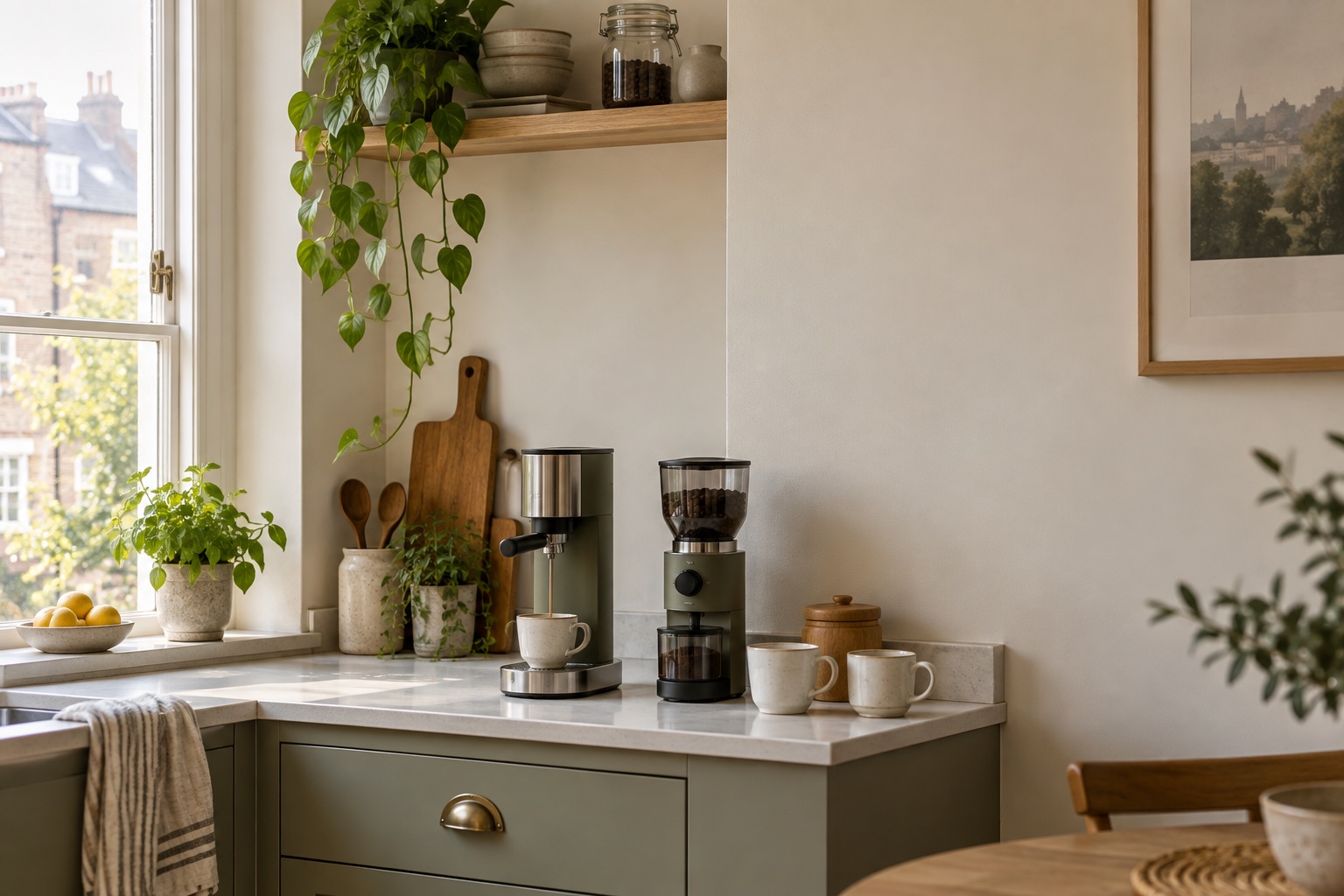
A narrow machine does not make a narrow complete espresso setup.
Leave space behind for the plug and in front for the portafilter and cup.
Make sure the water tank or bean hopper can actually be lifted.
Decide where beans, capsules, tools and cleaning supplies live.
The useful shortlist
Three space-saving routes, with one clear category boundary
The first two use ground coffee and a manual portafilter. The third uses Nespresso Original capsules and is included only as the smallest low-effort alternative—not as equivalent traditional espresso.
EC685.M
- 149 × 330 × 305mm
- 1.1L water tank
- EC685.M
Slim manual espresso choice
De’Longhi Dedica Style
Best for: a narrow worktop and someone willing to prepare and steam manually
At about 15cm wide, the Dedica makes manual espresso possible on a narrow counter. Its Thermoblock, programmable cup quantities and adjustable drip tray are useful; a separate grinder is still needed for fresh-ground coffee.
Why it earns a place
- About 15cm wide
- Manual steam wand
- Ground coffee or ESE pods
What to weigh up
- No built-in grinder
- Pressurised baskets limit fine espresso control out of the box
Skip it if You expect one-touch coffee or milk, or cannot spare space for a grinder.
Check the official specification →EC260.BK
- 205 × 343 × 285mm
- 1L water tank
- EC260.BK
Lowest-cost manual route
De’Longhi Stilosa
Best for: a first attempt at milk drinks without a large machine purchase
A simple dial-operated manual machine with a stainless-steel boiler, 1L tank and steam wand. The low entry price leaves more of the budget for an appropriate grinder, but the workflow is entirely hands-on.
Why it earns a place
- Low entry cost
- Manual milk frother
- Removable two-tier drip tray
What to weigh up
- Manual dial and simple controls
- No grinder or automatic milk routine
Skip it if You want automatic milk, a timer display or a machine that makes the drink without preparation.
Check the official specification →EN85.B
- 0.6L tank
- Espresso and lungo
- EN85.B
Smallest pod routine
Nespresso Essenza Mini by De’Longhi
Best for: one or two quick Original-capsule drinks without a grinder
A very compact Original-capsule machine with espresso and lungo buttons, a 0.6L tank and no grinder. It saves worktop space, but the capsule format makes every drink a consumable decision.
Why it earns a place
- Very narrow body
- Simple espresso and lungo buttons
- No separate grinder
What to weigh up
- Original capsules required
- Small water tank
- Milk needs a separate device
Skip it if You want to choose your own beans or avoid a capsule supply routine.
Check the official specification →| Model | Machine width | Coffee input | Extra worktop item | Trade-off |
|---|---|---|---|---|
| Dedica Style EC685.M | 149mm | Ground coffee / ESE pod | Grinder for whole beans | Narrow machine but hands-on prep |
| Stilosa EC260.BK | 205mm | Ground coffee | Grinder for whole beans | Basic controls and deeper body |
| Essenza Mini EN85.B | Check exact variant footprint | Original capsules | Capsule storage / optional frother | Capsule format |
Space-constrained shopping is often reduced to a width number. That is the least reliable way to plan a coffee station. The machine occupies a footprint; making a drink uses a workspace. You need room to remove a water tank, fill a grinder, lock a portafilter, wipe a steam wand and park a milk jug. A slim machine can still feel awkward under wall cupboards or beside a sink.
The models below give three different answers to that problem. For a full kitchen layout exercise, use our small-kitchen coffee setup guide. If you do not yet know whether you want manual or pod brewing, begin with which coffee machine should I buy?.
De’Longhi Dedica Style: narrowest manual route here
The EC685.M measures 149 × 330 × 305mm according to De’Longhi. Its height and depth matter almost as much as its slim face. The tank sits at the back, and the portafilter handle projects during use. Place a paper rectangle of the footprint on your actual counter, then open nearby drawers and cupboard doors before buying.
The Dedica includes a manual milk frother, programmable cup quantities and a removable lower drip-tray section to fit a taller cup. It accepts ground coffee and ESE paper pods. It does not include a grinder. If you plan to make fresh-ground espresso, add the grinder’s own footprint and a tamping area. A small hand grinder can be stored away, but hand-grinding fine espresso each morning is a real effort. The grinder shortlist makes that choice explicit.
Best for: one person making a short coffee or milk drink in a narrow permanent station. Less suitable for: several back-to-back drinks with no adjacent prep space.
De’Longhi Stilosa: lower price, wider body
At 205 × 343 × 285mm, the EC260.BK is wider and slightly deeper than the Dedica, although not exceptionally large. Its simpler dial and stainless-steel boiler can make sense if the budget is the tighter constraint and the counter can accept a further 56mm of machine width. That is not a minor difference on a cramped run, so measure it.
The Stilosa’s manual milk frother and two-tier tray provide the basics. It is not more convenient just because it is an entry machine. Ground-coffee preparation, tray emptying and cleaning remain. Its lower machine price could fund a grinder, but check the total layout before treating it as a space-saving bargain.
Best for: a compact-ish, lower-cost first manual machine. Less suitable for: a counter where every centimetre of width is already assigned.
Nespresso Essenza Mini: smallest routine, different coffee system
The EN85.B needs an Original-compatible capsule rather than a grinder, dosing cup and tamper. A 0.6L tank and used-capsule container keep the machine compact, while espresso and lungo buttons make operation simple. This is the route if the complete daily operation matters more than the manual espresso craft.
There is a catch: the appliance footprint moves some space into capsule storage, and milk drinks still need a separate frother or pan. Its ongoing cost depends on your chosen capsules and drink volume. We do not present it as a substitute for fresh-ground espresso when that is your actual goal. Compare the running-cost logic in pod versus bean-to-cup.
Best for: occasional short drinks and the smallest low-effort station. Less suitable for: people choosing specific whole beans and dialling in extraction.
What about the Sage Bambino?
Sage lists the Bambino BES450 at 30.2 × 15.4 × 34.2cm in the order width, depth and height shown on its UK page. That makes it a narrow manual machine with a different depth balance from the Dedica. Its fast ThermoJet heat-up and supplied single- and dual-wall baskets are attractive for an enthusiast’s small station. Yet it still needs a separate grinder and preparation space. We have kept it as an editorial comparator rather than a product card because an exact standard UK Amazon listing was not verified during this batch.
A five-minute countertop test
Measure the open counter width and depth. Mark each machine’s footprint with masking tape or paper; leave room behind for cable bend, and in front for cup and portafilter. Mark the grinder beside it, then put a real milk jug and scales where you would use them. Reach for the water tank as if the machine were under the cupboard. If the motion collides with a shelf, the published dimensions are not enough. Keep electrical equipment away from splashes and follow the manufacturer’s placement and ventilation requirements.
Frequently asked questions
Is a 15cm-wide espresso machine enough for a 15cm gap?
No. You need clearance for the machine, the moving portafilter handle, water filling, cleaning and safe cable routing. Treat the product width as a minimum footprint measurement, not an installation specification.
Is a small pod machine really espresso?
An Original capsule machine produces a short concentrated drink marketed as espresso. It is a different preparation and ingredient format from tamped fresh-ground manual espresso. Choose according to the cup and process you want, not just the word on the button.
Can I store the grinder in a cupboard?
Yes, if you are happy to lift it out and put it away each use, and if the grinder’s instructions allow that handling. A compact hand grinder is easier to store than a hopper-fed electric model; the effort trade-off matters for fine espresso.
Which measurements should I compare first?
Width, depth and height, then the usable clearance to fill the tank, operate controls and open adjacent doors. For a manual machine, include the grinder and tamping surface.
How we chose
We separated manual machines from the capsule alternative and compared dimensions and functions using De’Longhi’s Dedica, Stilosa, Essenza Mini support and Sage Bambino. Verify the exact model's specifications and clearances before purchase.