
Choosing a setup · Small kitchens
Coffee setup for small kitchens: fit the whole routine
Compare coffee-machine footprints and plan the full small-kitchen station, including grinder, storage, preparation and access clearances.
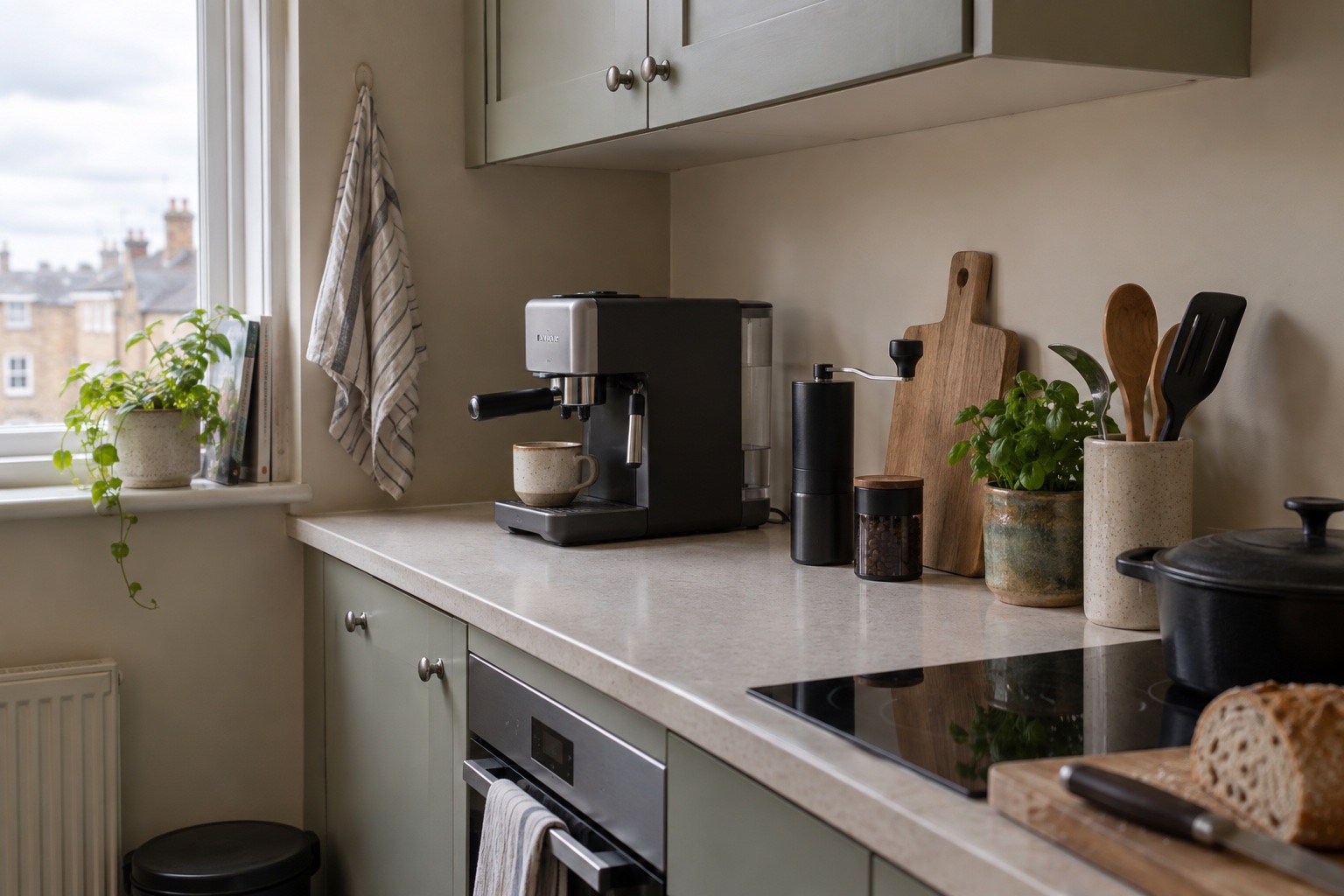
Make paper templates of each appliance footprint and place them on the real counter.
Allow vertical clearance for tank, hopper and filter-basket access.
Reserve safe prep and cleaning space, not only storage space.
Choose a routine you can still use when the kitchen is busy with food.
In a small kitchen, counter space is not an abstract dimension. It is the area used to chop vegetables, dry dishes, plug in a kettle and set down a hot pan. A coffee machine must fit alongside those tasks. Begin with a plan for making, cleaning and storing a drink—not a “compact” badge on a product page.
The paper-footprint test
Measure available width, depth and height to any wall cupboard. Cut paper to the published machine footprint, place it on the counter, then add a separate shape for a grinder if needed. Leave space for a mug, a portafilter handle, a milk jug and your hand. Simulate opening a tank lid, pulling a drip tray and moving the machine far enough to clean behind it.
Do this at the time of day you actually make coffee. If breakfast means the toaster and breakfast plates are on the same surface, include them. A station that fits only in an empty kitchen is not a working station. Follow each manufacturer’s ventilation, electrical and water-clearance instructions; do not treat our paper test as an installation manual.
Two machines with almost the same bare footprint
Published dimensions make a useful first comparison, but width × depth describes only the body on the counter. The table converts millimetres to square centimetres: multiply width by depth and divide by 100. It does not add a guessed safety clearance.
| Exact model | Published body size (W × D × H) | Bare counter area |
|---|---|---|
| De’Longhi Dedica Style EC685.M | 149 × 330 × 305mm | About 492cm² |
| Melitta Look V Timer 6766591 | 240 × 210 × 335mm | 504cm² |
The areas differ by only about 12cm², yet the Dedica body is 91mm narrower and 120mm deeper. A shallow counter may favour the Melitta's shape even though it is wider; a narrow gap may favour the Dedica only if its grinder and preparation space also fit. The Dedica figure omits the grinder, tamping patch, cup and access to tank and wand. The Melitta figure omits swing-filter movement, tank filling and carafe handling. Neither area tells you where the cable, hot parts or moving pieces can safely go. Draw those zones from the exact manual, then place the paper templates on your own worktop. For a closer look at espresso-machine fit, use the dimensions guide.
Route A: narrow manual espresso
The Dedica Style EC685.M is roughly 149mm wide, 330mm deep and 305mm high by De’Longhi’s specification. That slim width can free valuable counter run. But fresh-ground espresso adds a grinder and a place to dose and tamp. A hand grinder stored in a cupboard saves permanent footprint but adds physical effort, particularly at fine espresso settings. A compact electric grinder is faster but remains on the counter or must be lifted out.
Choose this route if you enjoy manual work and can create a small dedicated preparation patch. If your available counter is only large enough for the machine body, the purchase is not complete. The espresso machine and grinder budget also needs to be physically allocated.
Route B: pod machine with hidden storage
The Essenza Mini EN85.B needs no grinder, tamper or grounds bin. Its small 0.6L tank suits modest use but needs refilling more often in a busy house. Put the capsules in a nearby drawer or a modest container rather than adding a large display rack simply because one is sold with the machine. Make a plan for used capsules too.
Milk changes this layout. The Essenza Mini has no integrated frother, so regular lattes require a separate device and cleaning place. If you only drink black short coffee, the space saving is much stronger. Calculate pod running cost before choosing the format solely for size.
Route C: one bigger box instead of two smaller ones
A Magnifica Start ECAM220.61.GB includes grinder and automatic milk system. That can remove a separate grinder and associated dosing area. But the cabinet is deeper and wider, and you must reach the bean container, water tank, milk system, grounds bin and drip tray. It may fit a generous corner better than two manual components while being wrong under a low shelf.
This route works when the household values one-touch drinks and can dedicate a permanent footprint. Check the exact model’s dimensional drawing and required clearances at purchase. Do not infer them from a photo or from a different Magnifica suffix.
Route D: filter machine or put-away brewer
The Melitta Look V Timer is about 240mm wide and 210mm deep according to Melitta, but its swing filter and removable tank need operating room. It earns space when several people use the jug. If you make one cup, a cafetière, AeroPress-style brewer or dripper that can be put away may be a better space decision than a permanent electrical machine. Our brewing hub covers these methods.
Make storage earn its place
Keep only a sensible quantity of beans or capsules close to the station. Store spare filters and cleaning products away from heat and moisture, according to packaging. Give a cloth, scoop and used-grounds destination a defined home. Avoid piling accessories on top of a machine or blocking ventilation. A neat routine is more important than an Instagram-ready line of jars.
Common cramped-kitchen mistakes
Do not put a machine directly under a cupboard when the water tank or hopper cannot open. Do not block the only safe food-preparation area with a permanent coffee station. Do not route a cable over a sink or hob. Do not expect a 15cm-wide machine to require only 15cm of usable width. Do not buy a grinder after the machine and discover there is nowhere to use it.
Frequently asked questions
What is the smallest coffee machine setup?
For a short pod drink, an Essenza Mini plus capsule storage is small. For fresh-ground manual espresso, even a narrow machine needs a grinder and prep area. For one long coffee, a put-away manual brewer may occupy no permanent counter space.
Should I measure a machine’s depth or width first?
Both. Depth often fails under wall cupboards or on shallow counters, while width determines whether there is room to prepare coffee beside it. Measure height and access motions too.
Can I put a coffee machine in a cupboard?
Only if the manufacturer permits its location and the machine has safe ventilation, water and electrical access. Do not run a hot appliance in a closed or unsuitable cupboard. Check the exact manual rather than applying a blanket rule.
Is an all-in-one machine better for space?
Sometimes. It removes a separate grinder but may be a large cabinet needing top and front access. Draw both complete routines on the counter to see which fits.
Helpful products
Different ways to save space
A slim manual machine, a pod machine and an integrated-grinder automatic solve different constraints. None is automatically the smallest complete station.
EC685.M
- 149 × 330 × 305mm
- 1.1L water tank
- EC685.M
Slim manual espresso choice
De’Longhi Dedica Style
Best for: a narrow worktop and someone willing to prepare and steam manually
At about 15cm wide, the Dedica makes manual espresso possible on a narrow counter. Its Thermoblock, programmable cup quantities and adjustable drip tray are useful; a separate grinder is still needed for fresh-ground coffee.
Why it earns a place
- About 15cm wide
- Manual steam wand
- Ground coffee or ESE pods
What to weigh up
- No built-in grinder
- Pressurised baskets limit fine espresso control out of the box
Skip it if You expect one-touch coffee or milk, or cannot spare space for a grinder.
Check the official specification →EN85.B
- 0.6L tank
- Espresso and lungo
- EN85.B
Smallest pod routine
Nespresso Essenza Mini by De’Longhi
Best for: one or two quick Original-capsule drinks without a grinder
A very compact Original-capsule machine with espresso and lungo buttons, a 0.6L tank and no grinder. It saves worktop space, but the capsule format makes every drink a consumable decision.
Why it earns a place
- Very narrow body
- Simple espresso and lungo buttons
- No separate grinder
What to weigh up
- Original capsules required
- Small water tank
- Milk needs a separate device
Skip it if You want to choose your own beans or avoid a capsule supply routine.
Check the official specification →ECAM220.61.GB
- 250g bean container
- Four one-touch recipes
- ECAM220.61.GB
One-touch bean-to-cup
De’Longhi Magnifica Start
Best for: a household that wants fresh beans and automatic milk drinks
This exact Magnifica Start variant includes an integrated grinder and LatteCrema Hot automatic milk system, with one-touch espresso, coffee and latte macchiato. It removes daily puck preparation but adds milk-system cleaning.
Why it earns a place
- Integrated grinder
- Automatic milk drinks
- Removable cleaning components
What to weigh up
- Large counter footprint
- Milk system needs regular cleaning
- Less direct control than separate equipment
Skip it if You enjoy dialling in separate grinder and espresso settings, or have a very shallow counter.
Check the official specification →Sources and method
Dimensions and functions come from De’Longhi Dedica Style EC685.M, Melitta Look V Timer, De’Longhi Magnifica Start and Nespresso Original machine information. The two bare areas are calculated from published widths and depths, then rounded to the nearest square centimetre. Check the exact variant and its manual before planning access or ventilation.