
Buying guide · Coffee machines
Best coffee machines for UK homes
Compare four exact UK coffee-machine models by drink, full setup, body footprint and daily routine before choosing a system.
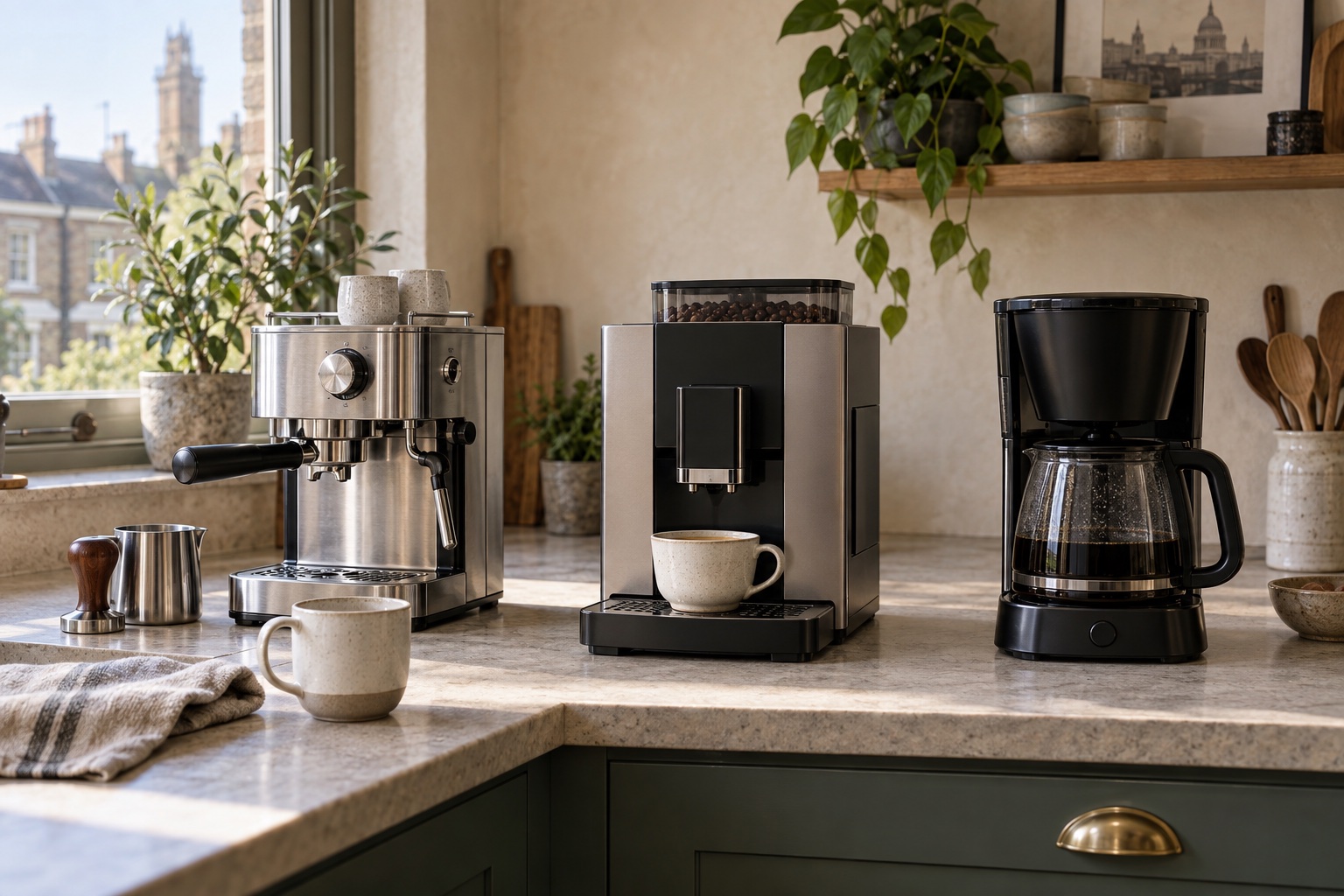
Espresso, long black coffee and several filter mugs point to different machines.
Decide whether grinding, tamping and steaming sound enjoyable or burdensome.
Measure depth, lid-opening height and the entire setup, not just machine width.
Include beans or capsules, filters, descaling and a grinder where needed.
The useful shortlist
Four genuinely different coffee-machine routes
Each card names an exact UK-listed model. The order is a route through the decision, not a taste-score ranking across incompatible brewing methods. The Magnifica Start is a conditional choice until its exact automatic-milk variant has a suitable offer.
EC685.M
- 149 × 330 × 305mm
- 1.1L water tank
- EC685.M
Slim manual espresso choice
De’Longhi Dedica Style
Best for: a narrow worktop and someone willing to prepare and steam manually
At about 15cm wide, the Dedica makes manual espresso possible on a narrow counter. Its Thermoblock, programmable cup quantities and adjustable drip tray are useful; a separate grinder is still needed for fresh-ground coffee.
Why it earns a place
- About 15cm wide
- Manual steam wand
- Ground coffee or ESE pods
What to weigh up
- No built-in grinder
- Pressurised baskets limit fine espresso control out of the box
Skip it if You expect one-touch coffee or milk, or cannot spare space for a grinder.
Check the official specification →ECAM220.61.GB
- 250g bean container
- Four one-touch recipes
- ECAM220.61.GB
One-touch bean-to-cup
De’Longhi Magnifica Start
Best for: a household that wants fresh beans and automatic milk drinks
This exact Magnifica Start variant includes an integrated grinder and LatteCrema Hot automatic milk system, with one-touch espresso, coffee and latte macchiato. It removes daily puck preparation but adds milk-system cleaning.
Why it earns a place
- Integrated grinder
- Automatic milk drinks
- Removable cleaning components
What to weigh up
- Large counter footprint
- Milk system needs regular cleaning
- Less direct control than separate equipment
Skip it if You enjoy dialling in separate grinder and espresso settings, or have a very shallow counter.
Check the official specification →EN85.B
- 0.6L tank
- Espresso and lungo
- EN85.B
Smallest pod routine
Nespresso Essenza Mini by De’Longhi
Best for: one or two quick Original-capsule drinks without a grinder
A very compact Original-capsule machine with espresso and lungo buttons, a 0.6L tank and no grinder. It saves worktop space, but the capsule format makes every drink a consumable decision.
Why it earns a place
- Very narrow body
- Simple espresso and lungo buttons
- No separate grinder
What to weigh up
- Original capsules required
- Small water tank
- Milk needs a separate device
Skip it if You want to choose your own beans or avoid a capsule supply routine.
Check the official specification →6766591 UK
- 1.25L tank
- 1×4 paper filters
- 6766591 UK
Best batch-filter routine
Melitta Look V Timer
Best for: households making several mugs of black filter coffee
A programmable glass-jug filter machine with a removable 1.25L tank, 1×4 filters and AromaSelector. It makes a batch with little active work but needs ground coffee and a separate grinder if you buy whole beans.
Why it earns a place
- Programmable start
- Removable water tank
- Up to ten maker-size cups
What to weigh up
- Not espresso
- Glass jug and hotplate require timely drinking
- Separate grinder for fresh beans
Skip it if You mainly drink espresso or make a single small cup each time.
Check the official specification →| Model | Coffee it makes | Daily work | Extra equipment | Main compromise |
|---|---|---|---|---|
| De’Longhi Dedica Style EC685.M | Manual espresso and steamed milk | Dose / tamp / brew / steam | Grinder and scales for whole beans | Learning curve |
| De’Longhi Magnifica Start ECAM220.61.GB | Espresso-style drinks and automatic milk | Fill / select / clean milk system | Beans and cleaning supplies | Space and price |
| Nespresso Essenza Mini EN85.B | Original-capsule espresso or lungo | Insert / brew / empty capsules | Capsules; separate milk frother if wanted | Consumable format |
| Melitta Look V Timer 6766591 | Several mugs of filter coffee | Fill / filter / brew | Paper filters and ground coffee | Not espresso |
The phrase “best coffee machine” hides four purchases. A manual espresso machine asks you to grind, prepare the basket and control milk. An automatic bean-to-cup machine combines grinder and brewer. A pod machine buys speed by using portioned capsules. A filter machine makes a pot, not a short espresso. Start with what you actually drink before comparing pump-pressure claims or touchscreens.
If you are still uncertain, use our which coffee machine should I buy? guide first. This shortlist is for a home choosing between the main routes; our beginner espresso, compact and under-£200 guides narrow the question further.
Four machines, four complete purchases
The maker dimensions below are body width × depth, converted to centimetres. They compare cabinets, not the safe amount of counter to reserve. The right-hand column is our synthesis of what the household must also buy or make room for if it wants the stated drink; it is not a bundle claim.
| Exact model and body (W × D) | Drink and input | What the complete route adds |
|---|---|---|
| Dedica Style EC685.M · 14.9 × 33cm | Manual espresso; ground coffee or ESE pods | For fresh beans, a separate espresso-capable grinder and preparation area; a scale helps control dose and yield |
| Magnifica Start ECAM220.61.GB · 24 × 44cm | Automatic espresso-style drinks; whole beans | No separate grinder, but bean storage, grounds-bin access and automatic-milk cleaning space |
| Essenza Mini EN85.B · 8.4 × 20.4cm | Original espresso/lungo capsules | Capsule storage and a separate frother if textured milk is the goal |
| Melitta Look V Timer 6766591 · 24 × 21cm | Batch filter; ground coffee and 1×4 paper | Paper supply, carafe handling and an optional filter grinder for whole beans |
This exposes why the smallest cabinet is not automatically the cheapest routine. The Essenza's body is narrow but every cup needs a capsule; the Dedica's body is narrow but a fresh-bean routine adds another appliance. Melitta's 1.25L figure is its water-tank volume, not a promise of five full 250ml finished mugs: grounds retain some brew water. Magnifica's 24 × 44cm cabinet is already much deeper than the Melitta's 24 × 21cm, before either is given working access. Draw the full route on your counter, then compare the actual prices of its machine, extras and consumables using our setup-cost worksheet or pod cost worksheet. The Magnifica model remains conditional on finding that exact automatic-milk suffix at a suitable offer.
De’Longhi Dedica Style: best compact manual espresso route
The EC685.M is about 149mm wide. That is unusually friendly to a narrow counter, but the work area must also accommodate a grinder, tamping and milk. De’Longhi specifies a Thermoblock heater, manual milk frother, two-tier drip tray and compatibility with ground coffee or ESE paper pods. The machine gives you an actual portafilter routine; it does not grind or dose for you.
Its supplied pressurised baskets make early shots more forgiving with less precise grinding. If the goal is to learn traditional single-wall espresso, check basket compatibility and budget for an espresso-capable grinder before buying accessories. Our espresso grinder shortlist explains why close adjustment matters. There is no point spending all the money on a machine and leaving no route to suitable grounds.
Buy for: a hands-on flat white or espresso habit in a limited space. Think twice if: several people expect a drink at one button press. See the dedicated beginner comparison.
De’Longhi Magnifica Start: one-touch fresh-bean route when available
This is specifically the ECAM220.61.GB: De’Longhi lists a built-in grinder, 250g bean container, LatteCrema Hot milk system and four one-touch recipes—espresso, coffee, latte macchiato and hot water. It makes the daily sequence shorter than a separate grinder and portafilter. It does not eliminate care: empty the grounds container, rinse removable parts, run the specified milk clean and descale when prompted.
Do not confuse this automatic-milk variant with Magnifica Start versions fitted with a traditional steam wand. The names and cabinets are similar, but the morning routine is not. Check the exact model suffix on the retailer page. Its broad cabinet also needs side and overhead room for water, beans and cleaning. Bean-to-cup versus manual espresso explores the control trade-off.
The ECAM220.61.GB product button opens an Amazon search for that model so you can compare current offers. Search results can include other Magnifica Start suffixes with different milk equipment; do not assume a similarly named result has LatteCrema Hot.
Buy for: shared households that want fresh whole beans without preparing a puck, if the exact variant has a suitable offer. Think twice if: you want direct control over dose, distribution and milk texture, or the available search results are different models.
Nespresso Essenza Mini: best pod choice for a tiny counter
The De’Longhi EN85.B is an Original-system capsule machine with espresso and lungo programmes and a small 0.6L water tank. It has no grinder, loose grounds or steam wand to accommodate. The trade-off is structural: each drink requires a compatible capsule, and milk drinks need a separate frother or manually heated milk. A lungo button is not the same as a full mug of brewed filter coffee.
Before choosing pods on machine price alone, estimate your household’s weekly drinks and the capsule price you would actually buy. A machine used twice daily consumes around 730 capsules over a year; the machine purchase is only the beginning of the cost. Consider storage and disposal as well. Read our pod versus bean-to-cup guide for a cost calculation rather than a vague “pods are expensive” claim.
Buy for: speed, minimal counter width and occasional short coffees. Think twice if: you want to choose fresh beans or make many drinks each day.
Melitta Look V Timer: best several-cups-at-once filter route
The Look V Timer is a filter machine with a removable 1.25L tank, 1×4 paper filters, programmable start and a glass jug. Melitta describes a maximum ten maker-size cups; that is not ten large British mugs. Its AromaSelector changes the brew path without requiring a different dose. A warm plate can hold the jug for a set period, though coffee is often most pleasant served soon after brewing.
This is the rational machine when the household drinks black coffee by the mug, particularly at breakfast. It uses pre-ground coffee or a separate filter-capable grinder. It cannot make concentrated espresso for a flat white. If you make only one small cup, a manual dripper may occupy less permanent space.
Buy for: several filter cups at a predictable time. Think twice if: your daily order is espresso or a single milk drink.
Which machine type should you choose?
Choose manual espresso when your favourite drink starts with a short concentrated shot and you welcome the ritual. Choose bean-to-cup when you want beans freshly ground but want the appliance to do the dosing and brewing. Choose Original pods when storage, speed and low daily volume dominate. Choose filter when a clean, longer coffee or a batch for several people is the target. Do not use “15 bar” versus “19 bar” marketing numbers to compare those types: capsule-system pump ratings and extraction at a manual espresso puck are not like-for-like measures of cup quality.
What to budget beyond the machine
A manual machine needs a suitable grinder if you use whole beans. Add scales, beans, a brush and milk jug before decorative accessories. A bean-to-cup machine incorporates the grinder but may require filters or branded cleaning supplies. A pod machine saves the grinder purchase yet commits the household to capsules. A filter machine needs paper filters and a grinder if freshness matters. See our machine-and-grinder budget split for example allocations.
Frequently asked questions
Is bean-to-cup better than manual espresso?
It is easier to repeat and share, not automatically better. Manual equipment offers more direct control when paired with a capable grinder and practised technique. The best choice is the routine that will actually happen every morning.
Do I need a grinder with a coffee machine?
For manual espresso with whole beans, yes. For the Magnifica Start, the grinder is built in. The Essenza Mini uses capsules. The Melitta accepts pre-ground coffee, although a separate grinder lets you buy whole beans and adjust the brew.
What is the best coffee machine for a small kitchen?
The narrowest machine is not always the smallest complete setup. An Essenza Mini needs capsule storage; a Dedica needs a grinder and preparation space; a bean-to-cup needs depth and lid clearance. Use the small-kitchen layout guide and measure the entire workflow.
Can one machine make espresso and filter coffee?
Some automatics offer a longer “coffee” recipe, but it is not the same extraction method as paper-filter coffee. Decide whether the distinction matters to you before expecting one appliance to replace two.
How we chose and verified
We compared distinct household jobs and maker dimensions for De’Longhi Dedica EC685.M, Magnifica Start ECAM220.61.GB, De’Longhi Essenza Mini EN85.B's manual and Melitta Look V Timer. Body figures exclude access and ventilation clearances; added equipment follows the stated brewing route, not a claim about box contents. Retail prices and stock change; check the exact variant and seller before purchasing.