
Grinder workflow
Single-dose vs hopper grinders: which routine suits you?
Single-dose and hopper coffee grinders compared for freshness, speed, retention, decaf switching, espresso dosing and shared kitchens.
A timer repeats motor run time, not necessarily the exact mass of ground coffee.
A grinder can accept one dose without being designed for very low retention.
Hopper beans are convenient but less protected than beans in a sealed opaque bag.
Shared households often benefit more from a clear routine than from theoretical flexibility.
Single dosing and hopper dosing describe how beans enter the grinder. They do not guarantee a particular burr, flavour or build quality. The best choice is the one that reduces waste and makes the household’s coffee repeatable.
If you change between regular and decaf, buy small bags or enjoy comparing coffees, single dosing is usually easier. If several people use one bag every morning, a hopper and timer can remove steps. A grinder that supports the chosen habit reliably is more valuable than a fashionable workflow nobody follows.
What is a single-dose grinder?
A single-dose grinder is designed to receive only the beans needed for the next brew. You weigh the input, add it to a small hopper or throat, grind and aim to collect nearly all of it. Purpose-built designs may use a steep feed path, short chute or bellows to reduce retained grounds.
Low retention is desirable because yesterday’s coffee should not appear in today’s dose, and changing setting should take effect quickly. But “zero retention” is an unrealistic absolute. Coffee can remain around burrs, threads and chutes, while static changes how much clings from one dose to the next.
Single dosing adds a scale action. It also lets the main coffee bag return to sealed storage immediately.
What is a hopper grinder?
A hopper grinder stores multiple doses above the burrs. The user controls output with a timer, dose programme, switch or—in more advanced models—a scale. It is fast and familiar: place the portafilter or bin, activate and brew.
Hoppers are well suited to one frequently used coffee. Gravity keeps beans feeding the burrs, and timed dosing can make the morning consistent after calibration. They are less convenient when changing coffee because beans remain above and inside the mechanism.
Clear hoppers also expose beans to light, air and kitchen heat more than a sealed opaque bag. That does not mean every hopper dose is stale; it means the household should fill an amount appropriate to how quickly it will be used.
Freshness: bag versus hopper
Roasted coffee changes after opening, and oxygen, heat and light accelerate flavour loss. Single dosing encourages users to keep most beans in their original resealable bag. A hopper encourages leaving some exposed in the grinder.
The practical difference depends on turnover. A busy household using the hopper contents quickly may value convenience more than a small freshness advantage. Filling a large 450g hopper for one daily espresso leaves beans there much longer.
Use the hopper as a working supply rather than compulsory storage: add only a day or two of coffee if that fits the routine, close the lid and keep the grinder away from direct sun or appliance heat.
Dose accuracy: weight, time and output
Single dosing starts with a known input mass. Output may be slightly different because of retention or exchange—old grounds emerge while new grounds remain. Weighing output occasionally reveals that behaviour.
A timed hopper grinder repeats motor duration. Output can change as beans, roast, grind setting and hopper pressure change. Calibrate the timer with scales after opening a new coffee, then check it periodically.
Grind-by-weight systems measure output directly but cost more and still require maintenance and calibration. Most homes can achieve a repeatable routine with a modest scale.
Retention and exchange
Retention is coffee left inside after grinding. Exchange is the older retained coffee displaced by a new dose. Both matter most when changing beans, switching decaf or moving settings.
Do not assume adding a small hopper or bellows turns any conventional grinder into a purpose-built single-dose model. A bellows can move grounds from the chute, but forceful use may spread dust and does not redesign internal spaces. Follow manufacturer guidance before fitting accessories.
When adjusting an espresso grinder finer, a small purge may be needed so the new setting reaches the basket. The maker’s manual is the right source for that procedure.
Which is better for espresso?
Both can work. A hopper grinder with timed direct-to-portafilter dosing is excellent for repeated milk drinks and shared mornings. The Sage Smart Grinder Pro illustrates that workflow. A single-dose design is better for people rotating coffee or logging exact inputs.
Adjustment matters independently. A low-retention grinder with broad steps is still difficult to dial in; a hopper grinder with close espresso control can produce repeatable shots. Start with our espresso grinder guide, then choose dose style among suitable models.
Which is better for filter coffee?
Single dosing is particularly natural for filter because recipes already use scales, and many brewers need one measured dose. The Wilfa Uniform’s automatic stop supports that routine. A hopper remains useful for an automatic filter machine used every morning, especially when the dose is large.
Manual grinders are inherently single-dose because the chamber is small. They are ideal for one cup and less practical for large batches; our manual grinder guide lists actual capacities.
Decaf and multiple coffees
Single dosing wins clearly when switching from regular to decaf. Weigh the new beans, adjust if needed and purge only what the grinder requires. With a full hopper, unused beans must be removed and the chamber cleared.
Some households solve this with two grinders: an electric hopper grinder for the main coffee and a compact hand grinder for decaf. That can be more convenient than forcing one large hopper grinder to change twice a day.
Noise, mess and speed
Hopper grinding removes weighing and filling for each drink, but may run longer if the timer is poorly set. Single-dose grinders can need a bellows or tap that adds noise and chaff. Static varies with humidity, coffee and materials in either design.
Watch the whole workflow: bag, scale, cup, chute, portafilter and cleanup. A ten-second grind can be part of a two-minute routine if coffee sprays across the counter.
A simple decision
Choose single dose if you change beans, use decaf, already weigh coffee, keep small bags or want the input recorded.
Choose a hopper if the household uses one coffee quickly, several people need simple controls, or timed direct-to-portafilter dosing removes meaningful friction.
Choose a flexible conventional grinder such as the Encore ESP if you are unsure. Feed one weighed dose when experimenting; use a modest working amount in the hopper when mornings are busy.
Frequently asked questions
Can I single-dose a hopper grinder?
Usually you can add one dose, but output and retention may be less predictable because the grinder was designed with bean weight above the burrs. Check the manual and weigh output.
Do beans go stale in a hopper overnight?
Freshness changes gradually rather than at midnight. A hopper exposes beans more than a sealed bag, so fill only what the household will use reasonably soon and avoid heat and sunlight.
Is a bellows necessary?
No. It is one method of moving retained grounds on compatible grinders. Use only a maker-approved or well-supported accessory and do not assume forceful air removes every retained particle.
Which workflow wastes less coffee?
Single dosing can reduce unwanted leftovers and bean switching waste. A well-calibrated hopper timer can also be efficient. Purging and changing settings often create more waste than the label itself.
Do I still need scales with a hopper grinder?
Scales are useful for calibration even if you do not use them every morning. They show whether a timed setting still produces the intended dose.
Helpful products
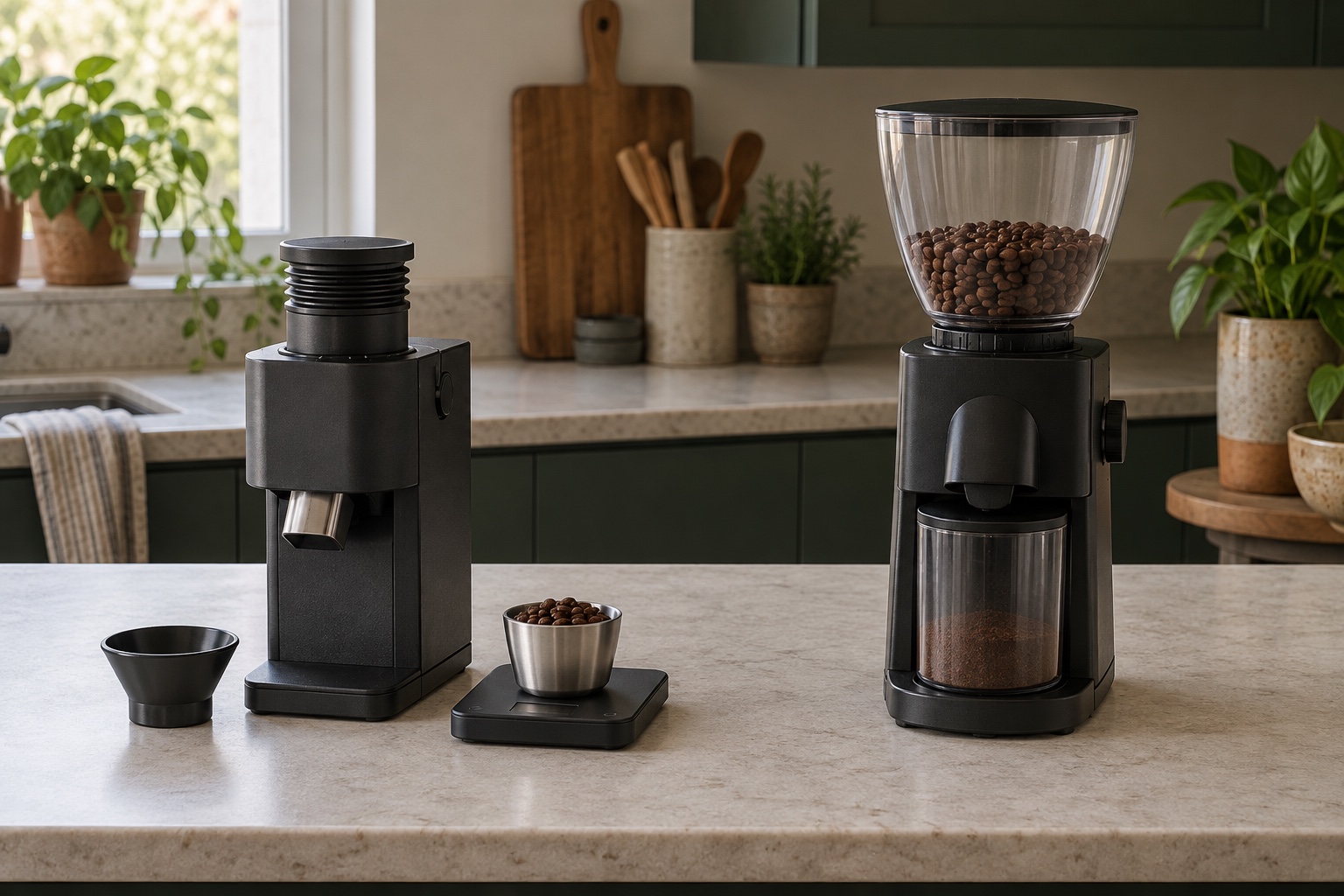
Three different dosing workflows
The Wilfa favours a weighed one-dose routine, the Sage centres timed hopper convenience, and the Encore ESP keeps the choice open.
WSFB-100S
- 41 settings
- 58mm flat burrs
- Model WSFB-100S
Best premium filter choice
Wilfa Uniform
Best for: people prioritising pour-over and filter clarity
The 58mm flat burrs, slow motor and automatic stop suit a measured filter routine, with a metal grounds container that avoids some of the static of lightweight plastic bins.
Why it earns a place
- 58mm flat burrs
- Automatic stop
- Five-year domestic warranty
What to weigh up
- Costs much more than entry filter grinders
- Espresso range is not the main reason to buy it
Skip it if Forgiving cafetière coffee is your daily drink; a sound entry grinder already does that job.
Check the official specification →BCG820BSSUK
- 60 settings
- 0.2-second dosing
- 450g hopper
Best for timed dosing
Sage Smart Grinder Pro
Best for: espresso drinkers who want repeatable timed doses
The screen, portafilter cradles and 0.2-second dosing adjustment make the daily workflow unusually clear, while 60 settings cover espresso through cafetière.
Why it earns a place
- Clear LCD dose display
- Direct-to-portafilter grinding
- Large 450g hopper
What to weigh up
- Takes more counter height
- Large hopper encourages beans to sit out
Skip it if You change beans often and prefer weighing one fresh dose before every brew.
Check the official specification →ZCG495 / 495W-230V-G
- 40 settings
- 40mm steel burrs
- 230V UK model
Best fit for most homes
Baratza Encore ESP
Best for: households switching between espresso and filter
Its adjustment range is deliberately divided between finer espresso settings and broader filter settings, so it is the most convincing one-grinder answer here for a mixed routine.
Why it earns a place
- Dedicated espresso and filter ranges
- Simple hopper adjustment
- Dosing cup included
What to weigh up
- Manual dosing rather than a timed display
- Plastic-led body
Skip it if Timed portafilter dosing is the feature that would make everybody else in the house use the setup.
Check the official specification →