
Grinder fundamentals
Burr vs blade coffee grinders: what actually changes?
Burr and blade coffee grinders compared by particle control, repeatability, price, cleaning and the brew methods each can realistically support.
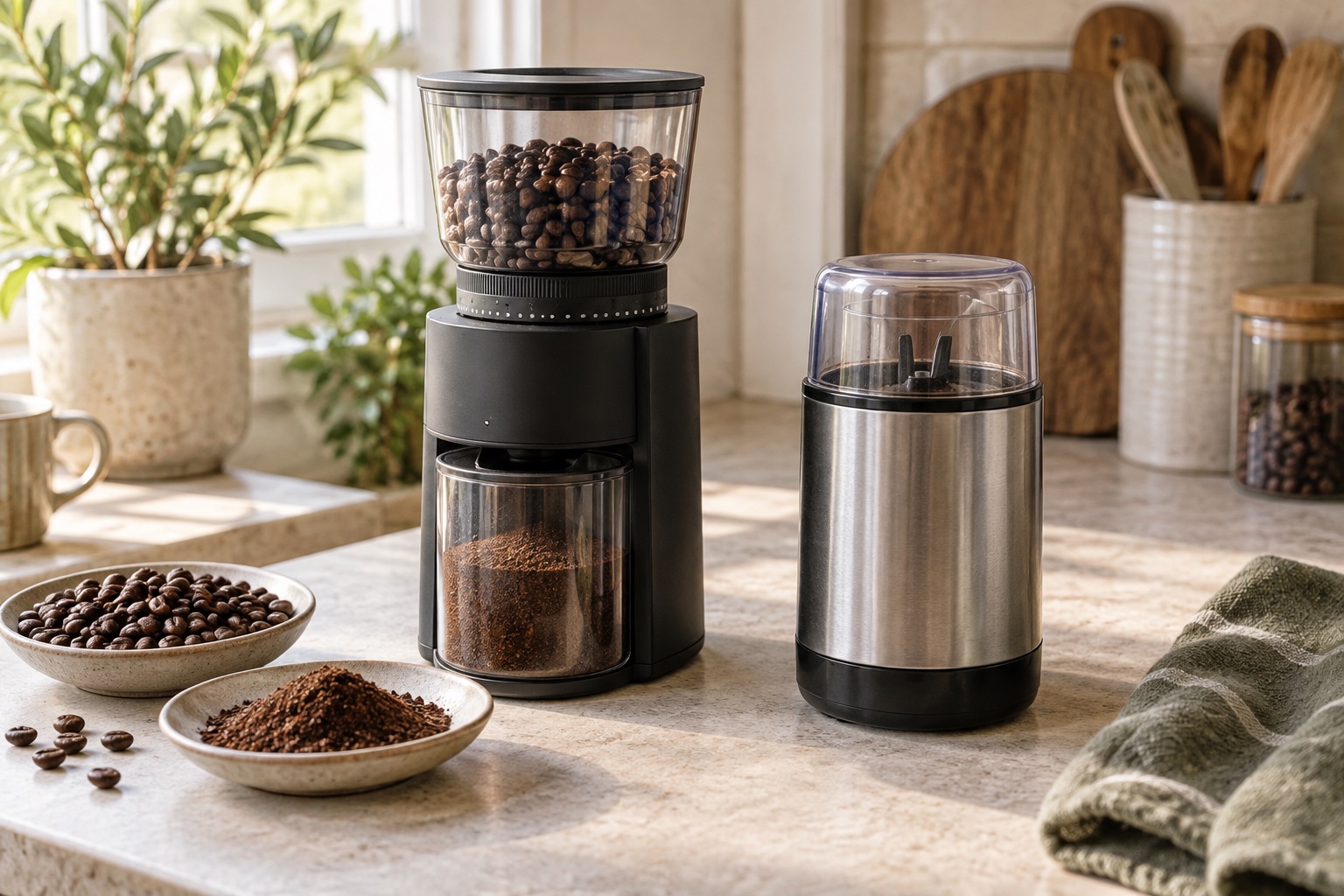
Burr grinders make grind size easier to control and repeat; they do not produce perfectly identical particles.
Blade grinders mix chopping time, shaking and fill level into one difficult-to-repeat control.
Burr material or shape alone is not a quality score; alignment, support and adjustment also matter.
For spices, check the maker's food-use instructions and avoid carrying strong aromas into coffee.
The difference between a burr and blade grinder is not that one makes perfect particles and the other makes chaos. Both create a spread of sizes. The useful difference is control. A burr grinder has a defined gap that can be moved and revisited; a blade grinder asks you to infer grind size from chopping time and appearance.
That makes a burr grinder the sensible default for home coffee. It helps you repeat yesterday’s recipe, diagnose a brew that ran too quickly and make a deliberate change. The case becomes stronger as the brewing method becomes less forgiving.
How a blade grinder works
A blade grinder uses a fast rotating blade in an open chamber. Beans hit the blade, break, circulate and hit it again. Holding the button longer generally makes the average particle smaller, but the same chamber contains dust, medium pieces and larger fragments at once.
Shaking or pulsing can redistribute the coffee and may reduce the most obvious unevenness. It does not create a fixed cutting gap. Fill level, pulse length and the way beans move all affect the result, so a ten-second grind is not a transferable setting in the way “position 18” can be.
This mechanism is inexpensive and compact. It can produce coffee usable in a forgiving cafetière or steep-and-release brewer, particularly if the alternative is stale pre-ground coffee. It is a weak choice for pour-over recipe development and an unsuitable foundation for non-pressurised espresso.
How a burr grinder works
A burr grinder feeds beans between two abrasive cutting surfaces. One burr is fixed relative to the other; adjustment changes the gap. The burrs may be conical or flat, steel or ceramic, and their geometry varies widely.
The output still contains a distribution of particle sizes. Coffee fractures rather than behaving like a precisely machined material. But a supported, aligned burr set produces a more controlled distribution and—crucially—lets the user return to a defined setting.
That repeatability gives recipes meaning. If a pour-over drains quickly, move one or two steps finer. If it stalls, move coarser. With a blade grinder, the correction might involve another second, a different shake and a different chamber fill, making cause and effect harder to separate.
Why particle size affects brewing
Smaller particles expose more surface area and create narrower pathways through a coffee bed. Water can extract material more quickly, while flow through espresso or filter coffee may slow. Larger particles expose less surface and leave wider pathways.
The relationship is not a simple rule that finer always tastes stronger. Excessively fine particles can slow flow, produce uneven pathways or over-extract parts of the bed while other areas remain under-extracted. The goal is a suitable distribution for the brewer and recipe.
Research on ground coffee and espresso supports the central point: particle-size distribution changes extraction and resistance. At home, a burr grinder gives you a usable control over that variable.
Which brew methods show the difference most?
Traditional espresso
Espresso is the clearest case for a capable burr grinder. A non-pressurised basket depends on the prepared coffee bed for resistance. Small setting changes alter shot flow; a blade grinder cannot make those changes predictably. Read our espresso grinder shortlist for appropriately close adjustment.
Pour-over and automatic filter
Filter brewing benefits from repeatability because grind affects both contact time and flow. A blade grinder may create enough fines to slow the bed while also leaving large pieces that extract less. A burr grinder does not remove every fine, but it gives the recipe a stable starting point.
AeroPress and immersion
Immersion methods are more forgiving because the full dose steeps rather than relying entirely on gravity through a bed. This is the strongest case for an existing blade grinder. Even here, burr grinding makes strength and flavour easier to repeat.
Cafetière
Cafetière coffee is often described as requiring a very coarse grind. Coarse is a sensible starting point, but brew time, agitation and the mesh also affect sediment. A blade grinder can make drinkable cafetière coffee; a burr grinder provides a cleaner learning loop.
Flat, conical, steel and ceramic burrs
These labels describe design choices, not a universal ranking.
Flat burrs use two facing rings or discs. Conical sets use an inner cone and outer ring. Either can be designed for different particle profiles, speeds and methods. Steel burrs can cut quickly and take complex geometries; ceramic burrs are inexpensive and corrosion-resistant. Neither material guarantees good alignment or adjustment.
Look at the complete grinder: how the shaft and burrs are supported, how settings change, whether the useful range suits the brew, how grounds leave the chamber and whether parts or documentation exist.
Is a cheap burr grinder always better than a blade grinder?
Usually for coffee, but not simply because it says “burr”. A poorly supported burr that wobbles at coarse settings can produce an uneven output. An anonymous electric grinder may disappear before replacement parts are needed. A basic manual burr grinder also becomes poor value if physical effort means it is never used.
Our under-£100 grinder guide separates affordable models by real job. For one cup, a manual burr grinder is often the strongest budget move. For a large filter batch, a modest electric burr grinder may be more sustainable as a routine.
Can a blade grinder overheat coffee?
Grinding converts energy into heat, and a small blade chamber can warm during long continuous runs. Heat is one reason users pulse rather than hold the motor continuously, but it is not the only or decisive objection. The larger problem is that blade duration remains an imprecise proxy for particle size.
Do not chase a dramatic temperature claim while ignoring repeatability. Follow the appliance’s duty cycle, avoid running it longer than instructed and let it cool if the manual requires.
Cleaning and cross-contamination
Coffee oils and fine dust collect in either mechanism. Unplug an electric grinder before cleaning. Do not immerse the motor body, and do not introduce water to burrs or internal metal parts unless the manufacturer explicitly instructs it.
Blade grinders are often sold for coffee and spices, but aromas can persist. If using one for both is permitted, clean exactly as directed and accept that strongly scented spices may affect the next coffee. A dedicated spice grinder is the clearer route.
Our coffee-grinder cleaning guide covers dry brushing, washable parts and when to stop dismantling.
Frequently asked questions
Does a burr grinder make coffee taste better?
It gives you better control over freshness and particle size, which makes balanced extraction easier to achieve. Taste still depends on coffee, water, recipe and technique.
Can I make espresso with a blade grinder?
Not reliably in a traditional non-pressurised basket. A pressurised basket may tolerate the output, but a proper espresso burr grinder is the more controllable route.
Are expensive burr grinders always more consistent?
No. Higher prices may buy stronger supports, larger burrs, lower noise, better dosing and serviceability, but model design matters more than price alone.
Is pre-ground coffee better than a blade grinder?
Freshness and grind suitability pull in opposite directions. Freshly opened coffee ground by a specialist roaster for your brewer may be more consistent than a blade grinder, while freshly blade-ground beans may retain more aroma. A basic burr grinder removes much of that compromise.
What should I buy first?
For filter coffee, start with our best filter grinders. For one-cup brewing and a tight budget, compare the manual choices in our hand-grinder guide.
Helpful products
Three practical ways into burr grinding
These cover a serviceable filter electric, a lower-cost electric disc grinder and a compact manual ceramic-burr option.
ZCG485 / 485-230V-G
- 40 settings
- 40mm steel burrs
- 300g hopper
Best simple filter grinder
Baratza Encore
Best for: filter, pour-over and cafetière without screen or dosing extras
A straightforward hopper grinder with 40 steps and strong UK parts support. It keeps controls simple and puts the budget into a well-established filter-brewing platform.
Why it earns a place
- Straightforward controls
- Replacement parts available
- Compact footprint
What to weigh up
- Not our pick for unpressurised espresso
- No timer or dose display
Skip it if You use a traditional non-pressurised espresso basket; move to the Encore ESP.
Check the official specification →1019-01
- 17 settings
- 200g hopper
- 2–14 cup selector
Low-cost electric choice
Melitta Molino
Best for: filter and cafetière drinkers who want electric convenience below £100
A simple electric disc grinder with 17 settings, a 200g hopper and a 2–14 cup selector. It is a convenience buy for filter and immersion, not our route into serious espresso.
Why it earns a place
- Low electric entry price
- 2–14 cup selector
- Removable burr and containers
What to weigh up
- Only 17 settings
- Not our recommendation for traditional espresso
Skip it if You use a non-pressurised espresso basket or want to weigh and switch beans for every brew.
Check the official specification →MSS-1DTB
- Ceramic burrs
- Up to two cups
- SKU MSS-1DTB
Best low-cost manual option
Hario Mini Mill PLUS
Best for: one or two filter cups, travel and quiet kitchens
This compact ceramic-burr hand grinder holds enough grounds for roughly two cups and dismantles easily, making it a sensible low-cost start for occasional manual brewing.
Why it earns a place
- Low entry cost
- Quiet and easy to pack
- Official UK stock and spares route
What to weigh up
- Manual effort
- Small 24g-style two-cup capacity
Skip it if You make several back-to-back cups, or limited grip makes hand grinding uncomfortable.
Check the official specification →