
Manual brewing · Method comparison
AeroPress vs cafetière: which should you make at home?
Compare AeroPress and cafetière coffee by cup texture, servings, filters, cleaning and daily work, with a clear choice for one person or a household.
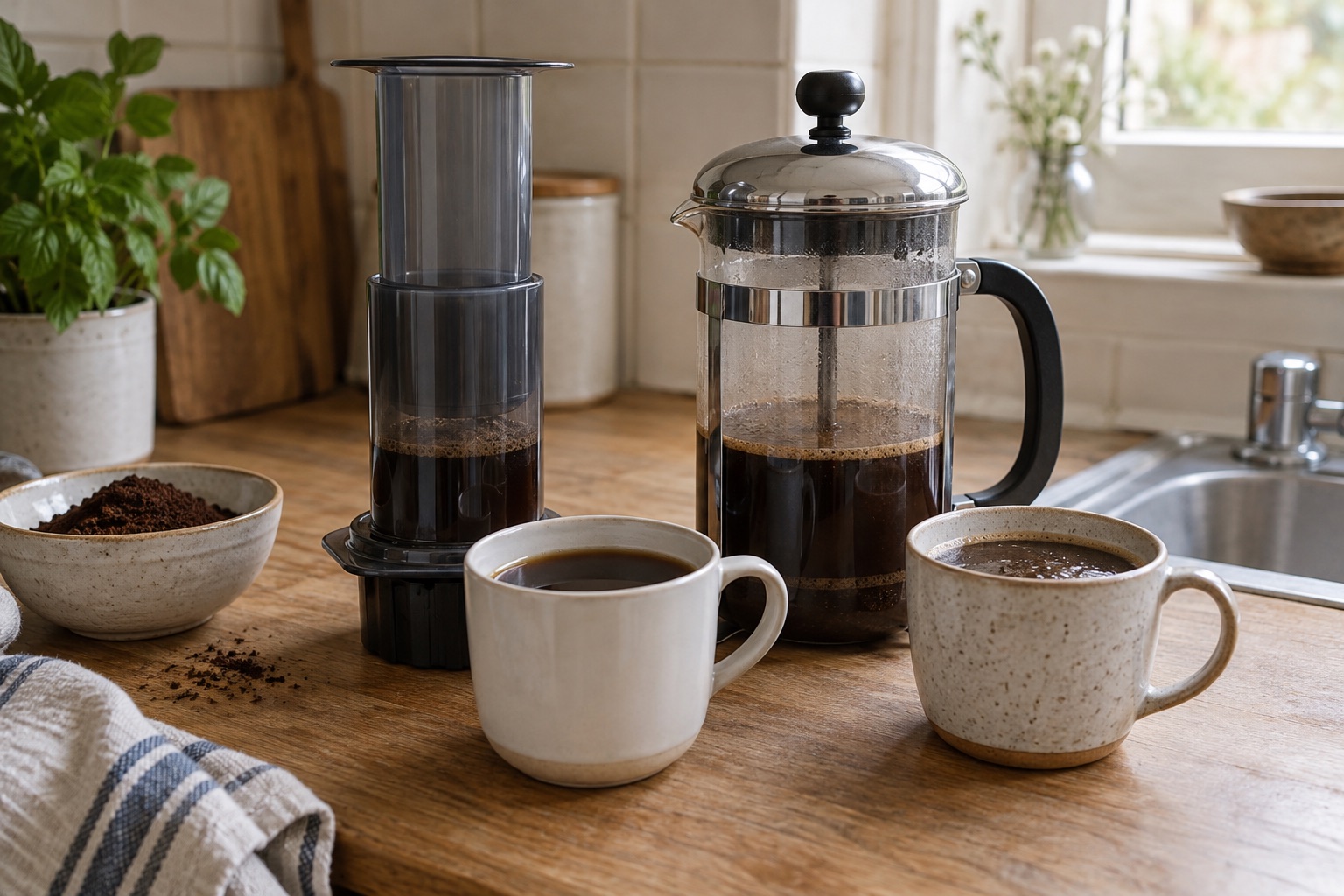
Filter choice changes the cup: paper is cleaner; metal allows more oils and fines.
A 1L press is not eight large mugs despite the maker's cup count.
Neither method makes traditional pump espresso.
Serve cafetière coffee after brewing rather than leaving it on the grounds.
Both brewers steep ground coffee in water. The important difference is what happens next. A cafetière uses a metal screen attached to a plunger to push most grounds to the bottom, then you pour from the pot. An AeroPress uses hand pressure to push liquid through a paper or metal disc into a mug. The coffee-to-water ratio can start similarly, but the cups are not identical because filtration and contact time differ.
What will the coffee taste and feel like?
With its usual paper disc, AeroPress tends to produce a cleaner cup with fewer fine particles. The official steel AeroPress disc lets more oils through and moves the texture toward the fuller end. A cafetière's reusable mesh naturally allows more oils and sometimes a little silt, particularly in the last pour. This is not a guarantee that one method has “more flavour”: beans, grind, dose and water matter, and people prefer different textures.
If you already dislike the sediment in a cafetière, buying a dearer glass press will not turn it into paper-filter coffee. If you find paper-filter brews too light, try a stronger ratio or a metal AeroPress filter before assuming the brewer is at fault. Our AeroPress accessory guide explains the filter swap.
One cup versus a breakfast table
An AeroPress Original or Go is designed around a compact chamber and one mug. You can brew concentrate and dilute it, but that is not the same as comfortably making two or three full cups at once. A 1L cafetière is a natural shared brewer. Bodum's eight-cup label means small portions; 1L of brew water is closer to three 300ml mugs after retention in the grounds. If two people want coffee together, the press lets you pour both cups at the same time.
For a single person, the 1L press may be oversized. You can buy a smaller cafetière, but remember to compare litres, not the word “cup”. A small pour-over brewer is a third route if clean filtration matters more than immersion.
Which morning routine is simpler?
An AeroPress asks you to fit a paper or metal disc, add coffee and water, steep, press, eject the puck and rinse. The process is compact and grounds disposal is tidy. The cafetière asks you to add coffee and water, wait, plunge and pour, then remove wet loose grounds from a larger vessel and wash the mesh assembly. It has fewer consumables but more wet-ground cleanup. Do not scrape grounds into a sink if your plumbing is prone to blockage.
Both methods need a kettle and a sensible grind. You do not need a gooseneck kettle for either: controlled circular pouring is far more important for open V60 pour-over. An AeroPress can leak before pressing with its ordinary cap; the optional Flow Control cap solves that specific nuisance, not an imagined quality defect in every brew.
Does either make espresso?
No. A short, concentrated AeroPress recipe can resemble espresso in serving size or be used in a milk drink, but it does not use a pump espresso machine's pressure and portafilter bed. A cafetière makes immersion coffee. If your favourite drink is a true espresso-based flat white, compare beginner espresso machines instead of expecting a manual brewer to duplicate one.
Cost, filters and breakage
The cafetière's mesh is reusable, but its glass beaker can break and may need a correctly sized replacement. Standard AeroPress paper filters are inexpensive per cup but recurring; an official reusable steel disc is an alternative. The plastic press body is small to store and less fragile than a glass pot. No universal cost winner follows: calculate equipment plus filters for how often you will brew, then choose the cup you actually enjoy.
Which should you choose?
Choose AeroPress if one person makes one cup, wants a compact travel-friendly brewer and appreciates quick grounds disposal. Choose a cafetière if you want several cups together, prefer a fuller-bodied brew and accept washing a larger glass-and-mesh assembly. If you are undecided, brew coffee you already like in each method before adding accessories. Our cafetière method gives a fair starting recipe.
Frequently asked questions
Is AeroPress coffee stronger than cafetière coffee?
Not by default. Strength depends on the ratio and whether an AeroPress concentrate is diluted. Compare the same coffee and water weights before judging the methods.
Which has less sediment?
An AeroPress with paper usually has less. A cafetière's mesh and an AeroPress metal disc both allow more fine material than paper.
Can I use the same grind for both?
You can begin near a medium grind, but each recipe may need adjustment. A cafetière is usually coarser; AeroPress methods vary widely. Use taste and flow rather than a fixed grinder-number chart.
Helpful products
A press and its simplest filter option
The Brazil illustrates the shared-pot route; genuine standard AeroPress paper filters illustrate the cleaner one-cup route.
1548-01, 1L black
- 1L
- Eight maker-size cups
- 1548-01
Lower-cost cafetière
Bodum Brazil
Best for: a practical larger press without a metal frame
A 1L borosilicate-glass press in a protective plastic frame with a reusable metal filter. It covers the same batch size as the Chambord with simpler styling.
Why it earns a place
- 1L capacity
- Reusable filter
- Protective frame
What to weigh up
- Glass still breakable
- Not insulated
- Sediment remains possible
Skip it if You want a paper-filtered low-sediment cup or an insulated vessel.
Check the official specification →Standard, 350
- 350 filters
- Standard size
- White paper
Reliable clean cup
AeroPress Paper Micro-Filters
Best for: replenishing standard AeroPress papers without changing the recipe
The official 350-count standard white paper discs are the simple replacement for a clean, low-sediment AeroPress cup. They are not XL filters.
Why it earns a place
- Familiar paper filtration
- Compact storage
- 350-count pack
What to weigh up
- Repeat purchase
- Not XL size
- Paper waste
Skip it if You own only an AeroPress XL or want a reusable metal filter.
Check the official specification →Sources and approach
We used AeroPress UK's filter explanation, its standard accessory fit and Bodum's 1L model records. The comparison focuses on household fit and daily workflow.