
Manual brewing · Practical method
How to make cafetière coffee that tastes balanced
A practical cafetière recipe with coffee and water weights, grind, timing, plunge and serving advice, plus fixes for weak, bitter or silty cups.
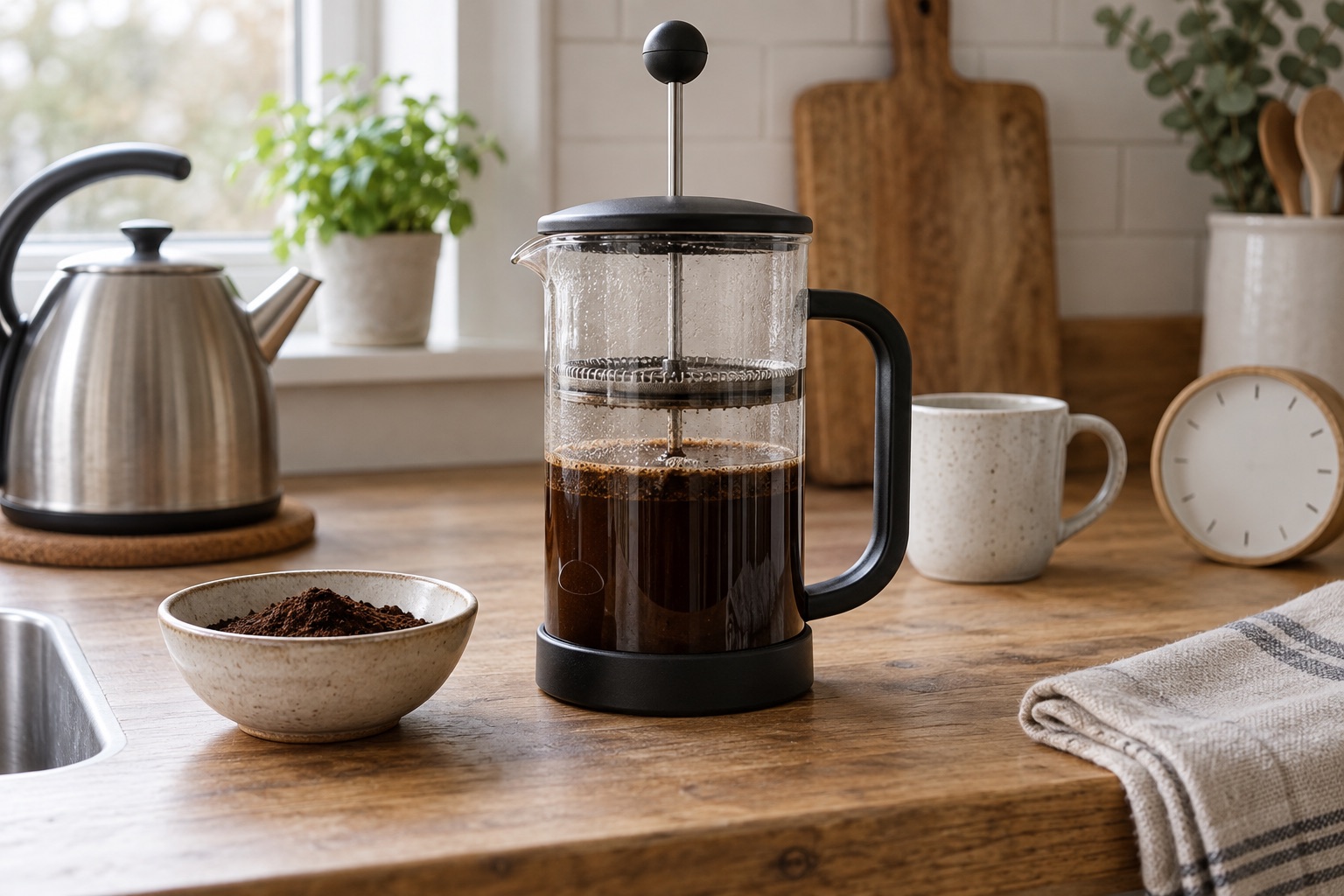
Use grams of brew water, not the manufacturer's vague cup markings.
Aim for an even medium-coarse grind; powdery fines bring more silt.
Plunge gently and stop if the screen meets unusual resistance.
Decant the coffee promptly so it does not keep steeping on the grounds.
A cafetière is a forgiving way to make several cups without a machine or paper filters. It is also easy to make muddy or harsh coffee if you grind very fine, stir aggressively or leave the finished drink sitting on the grounds. The method below gives a repeatable starting point, not a claim that one recipe suits every bean. For a different cup texture, compare AeroPress versus cafetière.
What you need
Use a clean 1L cafetière, 36g coffee, 600g fresh water, a kettle, scales and a timer. A spoon helps wet dry grounds. A burr grinder is useful but not compulsory: ask a roaster to grind for cafetière if you are beginning with pre-ground coffee. Use the grind-size guide to understand what “medium-coarse” means, then judge by how your own cup tastes. The 36:600 ratio is 1:16.7; our ratio table scales it to your pot.
Warm the pot briefly with hot water if the kitchen is cold, then empty it. Do not place a cold or damaged glass beaker on a hob, and follow the manufacturer's heat and cleaning guidance. Add the coffee to the empty pot. Heat fresh water and allow the rolling boil to settle. You do not need a special pouring kettle for immersion brewing.
A four-minute starting method
- Place the pot on scales and add 36g of coffee. Tare the scales.
- Pour 600g of hot water, wetting all visible grounds. Start the timer as the first water touches the coffee.
- If a dry raft remains, give one gentle stir to submerge it. Put the lid on with the plunger raised.
- At around four minutes, lower the plunger slowly and steadily. If it needs excessive force, stop; a very fine grind may be blocking the mesh.
- Pour into both mugs or a clean server immediately. Leave the last silty splash behind if you prefer a cleaner cup.
Some recipes add a long settling stage after the first steep, and some barely plunge at all. Those are useful variations, not prerequisites for a pleasant weekday brew. Make the straightforward version first and note what you would change.
How to adjust the next pot
If it tastes thin and weak, first confirm you did not under-dose or overfill the pot. Try 39g coffee for the same 600g water, or grind a little finer, but change only one thing. If it tastes harsh or dry, try a slightly coarser grind or shorten the steep. If it tastes sour and insubstantial, a finer grind or a little more contact time may help. Different coffees and roasts behave differently; no fixed “four clicks” applies across grinders.
If the cup is silty, a fine-heavy grind or rough pouring is often involved. Let the grounds settle briefly before pressing, press without a sudden shove and avoid pouring the bottom sludge. A clean mesh matters too. Even a careful cafetière is not as clear as paper-filter coffee; choose pour-over if that texture is what you want.
Make a single mug or a full pot
For one roughly 250ml brew-water portion, use about 15g coffee. For 1L water, use about 60g. The liquid served will be less because coffee grounds retain water. A very small recipe in a very large press can leave the plunger screen high above the bed; use a pot size that lets the press work sensibly. Do not confuse Bodum's “eight cups” for eight modern mugs: it describes 125ml maker portions in a 1L pot.
For two people, 600g is a useful middle ground. Serve together, or transfer the second portion to a clean insulated container rather than leaving it in the cafetière. For repeated family batches, a filter coffee machine may ask less work.
Cleaning without a sink full of grounds
Allow the pot to cool. Scoop or shake grounds into food waste where available, then rinse the beaker and plunger. Separate and wash the mesh components as directed by the maker so stale oils do not build up in hidden layers. Check that the plunger is reassembled in the correct order before the next brew. Do not force a tight filter through glass, and replace cracked beakers rather than using them with hot water.
Frequently asked questions
Should I stir cafetière coffee?
Only enough to wet dry grounds. Vigorous stirring can suspend more fine particles; a gentle stir is enough for this recipe.
Is boiling water too hot?
Use freshly heated water after the vigorous rolling boil settles. The coffee, air and vessel cool it quickly. The best point depends on the roast and recipe; make taste-led changes rather than following a universal temperature slogan.
Why is my cafetière hard to press?
Grounds may be too fine or trapped against the mesh. Stop rather than forcing the plunger and risking a spill or breakage. Try a coarser, more even grind next time.
Can I make cafetière coffee with pre-ground coffee?
Yes, if it is suitable for a press and used while fresh. A burr grinder gives more control, but it is not required to learn the basic method.
Helpful products
Cafetières sized for a shared brew
Both are 1L glass presses; the Brazil favours a simple frame, while the Chambord has a metal frame. The recipe works with either.
1548-01, 1L black
- 1L
- Eight maker-size cups
- 1548-01
Lower-cost cafetière
Bodum Brazil
Best for: a practical larger press without a metal frame
A 1L borosilicate-glass press in a protective plastic frame with a reusable metal filter. It covers the same batch size as the Chambord with simpler styling.
Why it earns a place
- 1L capacity
- Reusable filter
- Protective frame
What to weigh up
- Glass still breakable
- Not insulated
- Sediment remains possible
Skip it if You want a paper-filtered low-sediment cup or an insulated vessel.
Check the official specification →1928-16, 1L
- 1L
- Eight maker-size cups
- 1928-16
Classic cafetière
Bodum Chambord
Best for: a shared, full-bodied cafetière brew
A 1L glass-and-stainless French press with a reusable metal plunger. The maker's eight cups are small servings, not eight large mugs.
Why it earns a place
- Reusable filter
- 1L batch
- Replacement-part ecosystem
What to weigh up
- Glass can break
- More sediment than paper
- Coffee keeps extracting if left in pot
Skip it if You dislike sediment or need a shatter-resistant pot.
Check the official specification →Sources and method note
The 1L Bodum model capacity is documented in its Chambord catalogue record. The 60g/L recipe is an adaptable starting point close to Hario's 15g to 250ml filter example; immersion recipes can differ. Adjust the grind, time and dose to suit your coffee.