
Buying guide · Espresso grinders
Best espresso grinders for UK homes
The best home espresso grinders in the UK, compared for fine adjustment, dosing, workflow, noise and mixed-method use.
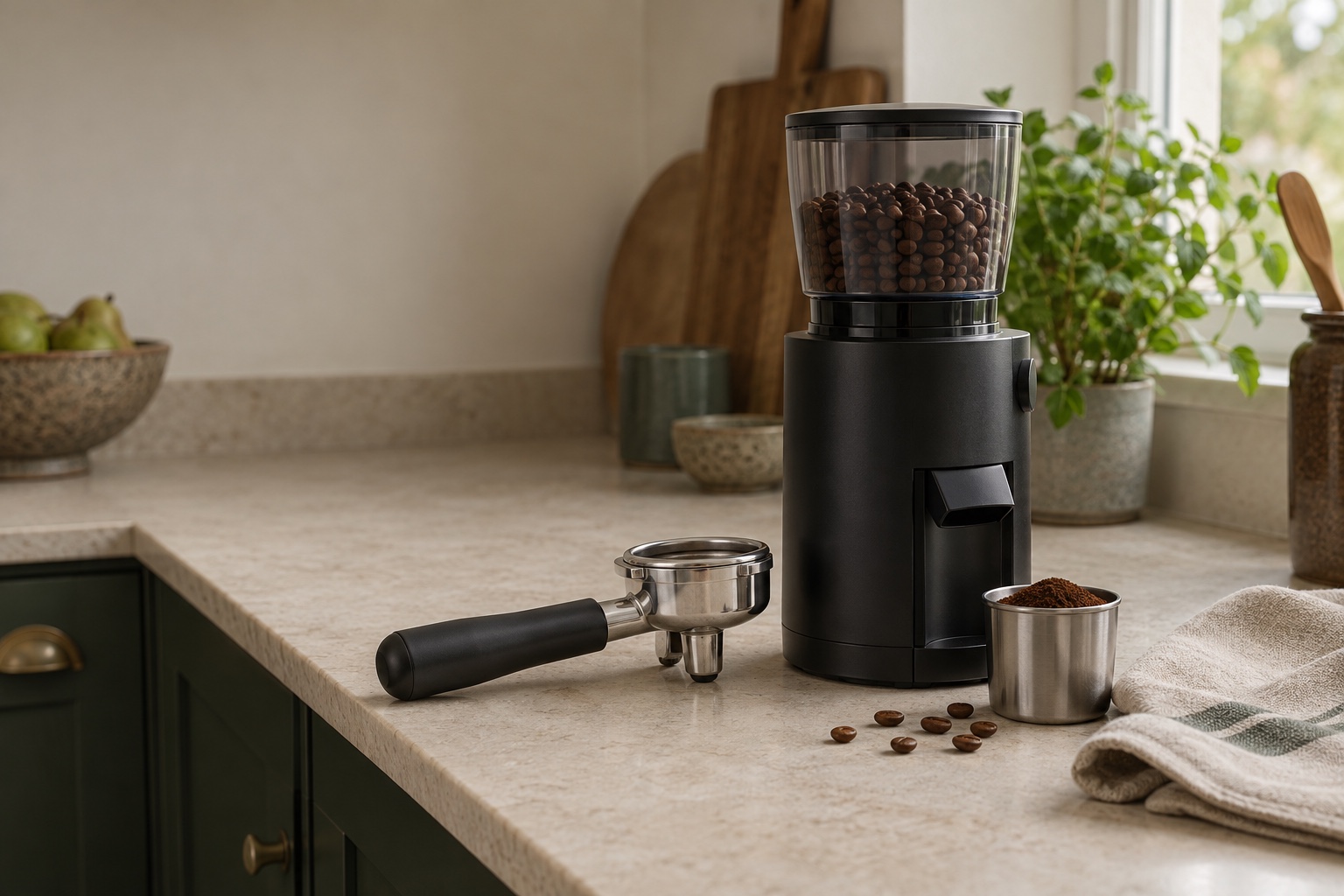
A non-pressurised basket exposes grinder limitations more clearly than a pressurised basket.
Small
Choose timed hopper convenience or weigh each dose before grinding.
Decide whether this grinder must also cover AeroPress
The useful shortlist
Four espresso grinders for four real routines
Each choice has a verified UK listing and a distinct reason to buy it. Recommendation order reflects household fit, not a claim that one burr set produces a universally better-tasting shot.
ZCG495 / 495W-230V-G
- 40 settings
- 40mm steel burrs
- 230V UK model
Best fit for most homes
Baratza Encore ESP
Best for: households switching between espresso and filter
Its adjustment range is deliberately divided between finer espresso settings and broader filter settings, so it is the most convincing one-grinder answer here for a mixed routine.
Why it earns a place
- Dedicated espresso and filter ranges
- Simple hopper adjustment
- Dosing cup included
What to weigh up
- Manual dosing rather than a timed display
- Plastic-led body
Skip it if Timed portafilter dosing is the feature that would make everybody else in the house use the setup.
Check the official specification →BCG820BSSUK
- 60 settings
- 0.2-second dosing
- 450g hopper
Best for timed dosing
Sage Smart Grinder Pro
Best for: espresso drinkers who want repeatable timed doses
The screen, portafilter cradles and 0.2-second dosing adjustment make the daily workflow unusually clear, while 60 settings cover espresso through cafetière.
Why it earns a place
- Clear LCD dose display
- Direct-to-portafilter grinding
- Large 450g hopper
What to weigh up
- Takes more counter height
- Large hopper encourages beans to sit out
Skip it if You change beans often and prefer weighing one fresh dose before every brew.
Check the official specification →Mignon Specialità 55
- 55mm flat burrs
- Stepless adjustment
- Timed touch dosing
Premium espresso workflow
Eureka Mignon Specialità
Best for: espresso drinkers who want stepless control and quiet timed dosing
A 55mm flat-burr espresso grinder with stepless adjustment, timed touch dosing and Eureka's quiet-drive system. It is the specialist choice here rather than the broadest all-rounder.
Why it earns a place
- Stepless micrometric adjustment
- 55mm flat burrs
- Programmable timed doses
What to weigh up
- Premium price
- Dial is optimised for small espresso changes rather than big brew-method jumps
Skip it if You routinely move between espresso and cafetière, or want the simplest possible return to an exact setting.
Check the official specification →K6 straight-handle
- 60 clicks per turn
- 16µm per click
- 25–35g capacity
Most versatile manual choice
KINGrinder K6
Best for: brewers who want one external-adjustment hand grinder for espresso and filter
External 16-micron adjustment, a large stainless-steel burr and a 25–35g capacity give it an unusually broad manual workflow without removing the catch cup to change settings.
Why it earns a place
- External numbered adjustment
- Fine 16-micron clicks
- Broad espresso-to-filter range
What to weigh up
- Manual espresso takes effort
- Heavier than compact travel grinders
Skip it if Hand grinding a fine espresso dose every day sounds like friction you will quickly resent.
Check the official specification →| Model | Best for | Adjustment | Dosing | Main compromise |
|---|---|---|---|---|
| Baratza Encore ESP | Espresso plus filter | 40 steps with a finer espresso zone | Dosing cup or grounds bin | No timer |
| Sage Smart Grinder Pro | Shared kitchens and repeatable mornings | 60 settings | Timed direct-to-portafilter dosing | Large hopper and footprint |
| Eureka Mignon Specialità | Dedicated premium espresso setup | Stepless micrometric dial | Programmable timed doses | Expensive and awkward for large setting changes |
| KINGrinder K6 | Maximum control below many electric prices | External 16-micron clicks | Weigh then hand-grind | Fine espresso takes effort |
An espresso machine can only work with the coffee it receives. If the grinder produces a dose with too many large particles, the shot can run quickly and taste thin; move too fine and resistance can rise until the flow stalls. The important feature is therefore not simply whether a box says “espresso”. It is whether the grinder lets you make small, repeatable changes around the setting your basket and coffee need.
For most UK homes starting with a traditional espresso machine, the Baratza Encore ESP is our first choice. It keeps the controls simple, gives the finer end of its dial more useful resolution and can still grind for AeroPress, pour-over and cafetière. It is a better first purchase than a filter grinder forced into its finest two settings.
The right alternative depends on the routine. Choose the Sage Smart Grinder Pro when a timer and portafilter cradle make espresso easier for several people. Move to the Eureka Mignon Specialità when espresso is firmly established and fine stepless adjustment, quieter operation and timed doses justify a much larger spend. Consider the KINGrinder K6 when budget matters more than motorised convenience.
What makes an espresso grinder different?
Espresso combines a fine grind, a compact bed of coffee and pressure. Small changes to the particle-size distribution alter resistance through that bed. Research on espresso extraction confirms that particle distribution affects puck permeability, flow and extraction; in a home kitchen, the practical result is familiar: a single grinder step can separate a fast, sharp shot from a much slower one.
That is why the useful question is not “How many settings does it have?” A grinder with 60 settings spread from espresso to cafetière may provide less control at the fine end than a 40-step design that deliberately compresses its espresso range. Stepless adjustment removes fixed clicks altogether, but the dial must still be easy to move and return to.
Consistency also matters, although no grinder produces identical particles. A broad mixture of dust and boulders makes extraction harder to control. Burr geometry, alignment and how firmly the mechanism is supported all influence the result; the outer material and screen tell only part of the story.
Match the grinder to your basket
A pressurised or dual-wall basket creates much of its own resistance through a restricted outlet. It is forgiving of pre-ground coffee and entry grinders. You still benefit from fresh grinding, but tiny adjustments are less critical.
A non-pressurised or single-wall basket relies on the prepared coffee bed. This is where an espresso-capable grinder becomes essential. If a machine ships with both styles, decide which one you intend to use before setting the grinder budget.
Pod and bean-to-cup machines are different cases. A pod machine does not need a grinder; a bean-to-cup machine already contains one. This guide is for semi-automatic, manual-lever and similar machines that take ground coffee in a portafilter.
Baratza Encore ESP: best espresso grinder for most homes
The Encore ESP divides its 40-position collar into two zones. Positions 1–20 use smaller changes for espresso; 21–40 move through broader filter settings. That structure is more important than the raw number. It acknowledges that a shot often needs a small correction while a cafetière setting can tolerate a larger jump.
There is no timed dose. You can weigh beans into the hopper and grind into the included dosing cup, or use the grounds bin for filter coffee. This encourages a simple single-dose routine and makes decaf changes manageable. The cost is one extra scale action each time.
It is our strongest all-round choice because it answers the difficult requirement—fine adjustment—without making occasional filter brewing awkward. Owners also have access to Baratza documentation and parts, which gives the product a clearer maintenance route than an anonymous marketplace grinder.
Choose it if: this will be the only grinder beside a manual espresso machine and you still brew filter coffee. Skip it if: the household wants push-button timed dosing more than method switching.
Sage Smart Grinder Pro: best timed espresso workflow
The Sage centres the morning around its LCD and timer. Grind time adjusts in 0.2-second increments, and the supplied cradles accommodate common portafilter sizes. Once a particular coffee is dialled in, the workflow is direct: insert portafilter, select dose and grind.
Its 60 settings extend from espresso to coarse brewing. The upper burr can also be repositioned to shift the overall range, although that is a setup change rather than a control to move daily. A 450g hopper suits a household using one coffee repeatedly, but beans left in a hopper are less protected than beans kept sealed in their bag.
Timed grinding is repeatable, not gravimetric. A timer controls how long the motor runs; it does not guarantee the same mass when bean density, roast or hopper level changes. Check the output with scales when changing coffee, then use the timer to simplify subsequent mornings.
Choose it if: several people value a visible dose and direct-to-portafilter routine. Skip it if: you change beans or decaf frequently and want a minimal single-dose path.
Eureka Mignon Specialità: the premium espresso specialist
The Mignon Specialità is the dedicated option. Eureka specifies 55mm flat burrs, stepless micrometric adjustment, timed touch controls and its noise-reduction system. The compact square body also takes less visual space than a tall appliance with a large control panel.
Stepless control lets you make very fine corrections without being trapped between clicks. The other side of that freedom is navigation: turning a small espresso dial through a large distance for cafetière and returning precisely is less convenient than using a clearly numbered all-purpose collar. We would buy the Specialità for a settled espresso station, not as the household’s most flexible brew-method switcher.
The price is substantial and Amazon listings can vary by colour, plug and seller. Check the exact UK model and return terms rather than treating every Mignon listing as equivalent.
Choose it if: espresso is already a lasting habit and quiet, stepless timed dosing improves it every day. Skip it if: you are still deciding whether manual espresso suits you.
KINGrinder K6: best manual espresso grinder for value
The K6 proves that espresso-capable adjustment does not require a motor. Its external dial provides 60 clicks per revolution at a published 16 microns per click, so changes are visible and repeatable. The 25–35g stated capacity covers common single and double espresso doses as well as one larger manual brew.
Hand grinding has two advantages at this price: more of the budget can go into the burr and support structure, and the grinder is quiet and easy to store. It also has a hard limit—your willingness to turn it. Dense, lightly roasted coffee at an espresso setting demands noticeable effort.
Choose it if: you make one or two shots, value control and do not mind the ritual. Skip it if: speed, limited grip or several back-to-back drinks make a motor worthwhile.
How much should an espresso grinder cost?
Below £100, a capable manual grinder is usually the safest way to obtain close adjustment. Entry electric grinders at that price often prioritise filter coffee or offer too few useful fine settings. Our coffee grinders under £100 guide explains the trade-off in more detail.
Around the lower hundreds, the Encore ESP and timed consumer grinders become realistic. Higher budgets buy workflow, build, lower noise, larger burrs and finer adjustment—not an automatic guarantee of a better shot. Read how much to spend on a coffee grinder before matching an expensive grinder to an entry pressurised basket.
Dialling in without wasting a bag
Start with the grinder maker’s suggested espresso region, not somebody else’s exact number: calibration, coffee and burr wear differ. Use the same dry dose, distribute consistently and change only the grind while you learn. If the shot runs much too quickly, go finer; if the machine barely produces liquid, go coarser.
Once close, make small changes and taste. Shot time is a diagnostic, not the goal. A recipe can land within a familiar time window and still taste hollow or harsh. Record the coffee, dose and setting so the next morning starts from evidence rather than memory.
When moving finer, run a very small amount of coffee through if the manufacturer recommends purging. Grounds retained in the chute can otherwise mix the old and new settings. See our coffee grind-size guide for a method-first starting map.
Hopper or single dose for espresso?
Hopper dosing is quick and suits one house coffee. Single dosing keeps each input deliberate, makes decaf changes easier and returns the main bag to sealed storage. Neither method improves burr geometry; it changes freshness, waste and convenience. Our single-dose versus hopper guide helps choose the routine before the machine.
Frequently asked questions
Can a normal coffee grinder grind for espresso?
Only if its fine range gives enough control for your basket. A general grinder may produce fine-looking coffee yet have such large steps that one setting runs fast and the next chokes the machine.
Is stepless always better than stepped?
No. Stepless adjustment gives maximum freedom, but numbered steps are easier to record and revisit. A well-spaced stepped espresso range is entirely workable at home.
Are flat burrs better than conical burrs for espresso?
Not automatically. Burr geometry, alignment, motor, speed and intended flavour profile interact. Buy the complete grinder for its adjustment and workflow rather than treating burr shape as a quality score.
Can I use one grinder for espresso and filter?
Yes. The Encore ESP is designed around that job. Expect a little purging and occasional re-dialling when moving far across the range; a specialist stepless espresso grinder is less convenient for frequent large changes.
What should I clean?
Brush loose grounds from the accessible burr area and chute according to the manual, and keep the motor body dry. Our coffee-grinder cleaning guide gives a safe routine.
How we chose
We matched four household jobs, checked exact current UK listings, and cross-referenced manufacturer specifications and support material. Stock and prices change; the retailer buttons show the current Amazon UK destination, while editorial conclusions are based on the named model and documented workflow.