
Running costs · Pod coffee
Coffee pod cost per cup: a UK buying worksheet
Calculate capsule coffee cost per finished drink and year, including double capsules, milk, machine price and comparison with beans.
[object Object]
[object Object]
Compare the equipment-price gap with the per-drink saving to find the break-even point.
Recalculate with current prices; subscriptions and offers can change.
“Pods cost 40p per cup” is not a reliable universal answer. Capsule systems have different pack prices, quantities and recipe structures, and a finished drink might use one or two capsules. Rather than freezing a headline price that soon becomes wrong, use a calculation you can repeat at checkout.
First, price the actual drink
Write down the capsule pack you would buy, its delivered price and the number of capsules in it. Divide price by quantity to get price per capsule. Multiply by capsules per finished drink. For illustration only, a hypothetical £4.50 pack of ten is 45p per capsule. A single-capsule drink would use 45p of pods; a two-capsule drink would use 90p. These are not claims about any current Nespresso or Dolce Gusto product.
Some Dolce Gusto milk recipes contain a coffee capsule and a milk capsule. A home-made flat white with an Original espresso might use one capsule plus your own fresh milk; a stronger drink might use two espresso capsules. A Vertuo mug capsule gives a larger cup but may have a different per-capsule price. Compare the finished drink you like, not simply capsule size.
Then calculate weekly and annual spend
Use drinks per day × 365 × capsules per drink. At two drinks a day, one capsule each means 730 capsules a year; two capsules each means 1,460. Multiply by the live price per capsule. Add the milk amount you actually use. If you buy a dedicated frother, allocate its purchase across your expected ownership years. Cleaning supplies, delivery and wasted or unused capsules belong in the real total too.
| Hypothetical scenario | Capsules per drink | Drinks per day | Capsules per year | Annual pod cost at a hypothetical 45p each |
|---|---|---|---|---|
| One short coffee daily | 1 | 1 | 365 | £164.25 |
| Two one-capsule drinks daily | 1 | 2 | 730 | £328.50 |
| Two double-capsule drinks daily | 2 | 2 | 1,460 | £657.00 |
The final column is an arithmetic demonstration, not a live price, forecast or purchasing recommendation. Replace 45p with your own pack calculation. If you drink coffee on weekdays only, use your actual annual drinking days rather than 365.
When does a dearer machine become cheaper overall?
A pod machine may cost less to buy while costing more per drink. To find the point where a more expensive alternative catches up, use extra equipment cost ÷ saving per finished drink = break-even drinks. Count the complete setup on each side, including any grinder or frother you would actually need. Work out each drink's capsule or bean cost first; if milk, delivery or routine care differ, include those differences in the per-drink figure or compare full yearly totals separately.
The table below is our sensitivity calculation, not a set of quoted shop prices. It assumes that one complete setup costs £200 more up front, both make the same number of drinks, and the dearer setup saves the stated amount on each finished drink. It excludes finance costs and equipment failures. Replace every input with prices and quantities relevant to you.
| Saving per finished drink | Drinks to recover £200 | At 1 drink/day · at 2 drinks/day |
|---|---|---|
| 10p | 2,000 | About 5.5 years · 2.7 years |
| 20p | 1,000 | About 2.7 years · 1.4 years |
| 40p | 500 | About 1.4 years · 0.7 years |
For example, £200 ÷ £0.20 = 1,000 drinks. At two drinks every day, that is roughly 1,000 ÷ 730 = 1.37 years. If the dearer setup does not actually save money per finished drink, it has no running-cost break-even point. If you drink coffee only on workdays, divide by your realistic annual drink count instead of 365 or 730. A machine reaching a calculated break-even point is not automatically the better choice: space, maintenance, waste and the daily routine still matter.
To repeat the analysis at checkout, record (1) the delivered cost of each complete setup, (2) the price and pack count of the capsule you would buy, (3) capsules used per finished drink, (4) bean bag price and grams per drink for the alternative, (5) any different milk or care cost, and (6) your actual annual number of drinks. The difference between setup costs is the numerator; the difference between recurring costs per finished drink is the denominator. Keep the date and links for the prices you used so you can revisit the decision when offers change.
Compare with beans fairly
Bean cost per drink is grams used ÷ 1,000 × price per kilogram. For a hypothetical 18g dose from £24/kg beans, coffee cost is 43.2p before milk and equipment. A bean-to-cup machine can dispense a different dose; measure or use the manufacturer’s setting data rather than assuming 18g for every machine. Add the larger machine purchase, descaling and cleaning, and compare over several years. Our pod versus bean-to-cup guide explores the workflow as well as cost.
The machine promotion trap
A discounted pod machine can still be an expensive ownership route for a high-volume household. Conversely, a person who drinks only occasionally may never recover the extra cost of an automatic bean machine. A subscription may lower capsule price but introduce order quantity and delivery conditions. Check the current terms and calculate using your expected use, not the subscription’s suggested consumption. Original versus Vertuo and best pod machines help choose a compatible format first.
Frequently asked questions
Is one capsule always one cup?
One capsule can make one machine recipe, but a finished drink may require two capsules, or a coffee and milk capsule. Count the drink you actually make.
Are pods cheaper than takeaway coffee?
Often a home drink can cost less than a café purchase, but a fair comparison includes milk, machine purchase, maintenance and the value of café service. No universal saving is guaranteed.
Do larger Vertuo capsules mean better value?
Not automatically. Compare the current capsule price and the cup you want, not millilitres alone.
Helpful products
Machines with different capsule economics
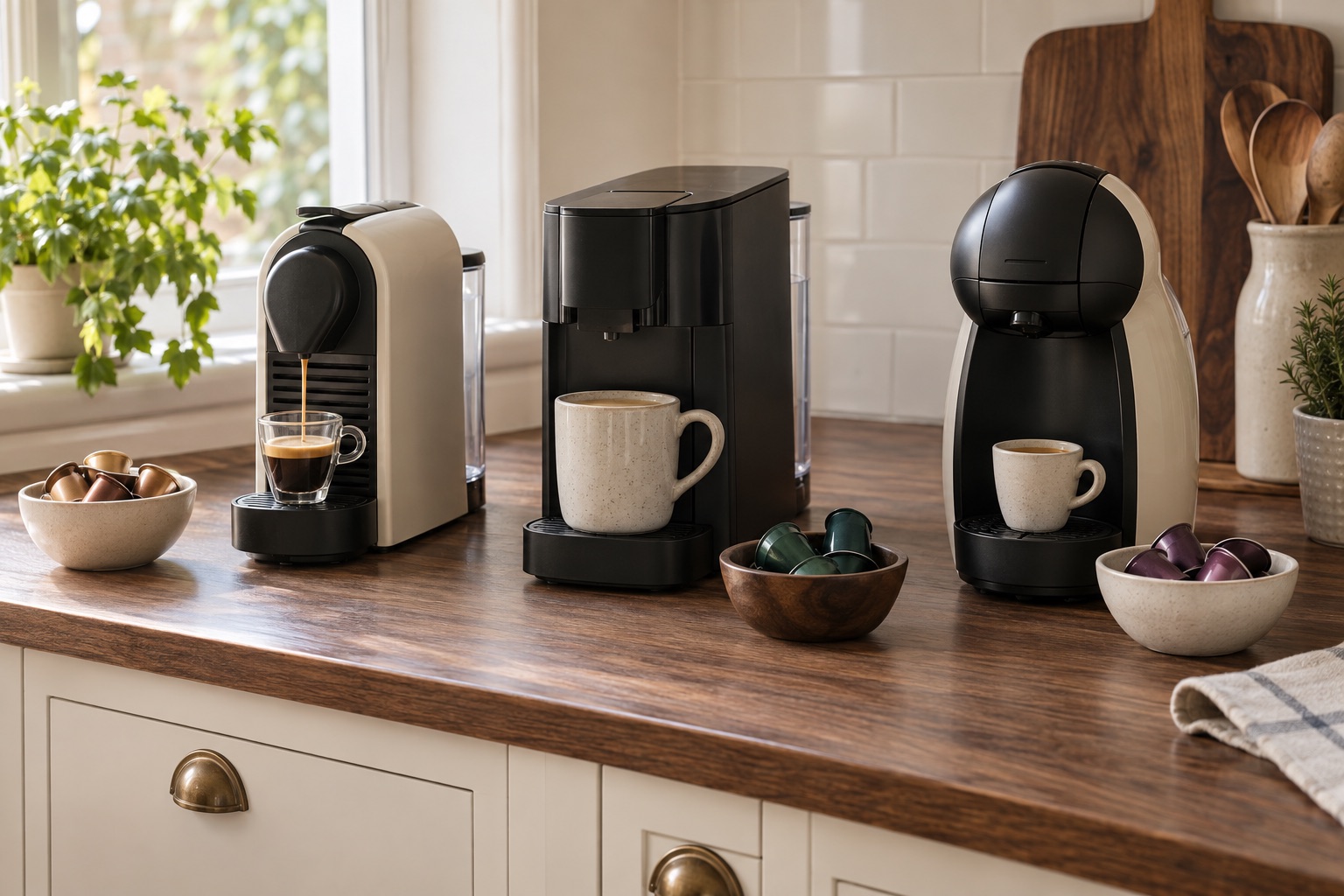
These use Original, Vertuo and Dolce Gusto respectively. Their capsules and recipes are not interchangeable.
EN85.B
- 0.6L tank
- Espresso and lungo
- EN85.B
Smallest pod routine
Nespresso Essenza Mini by De’Longhi
Best for: one or two quick Original-capsule drinks without a grinder
A very compact Original-capsule machine with espresso and lungo buttons, a 0.6L tank and no grinder. It saves worktop space, but the capsule format makes every drink a consumable decision.
Why it earns a place
- Very narrow body
- Simple espresso and lungo buttons
- No separate grinder
What to weigh up
- Original capsules required
- Small water tank
- Milk needs a separate device
Skip it if You want to choose your own beans or avoid a capsule supply routine.
Check the official specification →ENV90.B
- ENV90.B
- 560ml tank
- Six cup sizes
Larger pod coffees
Nespresso Vertuo Pop by De’Longhi
Best for: capsule drinkers wanting espresso and larger mugs
A compact Vertuo machine with six supported cup sizes and a 560ml tank. Uses Vertuo, not Original, capsules.
Why it earns a place
- Six cup sizes
- Compact
- One-button brewing
What to weigh up
- Vertuo-only capsules
- No milk wand
- Small tank
Skip it if You own Original capsules or want their third-party options.
Check the official specification →EDG210.B by De’Longhi
- EDG210.B
- Dolce Gusto capsules
- 0.8L tank
Multi-drink capsules
NESCAFÉ Dolce Gusto Piccolo XS
Best for: households interested in the Dolce Gusto drink range
A compact manual-lever Dolce Gusto machine. Some milk recipes use two capsules, changing the cost per drink.
Why it earns a place
- Compact
- Broad drink menu
- Simple lever
What to weigh up
- Separate capsule format
- Some two-capsule recipes
- Manual stop
Skip it if You want Nespresso capsules or fresh steamed milk.
Check the official specification →Sources and method
System and capsule-format distinctions follow Nespresso UK’s system comparison and NESCAFÉ Dolce Gusto’s range. The cost and break-even tables use hypothetical inputs; dividing the £200 equipment gap by 10p, 20p or 40p gives the drink counts, and dividing those by 365 or 730 gives the rounded years.