
Choosing a setup · Pods or beans
Pod vs bean-to-cup coffee machine: which costs less to live with?
Compare pod and bean-to-cup coffee machines by upfront price, per-drink spending, speed, waste, milk, cleaning and kitchen space.
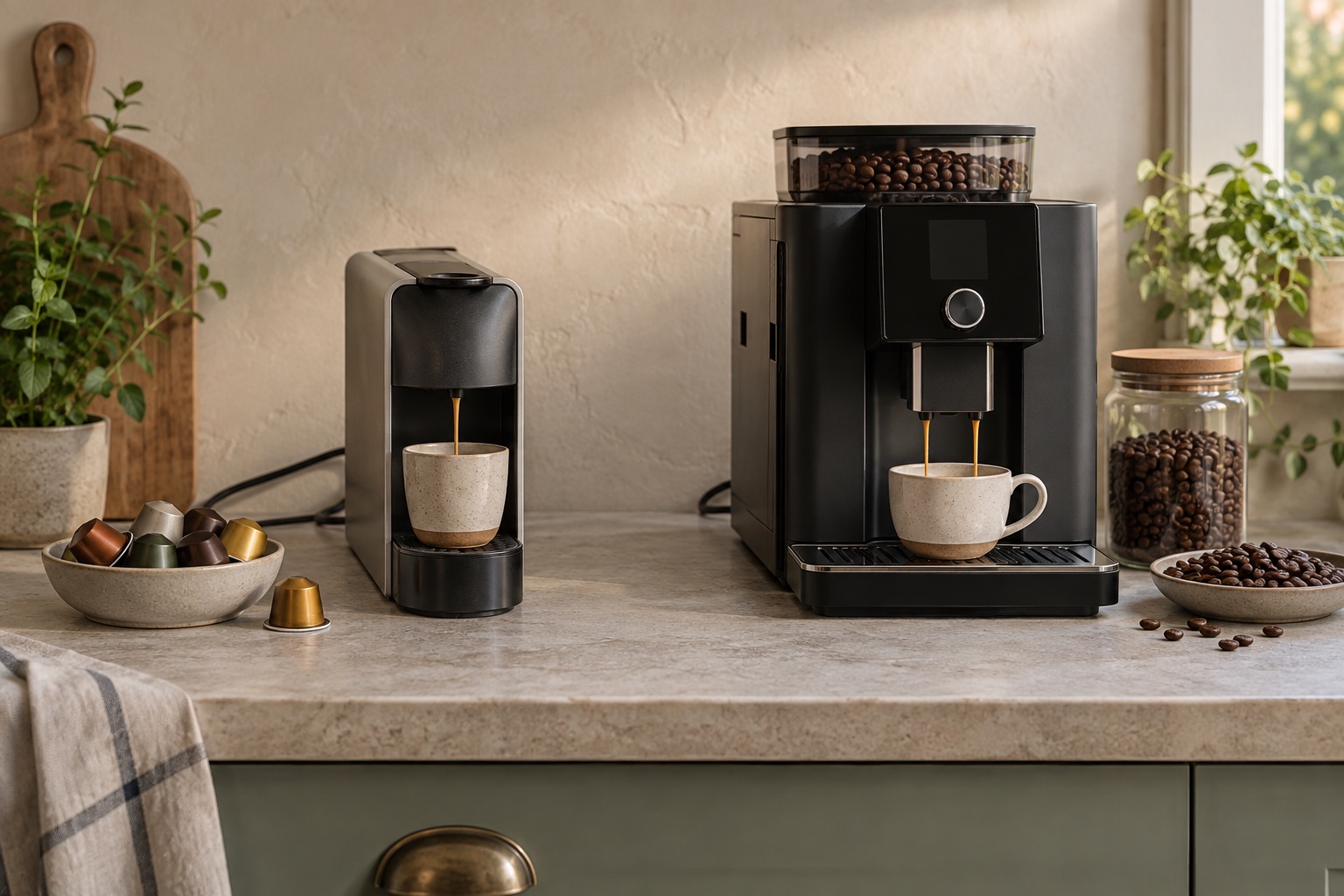
Compare the exact capsule system; Nespresso Original and Vertuo are not the same format.
Multiply your household's actual drinks per day by 365 before comparing consumables.
Milk adds equipment or cleaning in both systems.
A machine footprint excludes capsule storage, bean bags and water-tank clearance.
Pod versus bean-to-cup is not a simple quality ladder. It is a trade between a small machine with a portioned supply chain and a larger machine with a built-in grinder. A person who drinks one short coffee most days may rationally value the pod machine’s convenience. A busy household can make the cost of hundreds of capsules more significant than the initial machine saving. The answer changes with use.
This comparison uses the Nespresso Essenza Mini EN85.B and the De’Longhi Magnifica Start ECAM220.61.GB as concrete examples. It does not claim every pod or automatic model has identical features.
Upfront spend
The pod machine usually asks for a smaller initial appliance purchase; the automatic bean-to-cup combines brewer and grinder in a more substantial machine. Compare live prices for the exact variants rather than relying on an old snapshot. The Magnifica Start ECAM220.61.GB product button opens a model search so you can check current offers. Check the suffix and milk system in each result. The Essenza Mini does not require a grinder, tamper or scales; the bean-to-cup includes its grinder.
Do not compare a basic pod machine with an automatic bean-to-cup and ignore milk. The Essenza Mini has no built-in milk system; a frother is extra if milk drinks matter. The ECAM220.61.GB has LatteCrema Hot, while a different Magnifica Start suffix may have a manual wand. Check the exact variant and included equipment.
Calculate your own annual coffee cost
Use four inputs you can verify at checkout: drinks per day, capsules per drink, price per capsule, and—for beans—grams used per drink and price per kilogram. For pods, annual spend equals drinks per day × capsules per drink × 365 × capsule price. For beans, annual bean spend equals drinks per day × 365 × grams per drink ÷ 1,000 × price per kilogram. Add filters, descaler, milk and wasted coffee where relevant.
For illustration only, two drinks per day means 730 drinks a year. At one capsule per drink, that is 730 capsules. A bean machine using 10g per drink would use about 7.3kg of beans. Substitute the doses and prices you actually buy; a double-shot milk drink or two-capsule drink changes the comparison sharply. These are arithmetic examples, not claims about what the named machines must dispense.
To compare total cost over three years, add machine purchase and any milk accessory to three years of consumables and expected cleaning supplies. If your household drinks rarely, the bigger machine may never recoup its purchase premium. If several people drink daily, the running-cost difference can matter sooner. Remember that a machine can fail or need service; no model has guaranteed life in a simple break-even spreadsheet.
Coffee choice and consistency
Original capsules offer a repeatable portion and little mess. You choose among compatible capsules rather than buying any whole bean and setting the machine’s grinder. The bean-to-cup uses beans you select, then grinds immediately before brewing. You may adjust strength, grind and volume within the machine’s controls, but not perform the same direct puck work as manual espresso.
If you care about trying local roasters, decaf changes and fresh whole beans, bean-to-cup gives more freedom. If your priority is a predictable short coffee with minimum decisions, pods may be a feature, not a compromise. Neither guarantees a cup you personally prefer without tasting.
Speed and cleaning
Pods minimise the steps: fill water, insert capsule, press, empty the used-capsule container and descale as instructed. An automatic bean machine adds hopper filling, grounds-bin emptying, brew-component care and, for automatic milk, a clean cycle and carafe care. It may still deliver the drink with one button, but the maintenance is more involved.
If you make several cups in a row, the difference in active preparation per drink may narrow. A pod machine needs a fresh capsule each time and a small tank may need refilling. Compare the full morning rather than only the button press.
Waste and recycling
Pods involve packaging per portion. Some capsules and local schemes can be recycled, but actual recycling depends on the material, scheme and whether you use it. Bean-to-cup produces spent grounds and a bean bag rather than a capsule for each drink. Do not assume “recyclable” means collected from your home; check the current scheme for the exact capsule you buy. Both machines consume water, electricity and cleaning supplies.
Counter space and ownership
The Essenza Mini is the smaller appliance, but keep capsules and an optional frother somewhere. The Magnifica Start is a larger cabinet that needs access for beans, tank, drip tray and milk system. In a small kitchen, try our paper-footprint test before buying. For a broader type comparison, see best coffee machines UK.
Frequently asked questions
Are Nespresso Original and Vertuo capsules interchangeable?
No. The Essenza Mini EN85.B uses Original capsules. Check the exact system printed on a machine and capsule pack. This page does not treat all pod systems as one interchangeable market.
Is bean-to-cup always cheaper per cup?
No. Compare the bean dose, bean price and machine premium with the capsules you would actually buy. A low-volume user may spend less overall on a pod machine even if each capsule costs more than a dose of beans.
Which is better for milk drinks?
The named Magnifica Start variant prepares automatic milk drinks. The Essenza Mini needs separate milk equipment. A different pod machine may include milk features, so compare exact models.
Is pod coffee the same as espresso?
An Original machine makes a short concentrated capsule drink. It is not the same process as a freshly ground portafilter espresso or a bean-to-cup extraction. Choose by preference and convenience, not by a single shared label.
Helpful products
Exact examples of each system
The Essenza Mini uses Original capsules; this Magnifica Start variant grinds beans and prepares automatic milk drinks.
EN85.B
- 0.6L tank
- Espresso and lungo
- EN85.B
Smallest pod routine
Nespresso Essenza Mini by De’Longhi
Best for: one or two quick Original-capsule drinks without a grinder
A very compact Original-capsule machine with espresso and lungo buttons, a 0.6L tank and no grinder. It saves worktop space, but the capsule format makes every drink a consumable decision.
Why it earns a place
- Very narrow body
- Simple espresso and lungo buttons
- No separate grinder
What to weigh up
- Original capsules required
- Small water tank
- Milk needs a separate device
Skip it if You want to choose your own beans or avoid a capsule supply routine.
Check the official specification →ECAM220.61.GB
- 250g bean container
- Four one-touch recipes
- ECAM220.61.GB
One-touch bean-to-cup
De’Longhi Magnifica Start
Best for: a household that wants fresh beans and automatic milk drinks
This exact Magnifica Start variant includes an integrated grinder and LatteCrema Hot automatic milk system, with one-touch espresso, coffee and latte macchiato. It removes daily puck preparation but adds milk-system cleaning.
Why it earns a place
- Integrated grinder
- Automatic milk drinks
- Removable cleaning components
What to weigh up
- Large counter footprint
- Milk system needs regular cleaning
- Less direct control than separate equipment
Skip it if You enjoy dialling in separate grinder and espresso settings, or have a very shallow counter.
Check the official specification →Sources and method
The comparison uses the De’Longhi Magnifica Start variant, De’Longhi Essenza Mini model identity and Nespresso Original machine specifications. Replace the cost examples with live prices and your own drinking frequency.