
Planning · Espresso budget
What does a home espresso setup really cost?
Calculate a UK home espresso setup's full cost, from machine and grinder to beans and care, with a reproducible three-year worksheet.
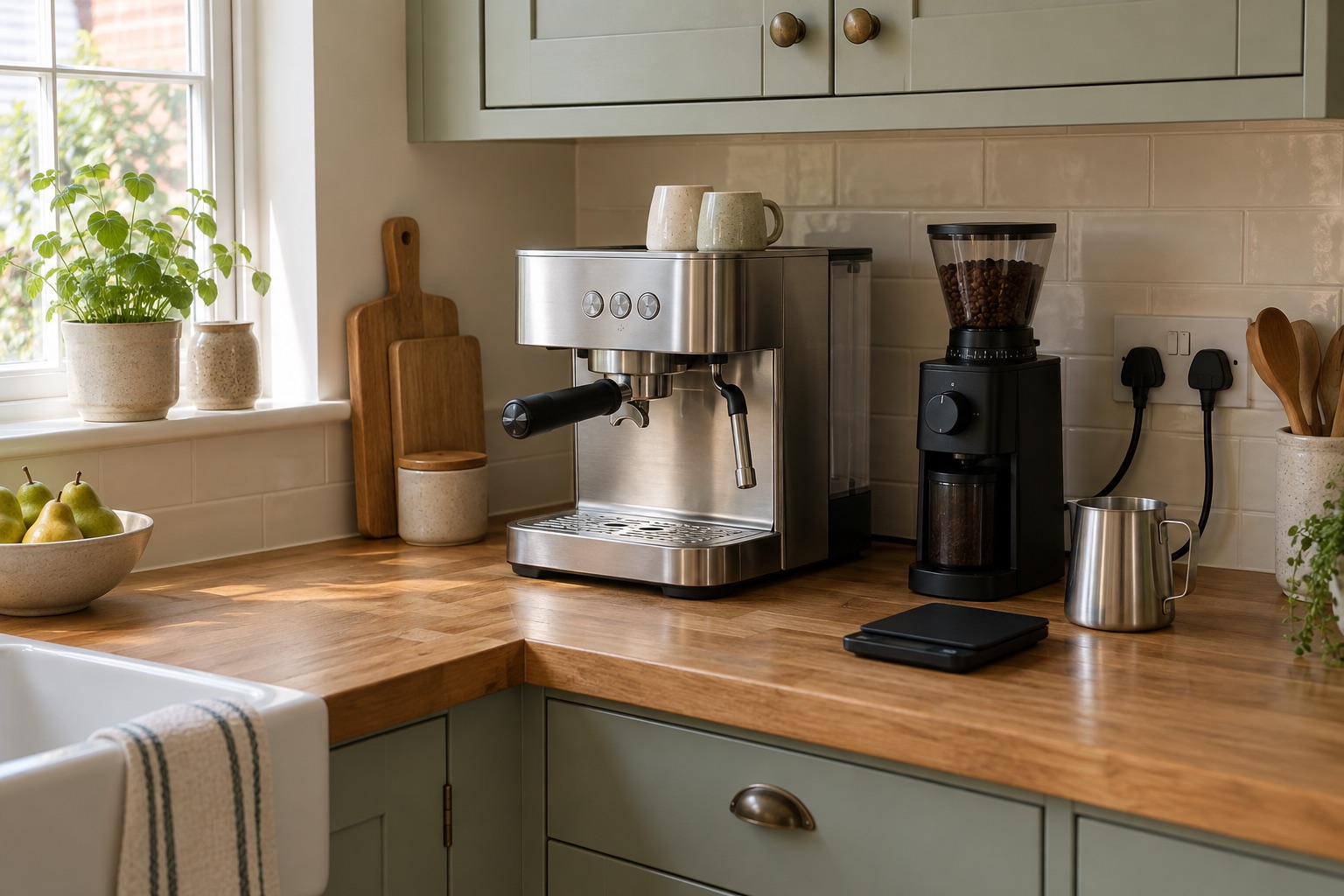
Check which basket, tamper and pitcher the UK machine box includes.
Give the grinder its own line before spending the full allowance on the machine.
Use beans-per-shot and bag price to calculate ongoing coffee cost.
Budget for model-specific cleaning and water care, not a generic chemical bundle.
An “espresso machine under £500” is not the same as a complete setup under £500. The decision changes sharply depending on whether you will buy pre-ground coffee for a pressurised basket, hand-grind fresh beans or use a powered espresso-capable grinder. Put your full spend on paper before comparing shiny machine features.
A useful budget worksheet
| Line | Questions to answer | Can it wait? |
|---|---|---|
| Machine | Does the exact UK box include baskets, tamper and milk pitcher? | No |
| Grinder | Can it adjust finely enough for the basket you plan to use? | Only with a forgiving basket or pre-ground coffee |
| Scale | Can a current kitchen scale weigh your dose and beverage? | Often yes |
| Beans and milk | How many drinks do you make weekly? | No |
| Cleaning and water | What does your exact manual specify? | No, but buy only what is needed |
| Extra tamper, funnel, distribution tool | Is there a measured problem with the supplied gear? | Usually yes |
The essential-accessories guide helps remove redundant purchases. A milk pitcher is only necessary if you steam milk and none is supplied. A dedicated tiny scale earns its cost when an ordinary kitchen scale will not fit the drip tray. You can time with a phone.
Three realistic purchase routes
Lowest initial outlay: a simple machine such as the Stilosa, supplied pressurised basket, suitable pre-ground coffee and a scale you already own. You can learn filling, locking, flowing and cleaning before buying a grinder. The trade-off is less direct flavour control and the recurring need for properly ground coffee.
Learning fresh-ground espresso: an entry machine plus a grinder with a fine adjustment range, such as the Baratza Encore ESP or a suitable manual model. Set aside money for beans and cleaning. Only move to a single-wall basket when grinder and basic routine are ready.
Convenience in manual espresso: a machine with automatic milk, such as the Dedica Maestro Plus or Bambino Plus, plus a separate grinder. The higher machine spend reduces milk-texturing effort, not the need to dose and prepare coffee. If you would rather remove those steps too, compare bean-to-cup instead.
Calculate the ongoing cost yourself
For beans, divide the bag price by its weight and multiply by the dose. Example only: a £12, 250g bag at 18g per shot costs £0.864 in beans per shot (£12 ÷ 250 × 18), before milk, electricity, water, cleaning and waste. If you use 16g, substitute 16. If you dial in a new bag and discard two test shots, include that too. Count complete drinks, not abstract cups per bag. Milk-drink cost depends on the volume and milk you actually use.
Maintenance is not optional, but it is model-specific. Read the cleaning routine, assess water hardness and use the maker's descaling guidance. Filter cartridges, seals or replacement parts may become costs over time; avoid inventing a universal monthly amount. Paid servicing and warranty terms vary by brand.
A three-year cost model you can recalculate
Compare complete setups over the same number of drinks: machine + grinder + essential accessories + coffee + milk + model-specific care. For recurring items, multiply cost per finished drink by the number of drinks you expect to make. Do not count an accessory on one side and quietly omit it from the other. If you already own usable scales or a grinder, enter £0 for that purchase rather than pretending every household starts from scratch.
Here is the coffee line alone using the hypothetical £24/kg beans and 18g dose above. It assumes every planned drink uses one 18g dose, with no waste or price change; it is not a prediction of anyone's actual spend.
| Routine | Drinks in three years | Beans at 43.2p per drink |
|---|---|---|
| One drink every day | 1,095 | £473.04 |
| Two drinks every day | 2,190 | £946.08 |
The calculation is £24 ÷ 1,000 × 18 = £0.432 per drink, then £0.432 × 1,095 or 2,190. Use your actual bag price, bag weight, dose and number of drinking days. A 250g bag at 18g per drink supplies about 13 full doses before any wastage, not an unlimited run of cheap cups.
This also changes how to judge an equipment upgrade. Spreading a hypothetical extra £100 of grinder cost over 1,095 drinks adds about 9.1p per drink; over 2,190 drinks it adds about 4.6p. That is an allocation, not a claim that the upgrade improves taste or saves money. If the grinder you need makes the initial budget unworkable, a pressurised-basket start or a different brewing method may be the better choice. Use the machine–grinder budget worksheet to see what remains after the other essentials.
Frequently asked questions
How much of the budget should go to the grinder?
There is no safe universal percentage. A traditional single-wall basket puts high demands on grinding. Protect enough budget for a compatible grinder before upgrading the machine; see the machine–grinder budget split.
Can I stay with pre-ground coffee indefinitely?
Yes, if you like the result and your machine's basket is designed for it. You sacrifice some freshness and adjustability, not the right to enjoy the drink.
Do I need to buy every accessory on day one?
No. Start with what the machine includes, a way to weigh and a cleaning cloth. Buy extras when a specific limitation appears.
Helpful products
An illustrative machine, grinder and scale
These three illustrate separate budget lines, not a mandatory shopping basket. Check what your machine supplies and whether you need a scale smaller than a kitchen scale.
EC260.BK
- 205 × 343 × 285mm
- 1L water tank
- EC260.BK
Lowest-cost manual route
De’Longhi Stilosa
Best for: a first attempt at milk drinks without a large machine purchase
A simple dial-operated manual machine with a stainless-steel boiler, 1L tank and steam wand. The low entry price leaves more of the budget for an appropriate grinder, but the workflow is entirely hands-on.
Why it earns a place
- Low entry cost
- Manual milk frother
- Removable two-tier drip tray
What to weigh up
- Manual dial and simple controls
- No grinder or automatic milk routine
Skip it if You want automatic milk, a timer display or a machine that makes the drink without preparation.
Check the official specification →ZCG495 / 495W-230V-G
- 40 settings
- 40mm steel burrs
- 230V UK model
Best fit for most homes
Baratza Encore ESP
Best for: households switching between espresso and filter
Its adjustment range is deliberately divided between finer espresso settings and broader filter settings, so it is the most convincing one-grinder answer here for a mixed routine.
Why it earns a place
- Dedicated espresso and filter ranges
- Simple hopper adjustment
- Dosing cup included
What to weigh up
- Manual dosing rather than a timed display
- Plastic-led body
Skip it if Timed portafilter dosing is the feature that would make everybody else in the house use the setup.
Check the official specification →Exagram
- 77×124×24mm
- 0.3g–2kg
- 2 AAA batteries
Compact espresso fit
Wacaco Exagram
Best for: small drip trays and a simple timed dose
A narrow 77mm-wide scale with timer, tare and 0.1g steps up to 999.9g. Useful beneath an espresso cup but less comfortable for a wide filter server.
Why it earns a place
- Compact width
- Timer and tare
- Silicone pad
What to weigh up
- AAA batteries required
- Small platform
Skip it if You regularly weigh a large pour-over server.
Check the official specification →Sources and scope
The machine and grinder examples are grounded in De’Longhi Stilosa, Dedica Maestro Plus, Sage Bambino Plus and Baratza Encore ESP. The three-year table is our arithmetic from explicitly hypothetical bean and equipment inputs; it excludes milk, water, care, waste and future price changes until the reader enters them.