
Espresso basics · Baskets
Pressurised vs non-pressurised espresso baskets
Learn how double-wall and single-wall baskets create resistance, which grinder each needs, how to identify yours and when an upgrade makes sense.
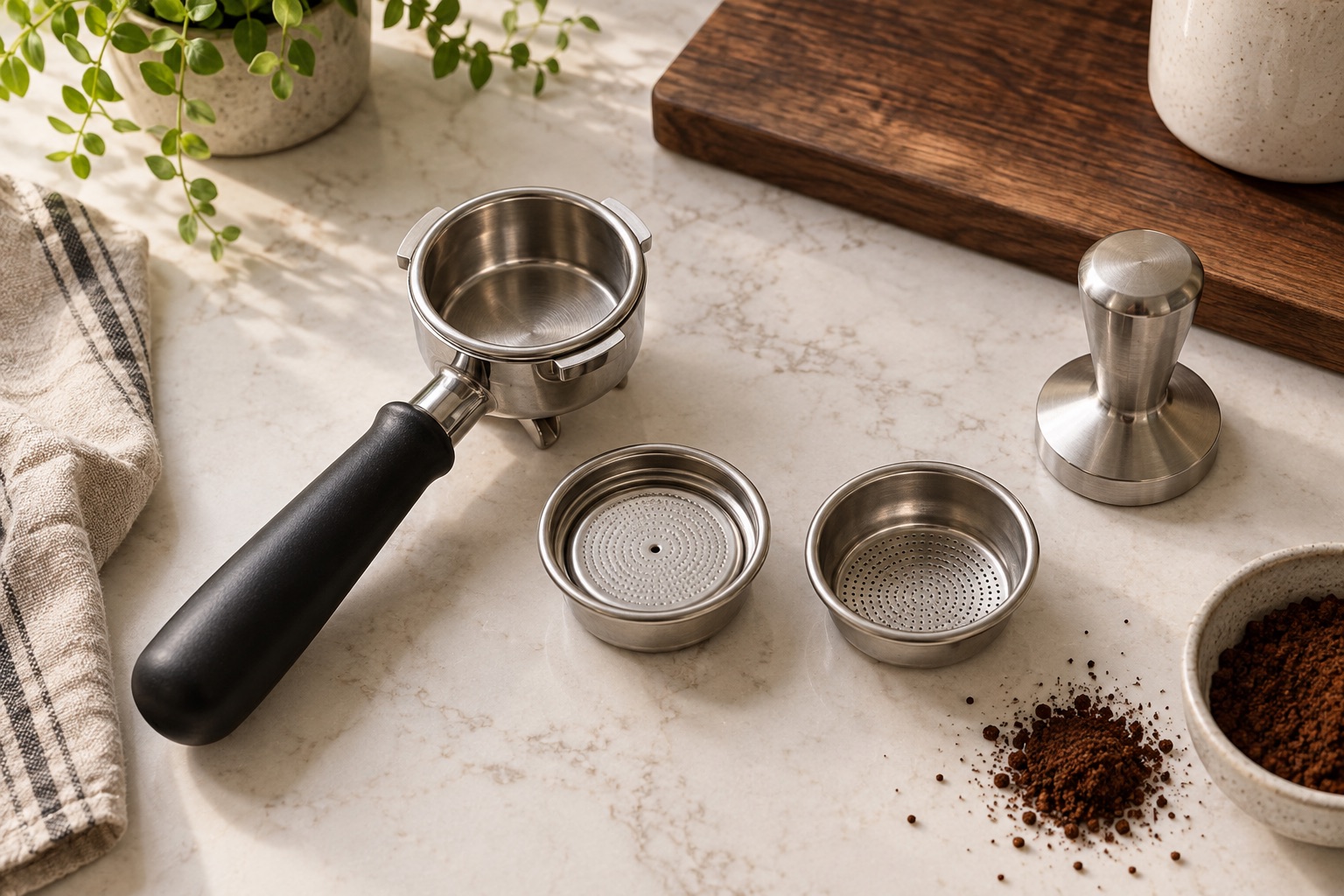
Check the underside and the machine manual; a perforated inner face alone does not tell the whole story.
Keep basket size and dose within the manufacturer's supported range.
Do not buy a single-wall basket as a substitute for an espresso-capable grinder.
Changing basket type resets your recipe; old timings are not a target.
The confusing part of the basket debate is that both types may look like perforated cups from above. In a single-wall basket, water passes through many holes in one metal wall; the coffee bed provides most of the resistance. A dual-wall or pressurised design has a restricted exit after the inner perforations, so the basket itself contributes resistance. Manufacturer terminology varies, so verify the exact part in your machine's manual rather than buying by a photograph.
Which should you use?
If you buy pre-ground coffee, have a blade grinder or a filter-only burr grinder, stay with a supplied pressurised basket while you learn the machine. It can make a satisfying milk drink without asking a rough grinder to control a narrow espresso flow range. The foamy layer may be partly the effect of the restriction; its appearance alone does not prove a better extraction.
If you own a grinder that can make small changes in the espresso range, a single-wall basket gives you direct control over flow and flavour. The trade-off is sensitivity: the same dose can run much faster as beans age or grind changes. Begin with the manufacturer's basket dose, weigh the beverage and use our taste-led dial-in method. A single-wall basket is a tool for adjustment, not an automatic upgrade.
A practical comparison
| Decision | Pressurised / dual-wall | Non-pressurised / single-wall |
|---|---|---|
| Best starting coffee | Suitable pre-ground or fresh ground | Fresh ground, adjustable espresso grind |
| Where much resistance comes from | Restricted basket exit plus coffee | The coffee puck |
| Grind tolerance | More forgiving | Narrower and more sensitive |
| What a fast shot suggests | Check dose, coffee, programme and basket | Check grind, dose and puck distribution |
| What to buy first | Often nothing beyond the machine | A suitable grinder, then a compatible basket |
This table describes the normal workflow, not a claim that every machine uses identical pressure or that one type always tastes better.
How to identify and switch safely
Read the basket markings and underside, then confirm with the manual. Do not confuse a single small outer hole with the many inner holes. Remove and replace a basket only as the maker instructs; some retaining springs are stiff. Check the exact basket diameter and portafilter compatibility before ordering. A nominal 54mm or 58mm name is not a guarantee that a random basket locks into your particular handle.
After switching, clean the group and basket, use the intended dose and reset your expectations. If the first single-wall shot gushes, make a small grind adjustment finer; if it chokes, go coarser. Change one variable at a time and stop if the machine or handle is behaving abnormally. Our fast-shot and slow-shot guides separate recipe problems from equipment faults.
Frequently asked questions
Can I use pre-ground coffee in a single-wall basket?
You can physically place it there, but you cannot change its grind to control the shot. A pressurised basket is normally a more practical route for fixed-grind coffee.
Does a bottomless portafilter require a single-wall basket?
It is usually bought to observe extraction with a suitable basket. It does not itself improve flavour or solve an inadequate grinder. Fit and hot-spray risks matter; start with the supplied spouted handle.
Is 58mm automatically superior to 54mm or 51mm?
No. Diameter changes accessory fit and puck geometry, but the complete machine, basket, dose and grinder matter more than the number in isolation.
Helpful products
When a single-wall basket justifies a grinder
The Encore ESP is an example of a grinder with an espresso adjustment zone. It will not fix a wrong basket, stale beans or poor distribution; use the supplied basket first.
ZCG495 / 495W-230V-G
- 40 settings
- 40mm steel burrs
- 230V UK model
Best fit for most homes
Baratza Encore ESP
Best for: households switching between espresso and filter
Its adjustment range is deliberately divided between finer espresso settings and broader filter settings, so it is the most convincing one-grinder answer here for a mixed routine.
Why it earns a place
- Dedicated espresso and filter ranges
- Simple hopper adjustment
- Dosing cup included
What to weigh up
- Manual dosing rather than a timed display
- Plastic-led body
Skip it if Timed portafilter dosing is the feature that would make everybody else in the house use the setup.
Check the official specification →Sources and scope
Sage's single- and dual-wall basket instructions distinguish fresh-ground and pre-ground workflows. Gaggia's Classic E24 specification lists both traditional and pressurised baskets.