
Troubleshooting · Slow shot
Espresso running too slowly or not at all
Diagnose a choking home espresso shot safely by checking grind, dose, basket, blocked holes and machine water flow in the right order.
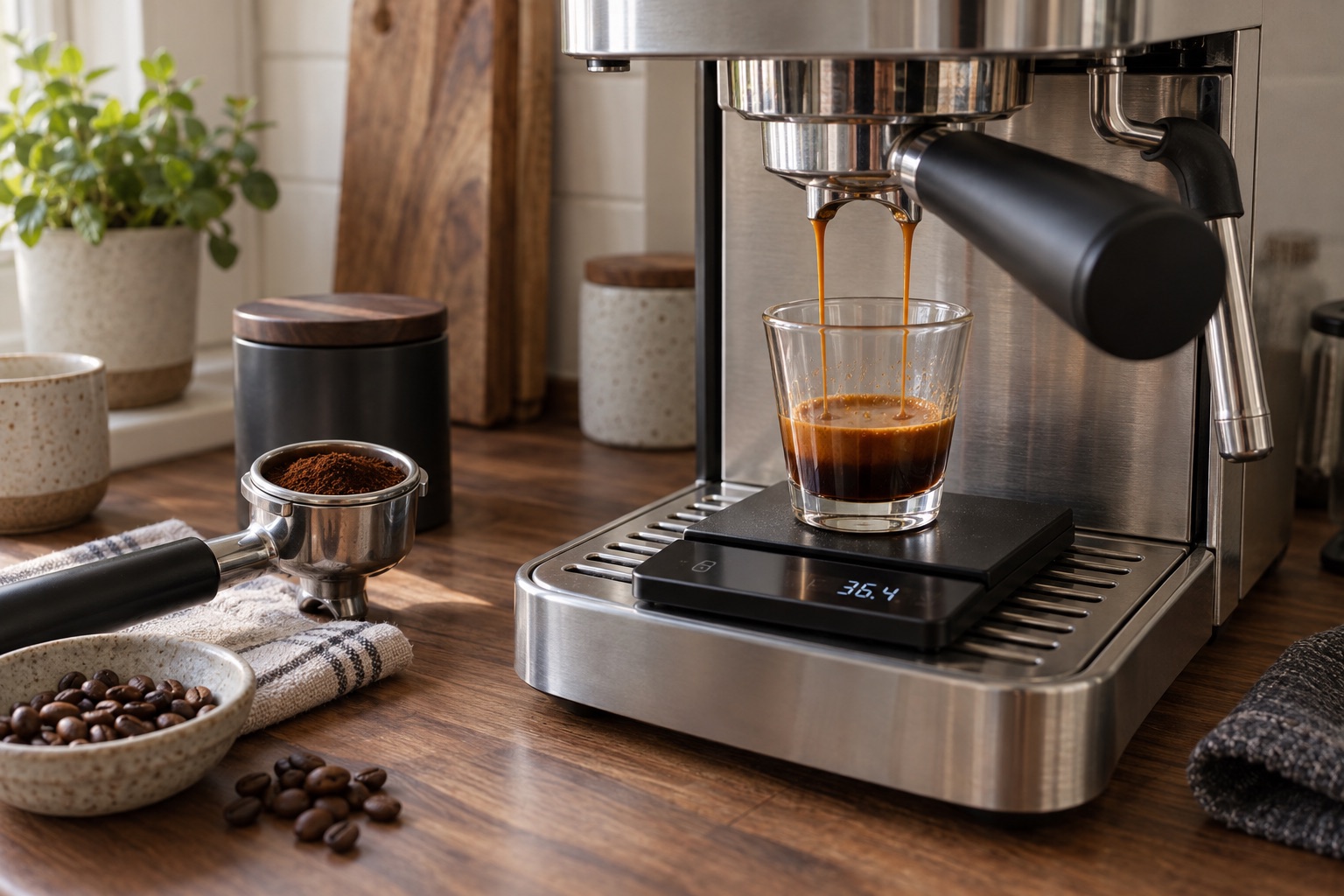
Do not unlock a portafilter while the machine is pressurised; follow its manual.
Too fine a grind or too much coffee can choke the puck.
A clogged basket or screen can imitate a grind problem.
A slow shot can still taste thin if water channels unevenly.
“Slow” can mean a delayed first drop, a thin drip throughout, or a shot that nearly stops. Write down dry dose, beverage mass and time before changing anything. A 25–30-second starting window often appears in espresso tutorials, but the best target is a drink that tastes good from your machine and basket; time is a clue, not a pass mark.
A safe order of checks
First let the machine finish or stop according to its instructions. A choked puck may retain pressure: do not force or immediately loosen the handle. Once safe and cool enough, check the coffee dose against the basket's intended range. Overfilling can press the puck into the shower screen or leave too little headspace.
With a single-wall basket, change grind one small step coarser while holding dose and target yield constant. If flow returns and the cup tastes good, stop adjusting. If it is now fast and sour, move partway back or alter the beverage yield using the taste-led method. In a pressurised basket, examine its restricted outlet for blockage and follow the machine manual; grinder adjustment may have a different effect.
Check the basket holes and group screen for coffee residue. Use the maker's supported espresso cleaning routine; do not poke electrical or pressure parts. If the machine's water flow is weak with an empty, correctly fitted basket or during its manual's test procedure, the problem may be water supply, an airlock, scale or a fault rather than the puck. The descaling guide explains when descaling is due, but it is not a universal cure for a mechanical fault.
Separate a choked puck from a machine-flow problem
If a familiar recipe suddenly stalls after a new coffee or grinder adjustment, note the dose and setting before changing anything. Once pressure has released safely, inspect the basket and make one small coarser adjustment with the same dose and target beverage mass. If flow returns, you have a useful recipe clue. If the empty-basket water path is also unusually weak when tested exactly as the manual permits, stop treating it as a grind problem. A blocked screen, tank seating issue, maintenance prompt or machine fault needs the model's care and support path.
Do not repeatedly run the pump against a blocked basket to “push through” the puck. Nor should you force a larger dose into a small basket to rescue a weak-tasting shot: more coffee can reduce headspace and make the restriction worse. The basket guide helps identify which outlet you actually have.
When flow is restored, compare taste at the same intended yield. A coarser grind may bring a choked shot back to a pleasant range; if it now tastes thin or sharp, adjust one variable again rather than changing grind, dose and yield at once. See the taste-led espresso guide for a repeatable sequence.
Why a slow shot might still taste bad
Very slow flow can give a bitter, drying cup, yet a channeled puck may be simultaneously over- and under-extracted. Look for obvious clumps, an uneven tamp or grounds left at the rim. Correct distribution before forcing the grind much coarser. The bitter-coffee guide distinguishes roast bitterness from extraction bitterness.
| Observation | First useful check | Avoid |
|---|---|---|
| Drips, basket overfull | Reduce to basket's supported dose | Forcing handle into group |
| Drips, dose normal | One step coarser on suitable grinder | Changing dose and grind together |
| Empty-basket water is also weak | Manual's water/cleaning/fault route | Assuming fresh beans will fix it |
| Sudden halt after changing basket | Confirm basket fit and outlet | Forcing an incompatible part |
Frequently asked questions
Is slow espresso always stronger?
No. Strength depends on dissolved coffee relative to beverage mass. A slow but very long or uneven shot can be harsh or thin.
Should I remove the portafilter immediately if nothing comes out?
No. Stop the cycle and follow the machine manual's pressure and removal instructions. Hot water and pressurised grounds can cause injury.
Could a dirty grinder cause this?
It may alter dose or particle distribution, but diagnose the puck and water flow first. Clean only via supported grinder maintenance.
The machine dispenses water but no coffee. Is the pump fine?
Not necessarily. A normal water test makes puck resistance more likely, but it does not prove every part of the machine is sound. Follow its manual if flow remains abnormal after a supported basket and recipe check.
Helpful products
Weigh before changing equipment
A scale helps distinguish a deliberately short shot from one that cannot reach your chosen beverage yield. A phone can handle timing.
Exagram
- 77×124×24mm
- 0.3g–2kg
- 2 AAA batteries
Compact espresso fit
Wacaco Exagram
Best for: small drip trays and a simple timed dose
A narrow 77mm-wide scale with timer, tare and 0.1g steps up to 999.9g. Useful beneath an espresso cup but less comfortable for a wide filter server.
Why it earns a place
- Compact width
- Timer and tare
- Silicone pad
What to weigh up
- AAA batteries required
- Small platform
Skip it if You regularly weigh a large pour-over server.
Check the official specification →Sources and scope
Sage's espresso dial-in guide explains changing grind and yield; Gaggia's Classic E24 guidance describes too-fine grounds obstructing flow. For pressure, blocked water paths and cleaning, the exact machine's instructions take precedence.