
Choosing a setup · Machine types
Bean-to-cup vs manual espresso machine: which suits your home?
Compare bean-to-cup and manual espresso by daily workflow, complete setup and a recalculable purchase-cost example for UK homes.
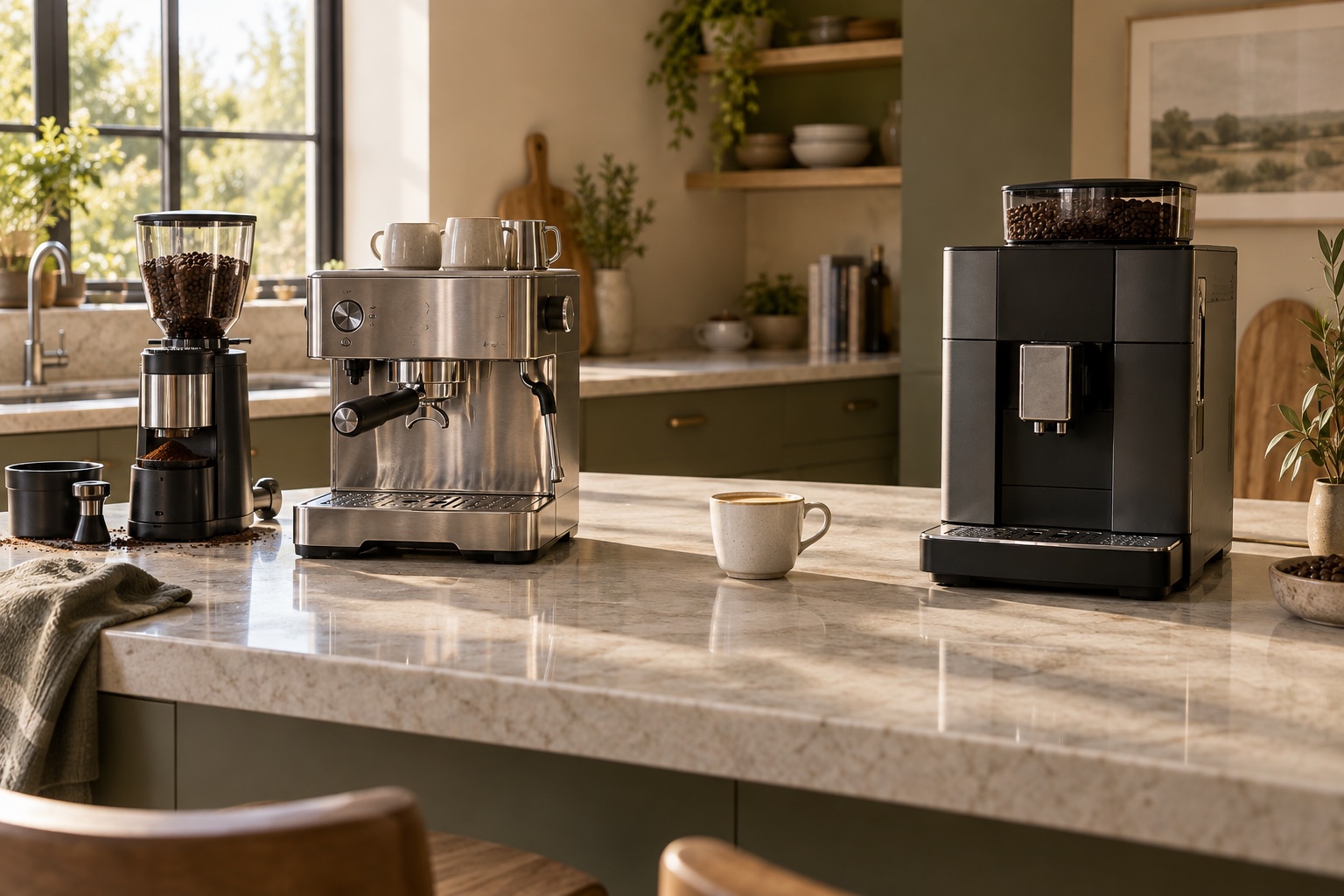
Compare the exact bean-to-cup variant; automatic and manual milk versions often share a family name.
A manual espresso setup normally needs a separate espresso-capable grinder.
Automation changes the cleaning jobs rather than removing them.
Measure the whole setup and weekly drink volume before comparing sticker prices.
“Bean-to-cup” is a broad retail label. Here it means a fully automatic machine that grinds whole beans internally, doses them, brews and ejects the spent puck with minimal user preparation. A manual or semi-automatic espresso machine uses a removable portafilter; you prepare the coffee bed and usually operate a separate grinder. Some machines sold as “bean to cup” have an integrated grinder but still require manual tamping. Read the product’s actual workflow, not its search category.
For a concrete comparison, consider the Magnifica Start ECAM220.61.GB and Dedica Style EC685.M. One has a built-in grinder and automatic milk; the other has a portafilter and manual wand. They are not interchangeable because both can serve a latte-shaped drink.
The daily sequence is the real difference
With bean-to-cup, fill the hopper and water, choose the recipe and collect the drink. Depending on the model, you may adjust aroma, grind and volume, but the internal mechanism performs puck preparation. Empty the grounds bin and drip tray, and clean the milk path as instructed. The visible time at the machine is short, particularly when several household members want the same type of drink.
With manual espresso, weigh or dose beans, grind, distribute, tamp, lock in, brew, remove the puck, clean the basket and steam milk if wanted. The process can be satisfying, but it happens every time. It is not only a weekend learning curve; it remains a series of steps on a work morning. If you make several drinks back-to-back, the repeated preparation matters.
Which gives more control over flavour?
Manual equipment exposes more variables: basket, dose, grind, yield, shot timing and milk texture. With a capable grinder, you can tune a particular bean or change recipe. That control is valuable only if you use it. An automatic machine offers fewer direct controls but can repeat a chosen recipe with less effort. “More control” is not proof that every manual cup tastes better; bean freshness, machine condition and technique influence both.
The grinder is central. An entry manual machine with a weak grinder may offer nominal control but little useful precision. Read our espresso grinder guide and grind-size guide before assuming the machine is the limiting component.
Milk drinks: automatic carafe or manual wand?
The exact Magnifica Start ECAM220.61.GB has De’Longhi’s LatteCrema Hot system and a one-touch latte macchiato recipe. Other Magnifica Start variants use a traditional milk frother, so model suffix matters. The Dedica gives you a manual wand. A manual wand lets you decide the milk texture and temperature by practice; the automatic system makes preparation more consistent and less involved for the household.
Neither milk route is maintenance-free. Purge and wipe a manual wand after each use. Follow the automatic milk system’s clean cycle and storage instructions for the removable carafe. If the household drinks mostly black coffee, do not pay for milk automation you will rarely use.
Cleaning and repairability
Automatic machines typically prompt you to empty internal grounds and water, descale and clean removable brew and milk components. Manual machines expose the portafilter and drip tray, and their grinder is a separate object to clean. The tasks are different, not absent. Before buying, read the exact model manual for access to the brew unit, descaling procedure and any required cleaning products.
A separate grinder and machine can be replaced independently. An integrated system uses fewer worktop objects but makes the grinder and brewer one purchase. That can be attractive or risky depending on your priorities and local service route. We do not claim one category is universally more durable without comparable long-term failure data.
Space and total cost
Bean-to-cup machines can be broad and deep, and need clearance to refill beans and water. A slim manual machine may look smaller but requires a grinder, tamping surface, scales and possibly a knock box. Draw both complete setups on the counter. Our small-kitchen guide gives a practical tape-and-paper method.
Compare machine plus essentials, then beans, filters, descaler and electricity over the period you expect to own it. Manual espresso can start with a cheap machine but needs an appropriate grinder to realise its control. Bean-to-cup has a higher initial appliance cost but includes grinding. The machine-and-grinder budget split is a more useful framework than machine price alone.
Work out the difference for a complete setup
Here is a hypothetical purchase, not a price quote for the models above. It gives the automatic route £450 for a machine with built-in grinder and £20 for essentials; the manual route has a £170 machine, £190 espresso-capable grinder and £40 of essentials. Count a jug, scale or other item only if the machine does not include it and you need it.
| Route | Example initial calculation | Example total |
|---|---|---|
| Automatic bean-to-cup | £450 machine + £20 essentials | £470 |
| Manual espresso with fresh beans | £170 machine + £190 grinder + £40 essentials | £400 |
The initial difference in this example is £70, not the £280 difference between the two machine stickers. At two drinks every day for three years (2,190 drinks), allocating that difference would be about 3.2p per drink. This does not establish which route actually costs less: neither bean dose nor filter, cleaner, milk or repair spending is held equal. Enter your own delivered prices, included accessories and maintenance supplies; then add each route's drink ingredients separately. Do not treat an automatic's grinder setting as an assured 18g dose or count both machines as making identical drinks.
The practical trade is clearer alongside the arithmetic: the automatic route removes separate grinding, distribution and tamping from the per-drink sequence, but adds grounds-bin and, for this exact Magnifica variant, milk-carafe care. The manual route retains per-shot preparation and wand cleaning, while keeping its grinder separately replaceable. Compare the full espresso cost model if your daily volume is different.
Choose bean-to-cup if…
Several people make drinks, short preparation is important, and you want whole beans without daily puck work. It is especially compelling when automatic milk is truly used. Choose an exact variant with the drinks and cleaning route you want, rather than assuming all machines in the family are alike.
Choose manual espresso if…
You enjoy making the drink, want to learn extraction and milk texture, and can reserve budget and space for an espresso-capable grinder. The beginner machine guide gives sensible entry points without implying you need a premium machine to start.
Frequently asked questions
Is an integrated-grinder espresso machine bean-to-cup?
Retailers may describe it that way. For practical buying, ask whether you still fill and tamp a removable portafilter. If yes, it retains much of the manual workflow even though the grinder is built in.
Is bean-to-cup cheaper per drink than manual espresso?
Both can use whole beans, so bean cost depends on dose and coffee chosen. Equipment, maintenance and cleaning costs differ. Calculate total ownership using your own drink volume; neither category has a universal per-cup advantage.
Can a bean-to-cup machine make café-quality coffee?
It can make enjoyable drinks from fresh beans. “Café-quality” is subjective and cafés vary; compare the drink and daily routine you prefer.
Which is quieter?
Both grind coffee if using whole beans. Noise varies by exact grinder and machine, kitchen acoustics and cycle. Check manufacturer noise information or listen to an in-person demonstration rather than assuming automation is quiet.
Helpful products
One example for each route
The exact Magnifica Start automatic-milk variant, the slim manual Dedica and an espresso-capable separate grinder illustrate the purchase decision.
ECAM220.61.GB
- 250g bean container
- Four one-touch recipes
- ECAM220.61.GB
One-touch bean-to-cup
De’Longhi Magnifica Start
Best for: a household that wants fresh beans and automatic milk drinks
This exact Magnifica Start variant includes an integrated grinder and LatteCrema Hot automatic milk system, with one-touch espresso, coffee and latte macchiato. It removes daily puck preparation but adds milk-system cleaning.
Why it earns a place
- Integrated grinder
- Automatic milk drinks
- Removable cleaning components
What to weigh up
- Large counter footprint
- Milk system needs regular cleaning
- Less direct control than separate equipment
Skip it if You enjoy dialling in separate grinder and espresso settings, or have a very shallow counter.
Check the official specification →EC685.M
- 149 × 330 × 305mm
- 1.1L water tank
- EC685.M
Slim manual espresso choice
De’Longhi Dedica Style
Best for: a narrow worktop and someone willing to prepare and steam manually
At about 15cm wide, the Dedica makes manual espresso possible on a narrow counter. Its Thermoblock, programmable cup quantities and adjustable drip tray are useful; a separate grinder is still needed for fresh-ground coffee.
Why it earns a place
- About 15cm wide
- Manual steam wand
- Ground coffee or ESE pods
What to weigh up
- No built-in grinder
- Pressurised baskets limit fine espresso control out of the box
Skip it if You expect one-touch coffee or milk, or cannot spare space for a grinder.
Check the official specification →ZCG495 / 495W-230V-G
- 40 settings
- 40mm steel burrs
- 230V UK model
Best fit for most homes
Baratza Encore ESP
Best for: households switching between espresso and filter
Its adjustment range is deliberately divided between finer espresso settings and broader filter settings, so it is the most convincing one-grinder answer here for a mixed routine.
Why it earns a place
- Dedicated espresso and filter ranges
- Simple hopper adjustment
- Dosing cup included
What to weigh up
- Manual dosing rather than a timed display
- Plastic-led body
Skip it if Timed portafilter dosing is the feature that would make everybody else in the house use the setup.
Check the official specification →Sources and method
The workflows come from De’Longhi's exact Magnifica Start automatic-milk variant and Dedica Style EC685.M. The two purchase totals are our calculation from hypothetical inputs, not current offers or a measured total cost of ownership. Check the full model suffix before buying.