
Care · Frequency
How often should you descale a coffee machine?
Understand how UK water hardness, machine prompts, filters and usage affect descaling frequency without relying on a misleading one-size-fits-all schedule.
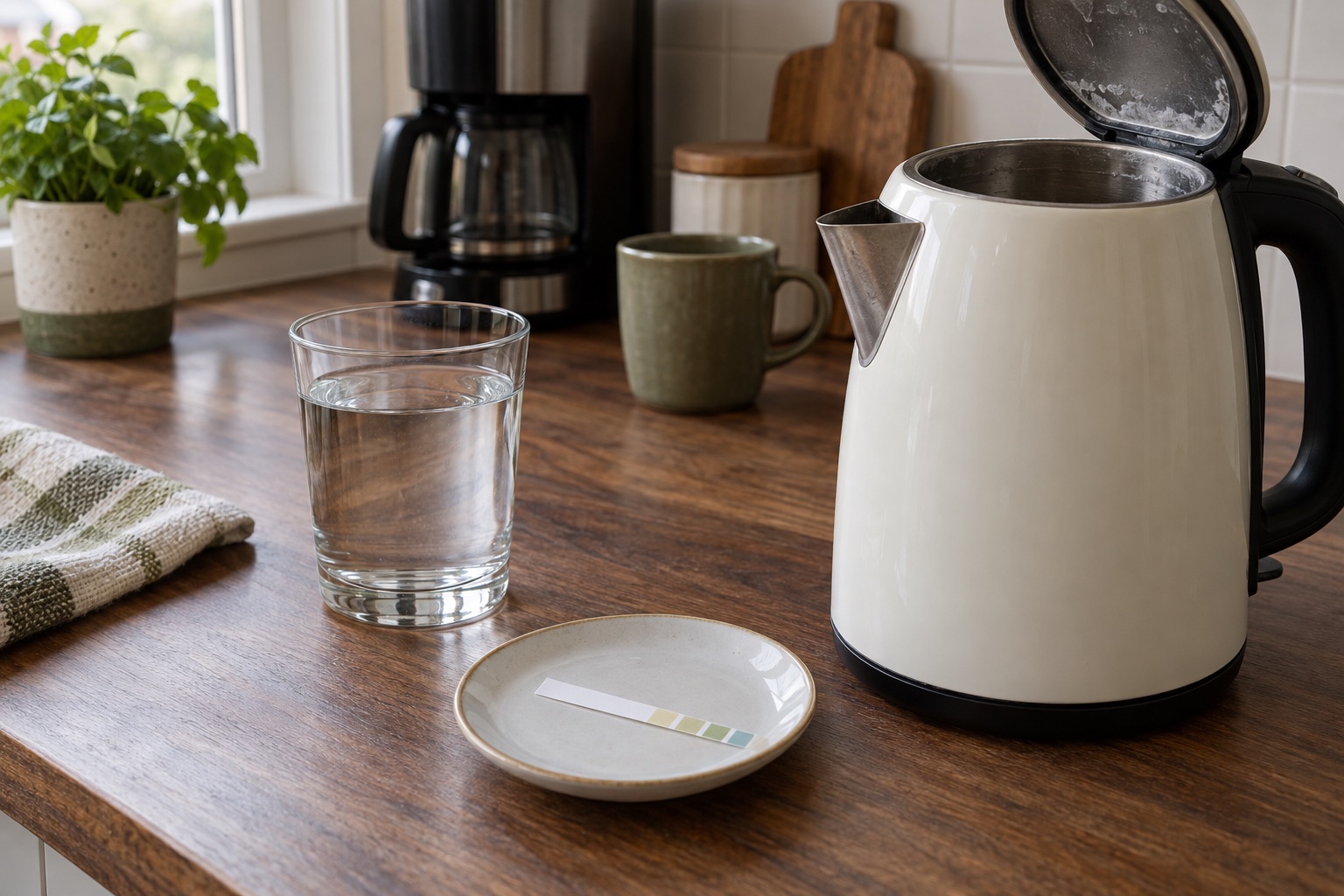
Check local supplier data or use the test supplied with your machine.
Set machine hardness correctly if its manual allows it.
Count actual use and prompts, not just months since purchase.
Cleaning coffee oils remains a separate routine.
“Every three months” sounds tidy but conceals the variable that matters: how much mineral-bearing water the machine heats. Two neighbours can have similar water but different coffee habits; two households brewing equally often can have different water. Manufacturers account for this with hardness settings, water filters, volume-based prompts or model-specific intervals.
Start with three facts
First, identify the machine model and its instructions. Second, check the water you actually put into it. Use your local supplier's postcode information—Water UK helps you find the supplier—or a manufacturer-provided hardness strip. Third, note how many drinks you make and whether the machine displays a prompt. Our UK coffee-water guide explains why a generic “UK water” label is not useful.
If the machine has a hardness setting, enter the value as instructed. A wrong “soft” setting in a hard-water area can delay a prompt. A wrong “hard” setting can request more frequent cycles than necessary. A filter setting may also change the logic; use it only with the specified filter and replace it at the manufacturer's interval.
A decision guide, not a universal timetable
| Your situation | Sensible next step |
|---|---|
| Machine displays a descale alert | Check the manual, product and water-filter step; run the complete cycle. |
| No alert, but manual gives an interval | Use that interval for your water setting and normal use. |
| No alert and the interval is unclear | Find the current model manual or manufacturer support. Do not invent a chemical schedule. |
| Poor flow, unexpected noise or leakage | Check the fault guide; do not assume more descaler is safe. |
| Recently changed home or water source | Retest and reset hardness if the model supports it. |
The table deliberately avoids a number of weeks. Some filter-machine descaler instructions do name an interval—Melitta's powder leaflet gives its own example—but it applies to that product route, not every espresso or automatic machine.
What changes the interval?
Hardness: dissolved calcium and magnesium can leave scale as water heats. The water company's hardness result is a useful local starting point; a test strip can reflect the water at your tap. Volume: four daily drinks move more water through the appliance than four weekly drinks. Filters: a correctly installed, in-date compatible filter may reduce scale exposure, but does not justify ignoring the model's instructions. Machine design: thermoblocks, boilers, automatic circuits and filter-brewer heaters have different procedures and alerts.
Do not confuse visible white marks on a tray with a direct measurement of scale inside. They suggest mineral-rich water but not an exact internal deposit. Equally, a coffee that tastes bitter is not itself proof that the machine needs descaling; taste troubleshooting begins with recipe and beans.
Keep a simple maintenance record
Write down the date, model's hardness setting, filter change, approved product and whether the full rinse completed. A phone note is enough. This helps if a warning returns unexpectedly and avoids repeating a chemical cycle when the real issue is a missed rinse or filter reset.
Follow the descaling method overview when the job is due. For daily tasks, use our machine-cleaning checklist instead of adding descaler more often.
Frequently asked questions
Does bottled water mean I never need to descale?
No. Bottled waters differ in mineral content, and a machine's manual may still require a programme. Use the water you actually brew with to set the machine correctly.
Should I descale when coffee tastes bad?
Only if a prompt, manual interval or model-specific symptom supports it. Taste has many causes, including grind, dose, roast and extraction. Diagnosis first prevents unnecessary chemical use.
Does a Brita-style jug replace the machine filter?
Not automatically. Jug cartridges and in-tank filters are different products with different claims. Follow your machine's hardness and filtration guidance.
Helpful products
Buy only after matching your machine
These represent different systems. Check the manual's named product or approved chemistry before ordering either.
DLSC500, 500ml
- DLSC500
- 500ml
- Descaler, not detergent
For supported De’Longhi machines
De’Longhi EcoDecalk
Best for: De’Longhi owners whose manual specifies EcoDecalk
De’Longhi’s own 500ml descaling liquid for supported coffee machines. Follow the machine’s dose, water fill, cycle and rinse instructions rather than treating the bottle as a universal recipe.
Why it earns a place
- Manufacturer-backed for supported models
- Liquid format
- 500ml bottle
What to weigh up
- Not a universal cleaner
- Model-specific dosing
- Must be stored securely
Skip it if Your machine specifies a different product or you need cleaner for coffee oils rather than mineral scale.
Check the official specification →192632, six 20g sachets
- Six 20g sachets
- Filter machine and kettle
- 192632
For filter machines
Melitta Anti Calc Filter Machine Powder
Best for: compatible filter coffee machines and kettles, especially Melitta models
A portioned powder sold for filter coffee machines and kettles. Use only in a compatible machine, mixing and rinsing exactly as its instructions and the machine manual require.
Why it earns a place
- Portioned sachets
- Designed for filter machines
- Maker publishes instructions
What to weigh up
- Not for every machine type
- Irritant handling precautions
- Still requires full rinse
Skip it if You have a bean-to-cup or espresso machine requiring its own descaler.
Check the official specification →Sources and scope
De’Longhi's pump-machine guidance links the alert behaviour to hardness setting and its model cycle. Water UK identifies suppliers for local data. Frequency is model- and water-dependent; this page intentionally does not claim a universal interval.