
Care · Espresso
How to backflush an espresso machine safely
Learn which home espresso machines support backflushing, the difference between a water rinse and cleaning tablet, and a safe model-led sequence.
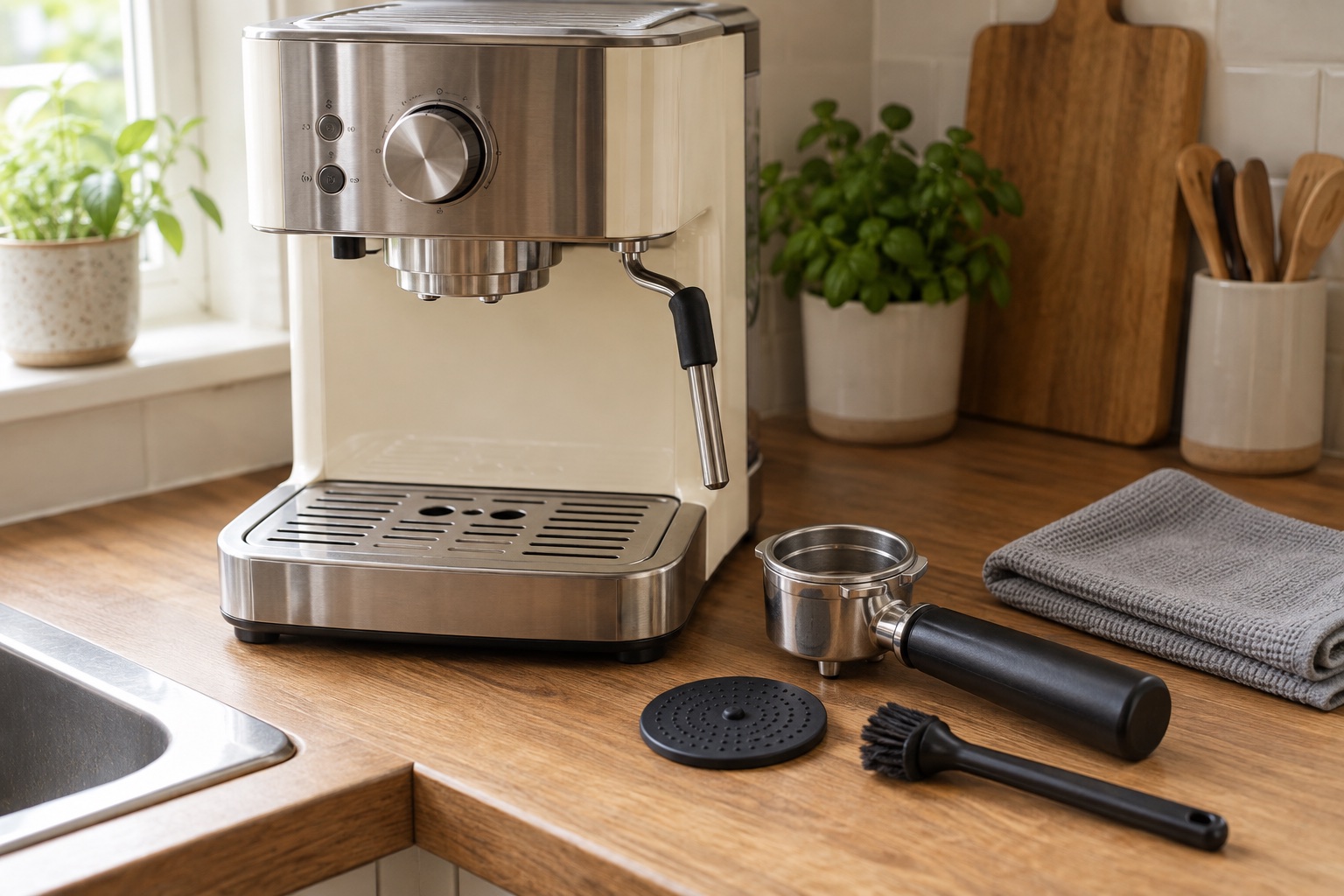
Find the exact model's cleaning-cycle instructions before inserting a blank.
A plain-water backflush and a detergent/tablet cycle are not the same routine.
Empty the drip tray and follow the manual's pressure and rinse sequence.
Descaler goes through a separate water-circuit programme, not a backflush.
The useful question is not “How many times should I pump the blind basket?” It is “Does this particular machine have a manufacturer-approved backflush path?” Backflushing blocks normal outflow at the portafilter so the machine routes water and residue through its cleaning path. That is why imitating a different model's sequence can be a costly mistake.
Which machines can be backflushed?
Look for explicit terms such as backflush, cleaning disc, blind filter or group-head cleaning cycle in the current manual. A supported three-way-valve machine may have a water-only routine and a periodic tablet routine. For example, Sage's Barista Express Impress manual calls its cleaning cycle a back-flushing cycle separate from descaling. Sage's Bambino Plus manual describes a cleaning-disc-and-tablet cycle, with its own button sequence and rinse. These examples do not certify other machines.
If the manual does not provide a backflush procedure, do not lock a blind basket into the group and run the pump. Compact pump machines can have different valve and drainage arrangements. Use their specified espresso-machine cleaning steps instead: rinse removable baskets and portafilter, wipe accessible coffee residue and follow the manufacturer's descale programme when due.
Safe sequence for a supported model
- Finish brewing. Let hot metal cool enough to handle and clear the work area. Read the exact cleaning chapter, including disc placement, tablet type, fill level and any warning light.
- Empty and refit the drip tray. A backflush can send water into it; an already full tray may overflow.
- Fit the supplied cleaning disc or correct blind basket as the model directs. For a plain-water routine, do not add cleaner. For a tablet cycle, use only the specified product and dose.
- Run the model's programmed cycle or manual pulse pattern. Do not copy a 20-second interval or button combination from another machine. Keep hands away from pressurised outlets and do not remove the portafilter while pressure remains.
- Empty the tray, remove the disc and rinse the basket and portafilter. Run every clean-water flush or rinse that the manual calls for; wipe the group area with the approved method.
Sage's Oracle manual describes a specific clear-water backflush after a session. That is a useful example of why water-only and chemical cycles are separated, not a timing prescription for every home machine.
What a backflush does not clean
It addresses coffee residue along the supported group path. It does not remove scale from the boiler or thermoblock, clean a milk system, wash a dirty basket exterior, or replace a full machine-care checklist. A group tablet is not a descaler. If the machine displays a descale prompt, follow its descaling guide instead.
If a cleaning cycle fails, the tablet remains intact or pressure behaves unusually, stop and consult the manual or manufacturer. Repeatedly forcing a blocked cycle is not a better clean.
Frequently asked questions
Can I backflush with washing-up liquid?
No. Use only the water-only or approved cleaning-product route stated by the manufacturer. Household washing-up liquid is not an automatic substitute for a group-head tablet.
Is a backflush needed after every coffee?
Frequency varies. Some manuals describe a quick water-only routine after a session and a separate prompted tablet cycle. Follow your own model's interval.
Is this the same as descaling?
No. Backflushing removes coffee oils and particles from a supported group path; descaling targets mineral build-up in water passages.
Helpful products
An approved cleaning route, not a universal tablet
Sage's group-head cleaner belongs only where the model's cleaning instructions specify it. The Bambino Plus is an example of a machine with a documented cleaning-disc cycle; check the exact machine you own.
SCC201NEU0ZEU1, six tablets
- Six tablets
- Group-head cleaner
- SCC201NEU0ZEU1
Cleans coffee oils, not limescale
Sage Group Head Cleaner
Best for: compatible Sage espresso machines with a supported cleaning cycle
Sage’s own group-head cleaning tablets for listed compatible espresso machines. They target coffee oils in a cleaning cycle; they do not replace a mineral descaler.
Why it earns a place
- Official Sage supply
- Specific cleaning purpose
- Six-dose pack
What to weigh up
- Not a descaler
- Compatibility varies
- Cycle differs by model
Skip it if You are trying to remove scale or your model has no compatible cleaning cycle.
Check the official specification →Black Truffle, 54mm
- 54mm portafilter
- ThermoJet
- Automatic milk texturing
Fast heat and automatic milk
Sage Bambino Plus
Best for: a compact manual espresso route with supplied single- and dual-wall baskets
A compact ThermoJet machine with a 54mm portafilter and automatic milk texturing. The machine is capable, but a separate espresso grinder still determines how much control you have with its single-wall basket.
Why it earns a place
- Fast ThermoJet heat-up
- Single- and dual-wall baskets supplied
- Automatic steam wand
What to weigh up
- Separate grinder required
- Amazon colour/price variants fluctuate
- 54mm accessories need compatibility checking
Skip it if The current Amazon seller price is above your budget or you want a built-in grinder.
Check the official specification →Sources and scope
The distinction between backflushing and descaling is explicit in Sage's Barista Express Impress manual. Bambino Plus and Oracle demonstrate different model procedures. The exact current manual always controls disc, cleaner, timing and rinse.