
Espresso basics · Heating
Thermoblock vs boiler espresso machines
Compare heat-up, brewing, steaming, temperature control and maintenance in thermoblock, ThermoJet, single-boiler and dual-boiler home machines.
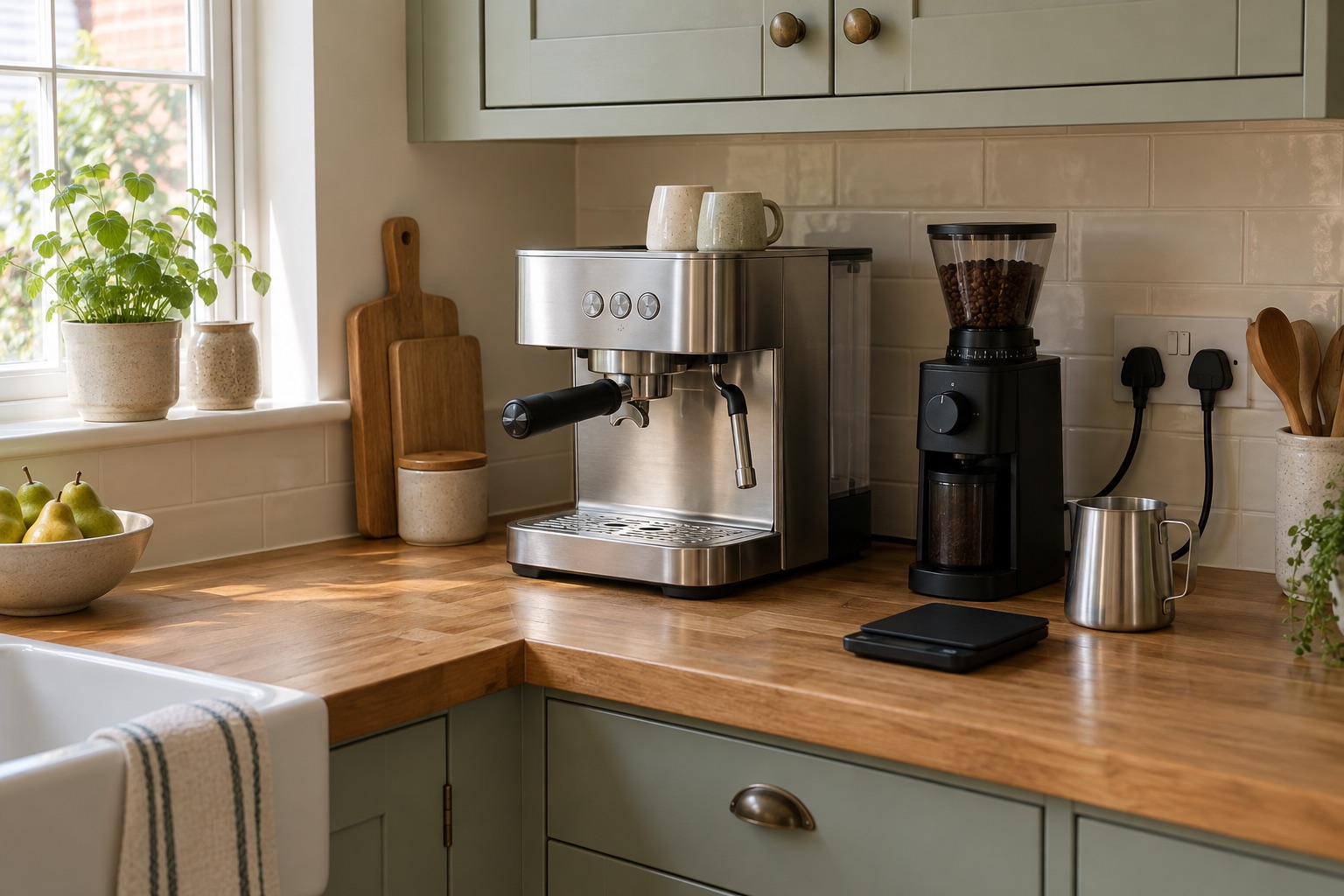
Manufacturer “ready” time may mean the heater, not a fully warmed portafilter and cup.
Milk-drink workflow depends on steam system and controls, not only heater type.
Follow the exact manual for flushing, descaling and water quality.
A capable grinder and basket still matter more than a heating-system slogan.
Many home-espresso comparisons imply “boiler equals serious” and “thermoblock equals cheap”. That is too blunt. Both are ways to supply hot water for brewing. Actual cup performance is shaped by temperature control, the group and portafilter, recovery between drinks, coffee preparation and the user. A poor grinder cannot be rescued by a heavy boiler.
What the systems do
Thermoblock: water flows through a heated channel or block. Designs vary; Sage's ThermoJet is its own fast-heating implementation, while De’Longhi calls the Dedica Style's system Thermoblock. These machines can reach their stated ready state quickly and suit a single or few drinks. Still allow the handle and cup to warm as the maker recommends. “Three-second heat-up” is not a promise that every component has stabilised.
Single boiler: a reservoir supplies a heated vessel. Brewing and steam need different temperature conditions, so some machines require a switch and wait between them. The Gaggia Classic E24 is a current example with a brass boiler. A boiler can be attractive to someone who enjoys a deliberate manual routine, but its maintenance, warm-up and steam workflow must be evaluated for that particular model.
Dual boiler: separate heating circuits can support brewing and steam more independently. That generally adds size, weight, cost and complexity. It is not a sensible default for a household that makes one short black coffee at a time. Do not confuse a separate steam thermoblock or thermocoil arrangement with a conventional dual-boiler machine merely because it can switch quickly.
| Question | Thermoblock / fast-flow heater | Single boiler | Dual boiler |
|---|---|---|---|
| Typical appeal | Short stated start time | Traditional manual routine | Multiple milk drinks and independent control |
| Check on exact model | Warm-up of cup and handle; steam strength | Brew-to-steam transition | Space, running cost and servicing |
| Main mistake | Assuming instant heater = instant stable cup | Assuming every boiler holds ideal brew temperature | Buying complexity without a matching daily need |
These are purchasing prompts, not measured performance claims for all machines in a category.
Which routine suits you?
For a weekday flat white, compare wand behaviour, milk cleaning and how many drinks you make back to back. The Dedica Maestro Plus and Sage Bambino Plus offer fast-heating, automatic-milk variants, but still need puck preparation. If you drink mostly straight espresso and enjoy manual control, a boiler machine may appeal—check warm-up and support before buying. If your aim is a fast button-to-cup drink, a bean-to-cup machine may be the more important method change.
Water treatment and maintenance follow the specific machine manual, not a generic instruction to descale more aggressively. See water hardness and cleaning an espresso machine. Never open an electrical heater or pressurised part as a home troubleshooting step.
Frequently asked questions
Is a thermoblock always less temperature-stable?
No universal claim follows from the word alone. Controls, sensors, flow and group design differ. Compare model-specific evidence rather than assuming one architecture wins.
Does a boiler machine need 30 minutes to warm up?
Warm-up varies by model and what you count as ready. Use the manufacturer's guidance; do not apply a café-machine rule to every domestic unit.
Which uses less electricity?
Usage patterns and the exact device matter. A fast-start machine used for one drink may spend less time heating, but no category-level energy ranking is warranted without comparable measurements.
Helpful products
Two real examples of different designs
The Dedica Style uses Thermoblock heating; the Stilosa specifies a stainless-steel boiler. Compare their full workflow and counter fit, not an assumed taste winner.
EC685.M
- 149 × 330 × 305mm
- 1.1L water tank
- EC685.M
Slim manual espresso choice
De’Longhi Dedica Style
Best for: a narrow worktop and someone willing to prepare and steam manually
At about 15cm wide, the Dedica makes manual espresso possible on a narrow counter. Its Thermoblock, programmable cup quantities and adjustable drip tray are useful; a separate grinder is still needed for fresh-ground coffee.
Why it earns a place
- About 15cm wide
- Manual steam wand
- Ground coffee or ESE pods
What to weigh up
- No built-in grinder
- Pressurised baskets limit fine espresso control out of the box
Skip it if You expect one-touch coffee or milk, or cannot spare space for a grinder.
Check the official specification →EC260.BK
- 205 × 343 × 285mm
- 1L water tank
- EC260.BK
Lowest-cost manual route
De’Longhi Stilosa
Best for: a first attempt at milk drinks without a large machine purchase
A simple dial-operated manual machine with a stainless-steel boiler, 1L tank and steam wand. The low entry price leaves more of the budget for an appropriate grinder, but the workflow is entirely hands-on.
Why it earns a place
- Low entry cost
- Manual milk frother
- Removable two-tier drip tray
What to weigh up
- Manual dial and simple controls
- No grinder or automatic milk routine
Skip it if You want automatic milk, a timer display or a machine that makes the drink without preparation.
Check the official specification →Sources and scope
We checked the heater terminology and workflow against De’Longhi Dedica Style, Sage Bambino Plus, De’Longhi Stilosa and Gaggia Classic E24.