
Choosing a setup · Two people
Best home coffee setup for two people
Choose a practical coffee setup for two UK drinkers: cafetière, pour-over server or timed filter machine, with dose, batch-size and counter-space guidance.
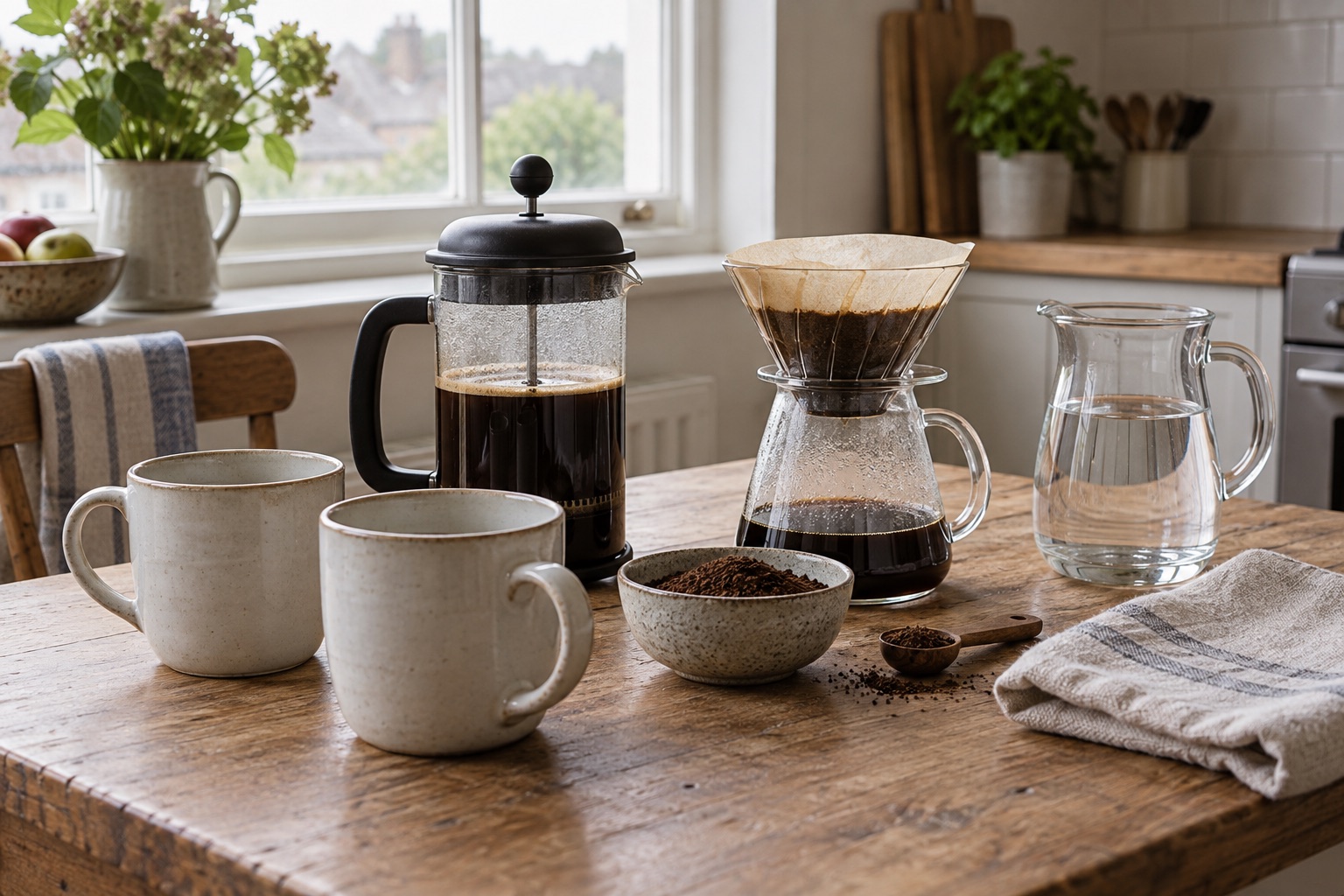
Two mugs need roughly 500–600g brew water, plus some allowance for retained water.
A manufacturer's eight-cup mark can mean eight 125ml portions, not eight mugs.
A shared brewer is efficient only if both people enjoy the same style of coffee.
Keep the whole routine—grinder, kettle, filters, jug and washing-up—in view.
The best coffee setup for two is the one that makes both cups at the right time. That sounds obvious, but “eight-cup” coffee makers can be smaller than expected and two individual brews can double the work. Start by writing down what each person actually drinks, the size of their mug and whether they drink together. Do not begin with a machine category.
Route one: a 1L cafetière for a shared, full-bodied pot
If both drink black coffee or add a little milk, a 1L press is a compact, inexpensive answer. Use around 36g coffee and 600g water as a starting recipe for two medium mugs. Steep, plunge gently and pour both cups. A Bodum Brazil or Chambord 1L gives enough headroom for the water and grounds, though the finished volume will be a little less than the water poured in.
This route has no paper-filter cost and can live in a cupboard. It does produce a fuller cup with more possibility of sediment and leaves loose wet grounds to clean. If one person hates that texture, a press may be a poor joint purchase. The cafetière method gives an exact first brew, and the cafetière buying guide clarifies size labels.
Route two: V60 02 plus a server for two cleaner cups
Put a size-02 V60 over a heatproof server large enough for the finished coffee. Start around 30g coffee to 500g water for two smaller cups, or 36g to 600g for larger mugs if the server and brewer can handle the dose without overflowing. A size-02 cone and matching papers are easy to store. A basic scale helps you split the finished brew evenly and repeat a cup you both liked.
This route takes more active pouring than a cafetière, yet cleanup is tidy: lift and dispose of the paper and grounds, then rinse the dripper and server. It usually gives a cleaner, lower-sediment drink. You need a stable place to set the server and enough time to pour safely. The pour-over method starts with a single cup and shows how to scale to two.
Route three: a timer filter machine for predictable mornings
When both people want coffee at the same time every weekday, a programmable filter machine removes the need to stand and pour. The 1L Melitta Optima Timer is a modest batch; the 1.25L Look V Timer gives more room for larger mugs. Both use paper filters and ground coffee. A thermal-jug Look variant is worth considering when the second person drinks later. These are full appliances with permanent counter space and cleaning duties, not automatic grinders.
Prepare the tank and filter before bed only if that suits your household's freshness priorities. A timer cannot make stale grounds fresh. The filter-machine guide compares the exact models and paper sizes. If each person drinks only one small cup at different times, a stored manual dripper may still be simpler than a large machine kept on the counter.
What if the two people want different drinks?
One person may want a long black filter mug while the other wants a flat white. A shared cafetière or filter pot cannot make a true espresso shot. You could use a manual espresso machine and make two shots and steam milk, but every drink takes preparation. An automatic bean-to-cup can shorten repeated milk-drink work at higher equipment cost; a pod machine provides separate choices but adds capsule cost. The machine-type chooser is a better route for a split-drink household than forcing one manual brewer to do everything.
Plan the actual budget and footprint
A cafetière needs a kettle and suitable grounds. A V60 needs a kettle, correctly sized papers and usually a server for two. A filter machine needs paper and a place to stand, with a grinder added only if you buy whole beans. The grinder need not be an espresso-capable premium model for these brew methods: a filter grinder or suitable hand grinder can serve. Include washing-up and storage. Draw the complete setup on a counter, especially in a small kitchen.
Our ratio table makes it easy to compare 500g, 600g and 1L brews. Remember that grounds retain water. Start with the pair of mugs you own, measure their comfortable fill level, then choose equipment that brews that amount with room to spare.
Frequently asked questions
Is a 500ml cafetière enough for two?
Only for two smaller servings. A 500ml water input will yield less than 500ml served. For two generous mugs, a 1L press gives more space.
Is AeroPress good for two people?
It is excellent for one compact cup, but a standard Original or Go usually means sequential brews or a concentrate diluted for two. If both drink together, a shared press, V60 server or filter machine may be less work.
Should we buy a grinder immediately?
No. Start with suitable fresh pre-ground coffee if that keeps the routine simple. Add a burr grinder when you want to choose whole beans and tune the brew.
Which method makes the least washing-up?
V60 paper makes grounds disposal tidy but adds a server. A press avoids paper but leaves loose grounds in the beaker. A filter machine adds basket and jug cleaning. The easiest route depends on which job your household dislikes.
Helpful products
Three routes for a two-person household
The shared press, manual paper-filter cone and small timed machine answer different morning routines.
1548-01, 1L black
- 1L
- Eight maker-size cups
- 1548-01
Lower-cost cafetière
Bodum Brazil
Best for: a practical larger press without a metal frame
A 1L borosilicate-glass press in a protective plastic frame with a reusable metal filter. It covers the same batch size as the Chambord with simpler styling.
Why it earns a place
- 1L capacity
- Reusable filter
- Protective frame
What to weigh up
- Glass still breakable
- Not insulated
- Sediment remains possible
Skip it if You want a paper-filtered low-sediment cup or an insulated vessel.
Check the official specification →VD-02T, clear size 02
- Size 02
- 1–4 maker-size cups
- VD-02T
Flexible first pour-over
Hario V60 Plastic Dripper
Best for: one or two cups with a low-cost, durable dripper
The size-02 cone is light, inexpensive and takes widely available V60 02 papers. Its open flow makes pouring and grind choice matter.
Why it earns a place
- Light and robust
- Common 02 paper format
- Works over a mug or server
What to weigh up
- Paper filters sold separately
- Pouring technique matters
- Not an immersion brewer
Skip it if You want a brewer that controls steeping time for you or dislike buying filters.
Check the official specification →100801
- 1L tank
- 102 paper filters
- 100801
Smaller scheduled batch
Melitta Optima Timer
Best for: one or two people who want a timed filter brew without a large jug
A 1L glass-jug filter machine with programmable start, removable tank and 102 paper-filter format. Its eight maker-size cups are not eight full mugs.
Why it earns a place
- Programmable start
- Removable 1L tank
- Descaling programme
What to weigh up
- Glass jug and hotplate
- Uses 102 papers rather than 1x4
- No built-in grinder
Skip it if You regularly need a larger 1.25L pot or want coffee held without a hotplate.
Check the official specification →Sources and approach
Capacity and filter specifications come from Bodum's model catalogue, Hario's V60 02 specification and Melitta's Optima Timer. The 60g/L dose is an adaptable starting point, not a universal preference.