
Care · Cafetière
How to clean a cafetière and its metal plunger
A clear daily and deeper-clean routine for a French press, including disposal of grounds, dismantling the plunger, oil residue, drying and broken-part checks.
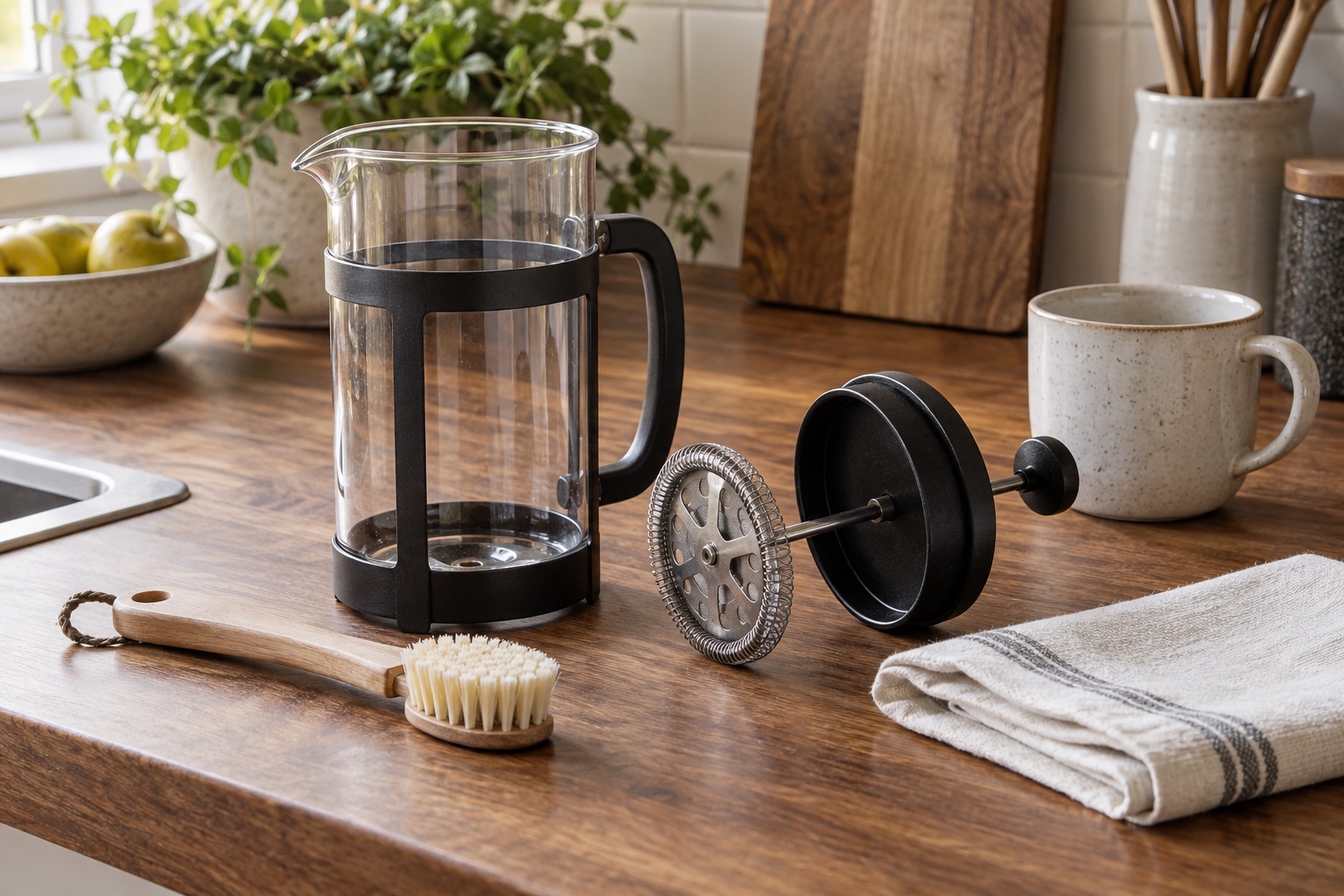
Hot glass and metal need time to cool before handling.
Coffee oils hide between the mesh disc and support plates.
Dishwasher permission is model-and-part specific.
Replace a torn mesh or cracked beaker rather than forcing the press.
A cafetière is easy to brew with and easy to neglect. A quick rinse of the glass leaves coffee grounds in the filter stack, where trapped oils can make a later cup taste stale. The fix is not a special brew recipe; it is separating the food-contact parts often enough to clean them properly.
Right after brewing
Pour out the coffee you intend to drink rather than letting it sit on the grounds. Allow the beaker and plunger to cool. Tip the grounds into a suitable food-waste or general-waste route according to your local council; avoid packing a large mass down the sink. If the final grounds stick, use a little water to loosen them, then collect them rather than flushing a dense slurry into the drain.
Wash the beaker with warm water and a soft sponge or brush. Avoid sudden temperature shocks to glass, and inspect for chips or hairline cracks. Wash the plunger surfaces, especially the lower mesh, with the method the manufacturer permits. Rinse well and leave components to dry where air can reach them. A damp reassembled press can retain odour. The coffee-oil cleaning guide explains why a clear rinse is not always sufficient.
Deeper clean: take apart the plunger
Bodum UK's brew guide recommends periodically dismantling the plunger and cleaning each piece separately. On a typical screw-together stack, note or photograph the order of the spiral plate, mesh and cross plate before taking it apart. Unscrew by hand rather than bending the mesh. Brush both faces and the rim, where fine grounds collect. Rinse every part and dry thoroughly before assembling in the original order. If your model is not designed for user disassembly, follow its manual instead of forcing it.
Do not stretch a mesh disc to make a poor fit seem better. A bent support plate, missing spring edge or torn screen can let grounds through and make plunging feel wrong. For a known model, a correct replacement part may be more sensible than a whole new press. See our best cafetières comparison only if the vessel itself is damaged or the size no longer works.
What about the dishwasher?
Do not assume every cafetière and every component share one dishwasher rule. Glass, frames, handles, decorative finishes and plunger parts differ. Check the exact model instructions. Even where a beaker is dishwasher-safe, hand-cleaning the mesh stack may be needed to dislodge trapped grounds. Avoid abrasive pads on glass or plated metal.
If the cafetière smells stale
Check the filter stack first, then the beaker rim, lid and any handle seams that contact coffee. Clean as the maker permits, rinse thoroughly and let it air-dry fully. If the smell remains after a proper clean, inspect old mesh or seals for trapped residue. A coffee-cleaning chemical should only be used if approved for the materials and then rinsed completely; it is not a reason to pour espresso-machine descaler into the press.
Frequently asked questions
Do I need to dismantle the plunger every day?
A thorough rinse after each use is sensible; periodically dismantle it to remove residue between layers. If you use very oily beans or notice stale odour, do it sooner.
Can I wash the beaker while it is still hot?
Let it cool first. Handling hot glass and exposing it to an abrupt water-temperature change increase the risk of damage or injury.
Why are there more grounds in my cup?
Some sediment is normal for a metal-filter press, but a torn mesh, misordered stack, wrong grind or forceful plunge can worsen it. Our cafetière method covers brew variables.
Helpful products
Two familiar cafetière constructions
The steel-framed Chambord and plastic-framed Brazil make different outer cleaning demands, but both need a clean beaker and plunger assembly.
1928-16, 1L
- 1L
- Eight maker-size cups
- 1928-16
Classic cafetière
Bodum Chambord
Best for: a shared, full-bodied cafetière brew
A 1L glass-and-stainless French press with a reusable metal plunger. The maker's eight cups are small servings, not eight large mugs.
Why it earns a place
- Reusable filter
- 1L batch
- Replacement-part ecosystem
What to weigh up
- Glass can break
- More sediment than paper
- Coffee keeps extracting if left in pot
Skip it if You dislike sediment or need a shatter-resistant pot.
Check the official specification →1548-01, 1L black
- 1L
- Eight maker-size cups
- 1548-01
Lower-cost cafetière
Bodum Brazil
Best for: a practical larger press without a metal frame
A 1L borosilicate-glass press in a protective plastic frame with a reusable metal filter. It covers the same batch size as the Chambord with simpler styling.
Why it earns a place
- 1L capacity
- Reusable filter
- Protective frame
What to weigh up
- Glass still breakable
- Not insulated
- Sediment remains possible
Skip it if You want a paper-filtered low-sediment cup or an insulated vessel.
Check the official specification →Sources and scope
Bodum UK's guide supports plunger disassembly and cleaning; Bodum's French-press manual illustrates the assembly and safe handling. Exact dishwasher and replacement-part rules depend on the model.