
Care · Residue
How to clean coffee oils from brewing equipment
Remove stale coffee-oil residue from food-contact brewing parts without confusing it with limescale or using the wrong chemical in a machine.
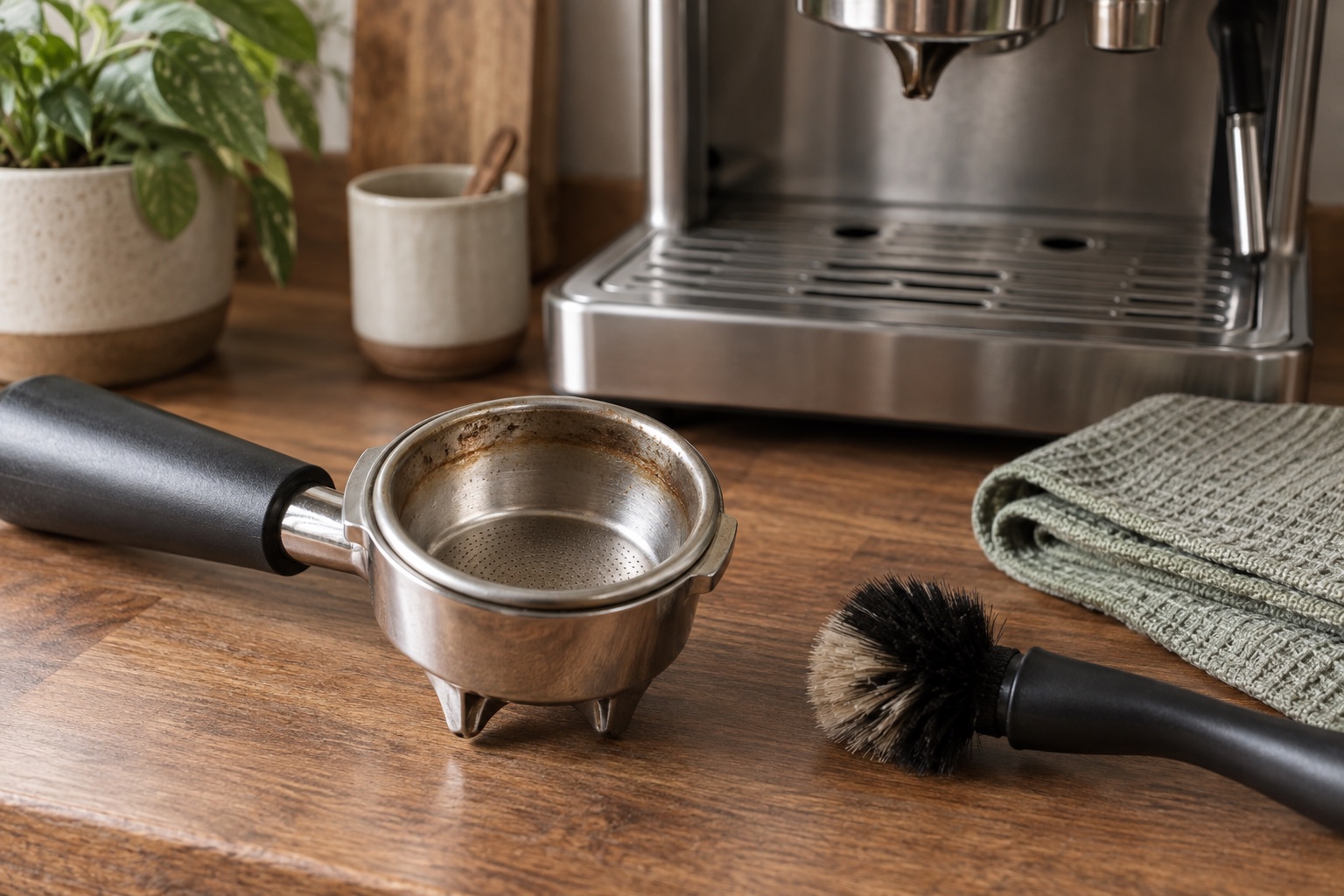
Remove grounds promptly before they compact into mesh and seals.
Glass, stainless steel, silicone, plastic and internal machine passages need different care.
A cleaner for coffee oils is not a water-tank descaler.
Dry reusable filters and grinder parts before reassembly.
A brewer can look clean while yesterday's coffee remains in the mesh or under a basket rim. Coffee oils cling to surfaces; over time they can leave a stale aroma or flavour. Limescale is a separate mineral deposit, often pale and hard. Treating every mark with descaler misses the oil, while putting detergent into a machine water tank can send it through the wrong circuit.
Start with the easiest parts
Discard used grounds. Wash the basket, server or cafetière beaker with warm water and the cleaning method permitted by its maker. A soft brush reaches perforations and mesh better than a rough scouring pad. Rinse until no detergent residue remains, then let parts dry before storage. For a cafetière, periodically separate the plunger stack so the fine mesh and plates are not left oily where they meet. Bodum UK specifically advises dismantling its plunger periodically.
Reusable metal filters need a through-rinse from both sides, particularly after oily dark roasts. AeroPress says its genuine stainless-steel filter can be rinsed and dried or placed on a dishwasher's top rack, but that permission does not automatically extend to every mesh filter or frame. Our reusable-filter cleaning guide separates the cases.
Espresso group and portafilter
Wipe the accessible group head and wash removable baskets and portafilter as the model allows. Pay attention to the basket rim, spouts and shower-screen area without dismantling parts the manual reserves for service. If the machine supports a cleaning-disc or blind-basket cycle, follow its exact backflush procedure. Sage's Barista Express Impress manual distinguishes its coffee-oil cleaning cycle from the descale cycle. A tablet belongs in the named cleaning path, not the water reservoir.
For a machine with no backflush procedure, do not manufacture one. Clean what the maker says is user-removable, follow its brew-unit or rinse routine, and leave internal service to the support route. A bean-to-cup machine may have a removable brew unit; a capsule machine uses a different path again.
Grinder residue
Coffee oils and fine particles can accumulate around grinder burrs and the exit chute. Unplug before opening an electric grinder. Baratza's cleaning guidance describes brushing accessible burr areas and, where appropriate, optional grinder-cleaning tablets. Do not pour water or a general cleaner into a motor housing. Refer to the grinder-cleaning guide for a dry-component sequence.
When a deeper clean is worth doing
After a dark, oily coffee, a long period of storage, a persistent stale smell or a slow reusable filter, inspect the removable parts instead of merely running more water through. Replace torn mesh, cracked plastic or damaged seals rather than scrubbing aggressively. If a machine's flow remains abnormal after its approved clean, troubleshoot it by model; do not double the chemical dose.
Frequently asked questions
Can descaler remove coffee oils?
It is intended for mineral scale. Use a separate coffee-oil cleaning route approved for the particular part or machine.
Can I put a cleaning tablet in the water tank?
Only if the exact manual explicitly says so. Group-head tablets usually have a different placement and path.
Does hot water alone remove all coffee oils?
It can rinse fresh residue, but oily films can persist in mesh and hidden seams. Use the maker-approved deeper wash when needed.
Helpful products
Parts with different cleaning routes
These show why one chemical or wash method does not fit every item: a Sage group tablet, a removable steel filter and a cafetière plunger have different instructions.
SCC201NEU0ZEU1, six tablets
- Six tablets
- Group-head cleaner
- SCC201NEU0ZEU1
Cleans coffee oils, not limescale
Sage Group Head Cleaner
Best for: compatible Sage espresso machines with a supported cleaning cycle
Sage’s own group-head cleaning tablets for listed compatible espresso machines. They target coffee oils in a cleaning cycle; they do not replace a mineral descaler.
Why it earns a place
- Official Sage supply
- Specific cleaning purpose
- Six-dose pack
What to weigh up
- Not a descaler
- Compatibility varies
- Cycle differs by model
Skip it if You are trying to remove scale or your model has no compatible cleaning cycle.
Check the official specification →Standard
- 316 stainless steel
- Standard size
- Original and Go
Reusable fuller-body filter
AeroPress Stainless Steel Filter
Best for: standard AeroPress drinkers who prefer less paper use and more body
The official 316 stainless-steel reusable disc lets more coffee oils pass than a paper micro-filter. It fits standard Original and Go models, not XL.
Why it earns a place
- Reusable
- Fuller body
- Official standard fit
What to weigh up
- Requires washing
- More oils and fine sediment
- Separate XL size
Skip it if A very clean paper-filtered cup is your priority.
Check the official specification →1928-16, 1L
- 1L
- Eight maker-size cups
- 1928-16
Classic cafetière
Bodum Chambord
Best for: a shared, full-bodied cafetière brew
A 1L glass-and-stainless French press with a reusable metal plunger. The maker's eight cups are small servings, not eight large mugs.
Why it earns a place
- Reusable filter
- 1L batch
- Replacement-part ecosystem
What to weigh up
- Glass can break
- More sediment than paper
- Coffee keeps extracting if left in pot
Skip it if You dislike sediment or need a shatter-resistant pot.
Check the official specification →Sources and scope
The machine-cycle distinction is from Sage's manual, removable-plunger care from Bodum UK, filter care from AeroPress and dry grinder care from Baratza. The exact appliance and material instructions remain decisive.