
Water · Machine care
Can softened water go in a coffee machine?
Understand salt-regenerated softened water, sodium, machine compatibility, scale and taste before filling an espresso or filter coffee maker.
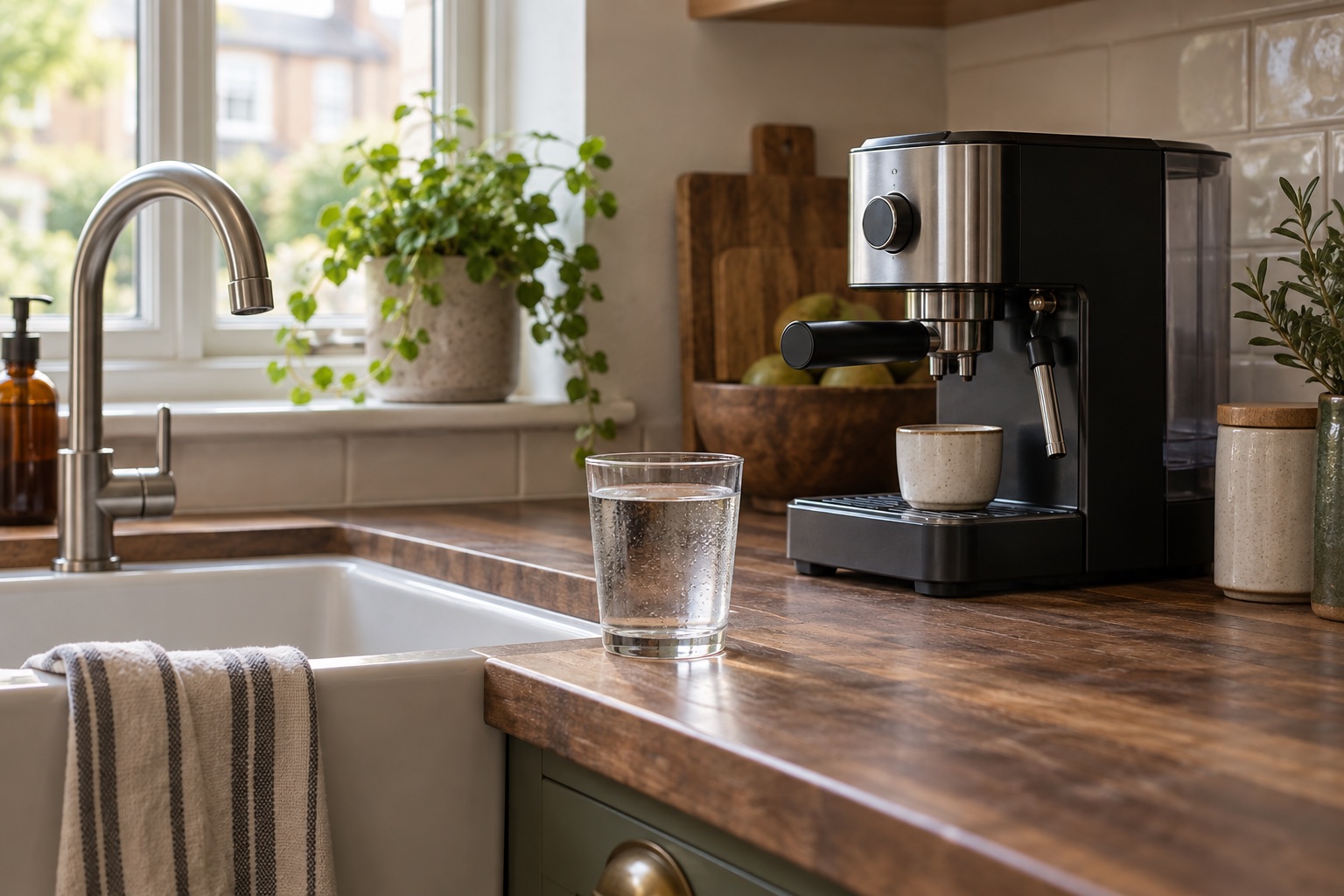
Check whether the kitchen cold tap bypasses the whole-house softener.
Do not equate low limescale with ideal drinking or brewing water.
Read the machine's water specification and hardness-setting method.
Treat a jug or in-tank cartridge as a separate technology with separate instructions.
The word “soft” sounds ideal for a machine threatened by limescale. But a domestic water softener, a jug filter and a machine tank cartridge work differently. The answer is not a universal yes or no for every coffee maker: identify your plumbing, check the water quality and read the appliance's own limits.
What a domestic softener changes
Many whole-house systems regenerate with salt. Their ion-exchange resin replaces calcium and magnesium hardness with sodium. This reduces scale formation in household hot-water systems. It can also increase sodium in water used for drinking. The Drinking Water Inspectorate recommends retaining an unsoftened kitchen drinking-water tap, and notes that softening may alter taste. That is the sensible starting source for coffee as well.
Some installations bypass the kitchen cold tap; others may not. Ask the installer or check the plumbing specification instead of guessing from a clear kettle. If you are unsure whether the tap is bypassed, obtain the water-treatment provider's details and supplier result. Do not use artificially softened water to prepare infant feeds; that is a separate public-health rule, not a coffee taste preference.
Can low-scale water still be wrong for coffee?
Yes. A lack of chalky deposits only tells part of the story. Water composition and alkalinity can affect extraction and flavour, while a machine may set minimum or maximum water specifications and use a hardness reading to calculate maintenance intervals. The SCA's water discussion explains why changing minerals affects taste. Very low hardness is not proof of an ideal espresso.
If you have an espresso or bean-to-cup machine, find its exact water guidance. Some manufacturers expect cold potable tap water and an approved in-tank filter; others discuss water treatment differently. Do not automatically set a machine to its softest option because a whole-house unit is fitted. Measure the actual water entering the tank using a method the manual accepts; see how to test hardness.
A practical decision route
- Identify the source of the machine's filling tap and whether it bypasses the softener.
- Read the machine manual's water and filter section. Check for prohibited water types and a required hardness setting.
- If the supply is unexpectedly softened, use the unsoftened drinking-water tap while you confirm with the manufacturer and installer.
- If scale remains a problem with unsoftened water, compare a jug filter or approved in-tank filter as separate options.
- Continue the machine's descale schedule and coffee-oil cleaning. A softener does not remove coffee residue.
Frequently asked questions
Can I mix softened and unsoftened water?
Do not improvise a blend to meet a guessed target. Ask the machine maker and water-treatment provider what is acceptable, then test the actual blend if approved.
Is a BRITA jug the same as a whole-house softener?
No. The media and intended use differ. A jug cartridge has its own capacity and replacement instructions; it does not make the home's softened-water tap equivalent to unsoftened mains water.
If there is no limescale, can I skip descaling forever?
No. Use the machine's maintenance programme and its setting for the water actually used. A warning or flow problem may also have causes other than scale.
Helpful products
Different treatment routes, not substitutes for a softener check
The BRITA cartridge treats water in a jug; ClaroSwiss belongs only in a compatible Sage tank. Neither establishes that softened household tap water suits your machine.
Six-cartridge pack
- Six cartridges
- MAXTRA PRO jug format
- Four-week replacement guidance
Hard-water jug route
BRITA MAXTRA PRO Limescale Expert
Best for: households with a BRITA jug and noticeable kettle scale
A jug cartridge designed to reduce limescale exposure before water reaches a kettle or coffee maker. It is a jug refill, not an in-tank machine cartridge.
Why it earns a place
- Purpose-built for hard water
- One jug serves several brewers
- Genuine six-pack listing
What to weigh up
- Regular cartridge replacement
- Jug space and refilling
- Does not replace a machine's own maintenance cycle
Skip it if Your machine requires its own proprietary tank cartridge, or you do not own a compatible jug.
Check the official specification →SES008WHT0NEU1
- SES008WHT0NEU1
- In-tank filter
- 90-day replacement guidance
Compatible Sage tank
Sage ClaroSwiss Water Filter
Best for: a Sage owner whose model and production batch take ClaroSwiss
Sage's in-tank ClaroSwiss cartridge targets scale and taste; older production batches can require a different filter, so the batch code matters.
Why it earns a place
- Manufacturer-listed model matrix
- Direct tank fitting
- Clear replacement guidance
What to weigh up
- Older batches need a check
- Ongoing replacement cost
- Not a substitute for descaling instructions
Skip it if Your existing filter housing or batch code points to a different cartridge.
Check the official specification →Sources and scope
The sodium, kitchen-tap and drinking-water advice follows the Drinking Water Inspectorate's domestic-filter and softener guidance. The SCA informs the taste discussion. Machine-specific water limits must come from the current manual for the exact model.