
Milk care · Automatic carafe
How to clean an automatic coffee-machine milk carafe
Clean a bean-to-cup machine’s detachable milk carafe without confusing the automatic rinse with thorough washing of the lid, tube, spout and connector.
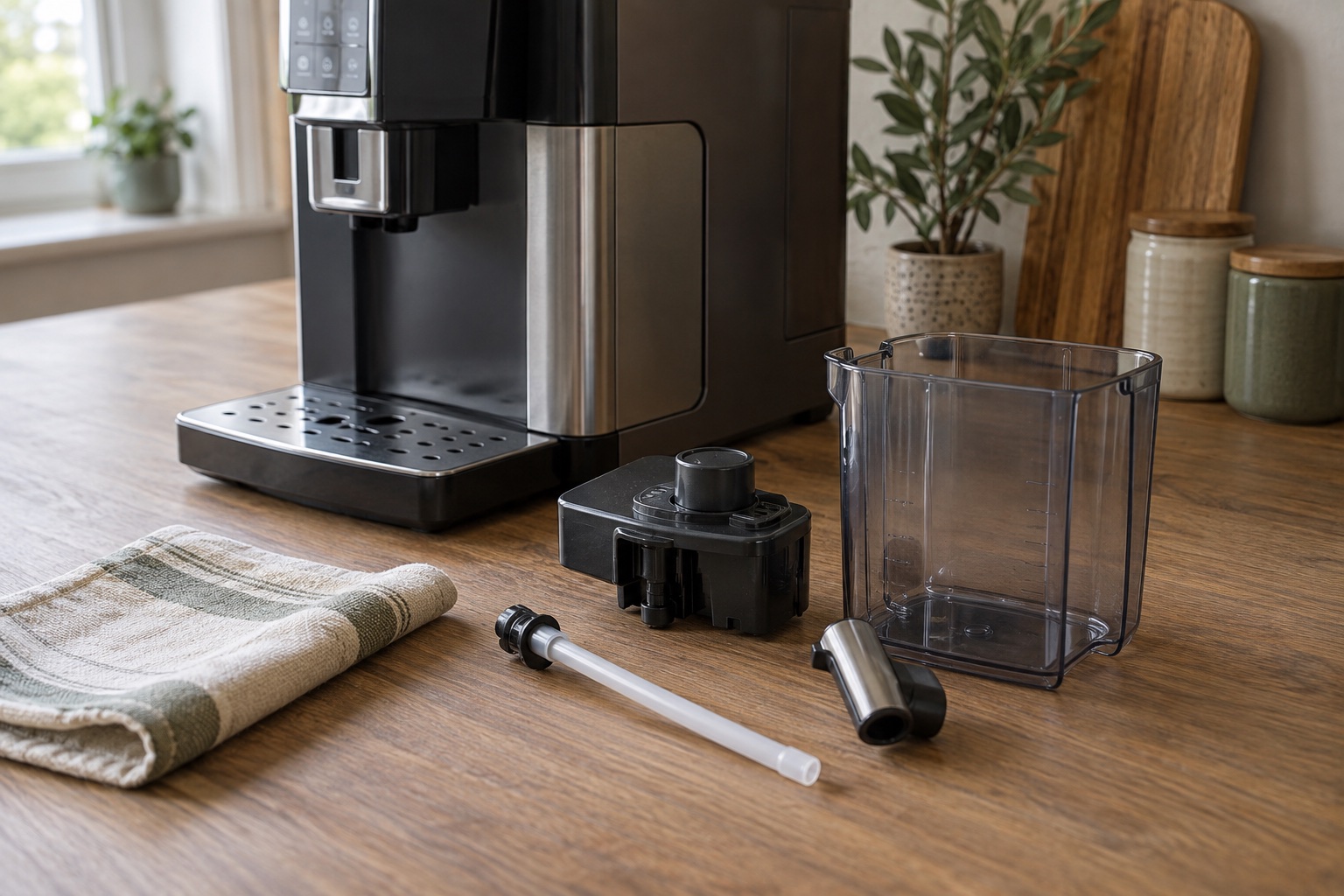
Follow the exact carafe diagram before pulling off a tube or seal.
Hot water or steam exits during an automatic clean cycle.
Check the machine-side connector as well as the visible jug.
A milk carafe is not cleaned by descaling the coffee water circuit.
An automatic carafe saves hand positioning at the steam wand, but milk travels through several parts you cannot judge by looking at the outer jug. The after-drink rinse helps keep the path clear. A separate deeper clean removes residue from the lid, suction tube, spout and seals. Confusing those two jobs is a common cause of poor foam and stale odours.
Immediately after the last milk drink
Keep the carafe attached if the machine’s display or manual tells you to. Place a suitable container beneath the milk spout, select CLEAN and let the programme finish. Keep hands away: it may discharge hot water or steam. De’Longhi’s Magnifica Evo guidance explicitly describes a clean cycle after each milk drink. The exact button, dial and sequence on a Magnifica Start or another brand can differ, so read the model manual.
If milk remains, refrigerate the carafe only if the manufacturer permits it and within the carton’s storage instructions. Do not treat the carafe as a room-temperature milk container simply because its lid is closed. De’Longhi’s advice for particular LatteCrema models mentions up to two days in a fridge, but that is not a universal safe period for every carafe or every milk carton. When in doubt, decant and clean rather than guessing.
The thorough clean
Unplug or switch off as required and allow hot parts to cool. Follow the model’s assembly drawing to remove the carafe, lid, suction tube, milk spout, foam selector and seals that are user-removable. Wash with the method and detergent allowed for each component. Work through holes and joints with the approved brush if supplied; do not jab at a hidden passage with a sharp improvised tool. Rinse thoroughly, dry as directed and check seals before reassembly. De’Longhi’s LatteCrema overview describes dishwasher-safe disassembled components for its system, but you must not transfer that permission to an unrelated brand or model.
Look at the machine-side milk connector too. De’Longhi flags connector cleaning in its Magnifica Plus advice. A spotless jug with a clogged connector can still under-froth. Do not let cleaning water enter electronics or force a carafe that no longer seats correctly.
If foam is weak after cleaning
First check that the carafe is fully assembled and seated, with the foam selector in the intended position. Start with properly chilled milk or a permitted plant drink. Inspect the intake tube for kinks and the spout for residue. Then check the maker’s troubleshooting steps. Milk formulation can be the cause even when the machine is clean; oat-milk troubleshooting separates that from blockage. If the coffee itself tastes weak, use the bean-to-cup diagnosis instead of changing milk settings.
What not to do
Do not assume the automatic rinse is a full wash. Do not leave milk in a warm machine overnight. Do not run water-tank descaler through the milk path unless the manufacturer explicitly directs it. Do not swap a carafe between models because it looks similar; connectors and programmes are model-specific. The steam-wand cleaning guide is a different route.
Frequently asked questions
Is an automatic CLEAN cycle enough?
No. It flushes an internal path; manufacturers also specify periodic disassembly and washing of the removable parts.
Can the whole carafe go in the dishwasher?
Only if the manual for your exact model permits it, and usually only specified detached components. Check temperature and rack instructions.
Why is milk left in the tube?
Check the exact rinse sequence, assembly, tube position and any obstruction. Seek manufacturer guidance if the system fails after approved cleaning.
Helpful products
Carafe versus automatic-wand examples
The Magnifica Start variant here has LatteCrema Hot. Creatista Plus uses an automatic steam wand instead, so its milk-cleaning instructions are a useful contrast—not interchangeable carafe steps.
ECAM220.61.GB
- 250g bean container
- Four one-touch recipes
- ECAM220.61.GB
One-touch bean-to-cup
De’Longhi Magnifica Start
Best for: a household that wants fresh beans and automatic milk drinks
This exact Magnifica Start variant includes an integrated grinder and LatteCrema Hot automatic milk system, with one-touch espresso, coffee and latte macchiato. It removes daily puck preparation but adds milk-system cleaning.
Why it earns a place
- Integrated grinder
- Automatic milk drinks
- Removable cleaning components
What to weigh up
- Large counter footprint
- Milk system needs regular cleaning
- Less direct control than separate equipment
Skip it if You enjoy dialling in separate grinder and espresso settings, or have a very shallow counter.
Check the official specification →BNE800 / Original system
- BNE800 family
- 8 texture levels
- 11 milk temperatures
Pod coffee, textured milk
Sage Nespresso Creatista Plus
Best for: Original-capsule convenience with an automatic steam wand
An Original capsule brewer with automatic steam wand, eight texture levels and 11 milk temperature settings.
Why it earns a place
- Automatic steam wand
- Milk settings
- Original convenience
What to weigh up
- High machine cost
- Original capsules only
- Jug and wand cleaning
Skip it if You want to buy beans or use Vertuo capsules.
Check the official specification →Sources and scope
The after-use versus thorough-clean distinction comes from De’Longhi’s Magnifica Evo FAQ, with connector and storage detail from its Magnifica Plus FAQ. These illustrate a LatteCrema system; the exact manual overrides them for any other model.